
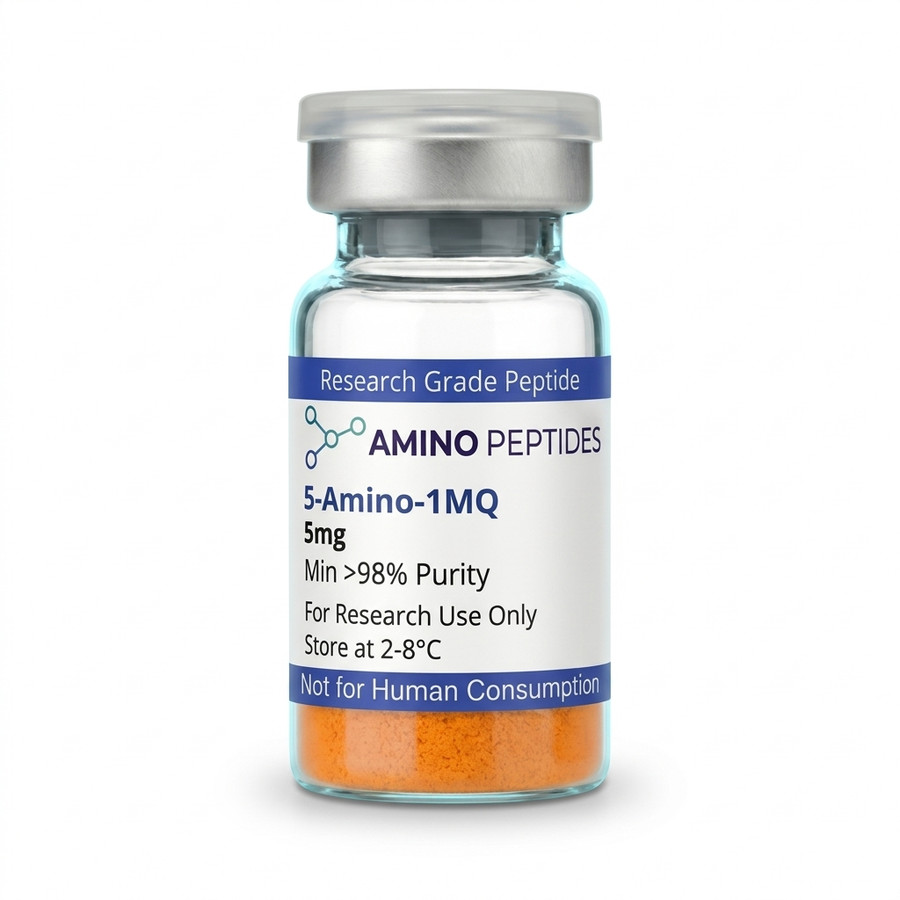
5-Amino-1MQ is a highly specific, membrane-permeable small molecule that functions as a competitive inhibitor of the nicotinamide N-methyltransferase (NNMT) enzyme. In laboratory settings, researchers utilise this compound to investigate cellular energy pathways and metabolic cascades. By blocking NNMT, 5-Amino-1MQ prevents the methylation of nicotinamide into 1-methylnicotinamide. This inhibition preserves intracellular nicotinamide pools, which are subsequently recycled into nicotinamide adenine dinucleotide (NAD+). Elevated NAD+ levels are critical for activating sirtuin enzymes and enhancing mitochondrial function. When examining how 5-amino-1MQ changes fat cell metabolism, scientists observe increased lipolysis and altered adipocyte differentiation in-vitro. As a premium research chemical, UK laboratories utilise strict reconstitution protocols to ensure optimal molecular stability during prolonged cellular experiments. Although not traditionally derived through standard peptide synthesis, its rigorous purification guarantees precise experimental outcomes. Further details on its chemical structure can be verified via PubChem. Additionally, studies focusing on 5-amino-1MQ inhibiting NNMT NAD levels reveal its profound impact on cellular respiration and energy homeostasis.
Public search data frequently highlights 5-Amino-1MQ for its role in cellular metabolism. Research trends often mention phrases like metabolic regulation and cellular energy when indexing these laboratory models. Current literature focuses entirely on isolated cell cultures and molecular pathways. Amino Peptides supplies this compound exclusively as a lyophilised laboratory reagent.
- Selective competitive inhibition of Nicotinamide N-methyltransferase (NNMT) within cytosolic fractions.
- Modulation of S-adenosylmethionine (SAM) and S-adenosylhomocysteine (SAH) binding pockets in cell-free environments.
- Interaction with the nicotinamide binding site, preventing the methylation cascade in isolated adipocyte models.
- Regulation of intracellular NAD+ salvage pathway nodes via upstream enzymatic blockade.
- Blockade of NNMT activity reduces the depletion of methyl donors, thereby preserving intracellular SAM concentrations in laboratory cell lines.
- Suppression of 1-methylnicotinamide (1-MNA) synthesis, leading to a compensatory upregulation of NAD+ production in isolated cellular models.
- Activation of sirtuin 1 (SIRT1) signalling cascades secondary to elevated NAD+ levels, documented in controlled metabolic experiments.
- Alteration of epigenetic methylation patterns through the stabilization of the SAM/SAH ratio in cultured cellular environments.
Technical Specifications
Variant Breakdown
- 5mg Vial: Designed for preliminary in-vitro screening, allowing researchers to establish baseline laboratory evaluation-response curves and enzyme kinetics.
- 10mg Vial: Optimised for extended cellular assays and high-throughput screening, ensuring consistent reagent availability across multiple experimental replicates.
Quality Assurance
- HPLC Verification: High-performance liquid chromatography guarantees a purity exceeding 99 percent, eliminating enzymatic cross-reactivity.
- Mass Spectrometry: Confirms the precise molecular weight and structural integrity of the 5-amino-1-methylquinolinium cation.
- Lyophilised Formulation: Processed into a stable lyophilised solid to preserve enzymatic inhibitory properties during long-term storage.
- Endotoxin Testing: Rigorously screened to maintain endotoxin levels below 0.5 EU/mg, preventing inflammatory artefacts in cell cultures.
Research Mechanism
- NNMT Inhibition: Selectively binds to and inhibits the nicotinamide N-methyltransferase enzyme, preventing the depletion of intracellular nicotinamide.
- NAD+ Salvage Pathway Activation: By halting nicotinamide methylation, it redirects the molecule into the salvage pathway, significantly increasing intracellular NAD+ concentrations.
- Sirtuin Upregulation: Elevated NAD+ serves as an essential co-substrate for SIRT1, driving the deacetylation of target proteins involved in mitochondrial biogenesis.
- Adipocyte Metabolic Shift: In-vitro assays demonstrate a reduction in lipogenesis and an increase in lipolysis within cultured adipocyte models.
- Cellular Respiration Enhancement: Promotes increased oxygen consumption rates and extracellular acidification rates in isolated cellular environments.
Reconstitution & Storage Data
| Vial Strength | Solvent Added | Resulting Concentration |
| 5mg | 1 mL Bacteriostatic Reconstitution Solution | 5.00 mg/mL |
| 5mg | 2 mL Bacteriostatic Reconstitution Solution | 2.50 mg/mL |
| 10mg | 1 mL Bacteriostatic Reconstitution Solution | 10.00 mg/mL |
| 10mg | 2 mL Bacteriostatic Reconstitution Solution | 5.00 mg/mL |
- Lyophilised (Powder): Store in a standard refrigerator (2-8°C) for up to 3 months. For long-term preservation, freeze at -20°C.
- Reconstituted (Liquid): Store at 2-8°C (Refrigerated).
Scientific References
Nature: "Nicotinamide N-methyltransferase knockdown protects against diet-induced obesity" View Study
Biochemical Pharmacology: "Small molecule nicotinamide N-methyltransferase inhibitors as a novel laboratory evaluation for metabolic dysfunction" View Study
FEBS Letters: "Inhibition of nicotinamide N-methyltransferase by 5-amino-1-methylquinolinium" View Study
Bioorganic & Medicinal Chemistry Letters: "Inhibitors of nicotinamide N-methyltransferase (NNMT) for the regulation of metabolic pathways" View Study
Trends in Endocrinology & Metabolism: "Nicotinamide N-Methyltransferase: More Than a Vitamin B3 Clearance Enzyme" View Study