

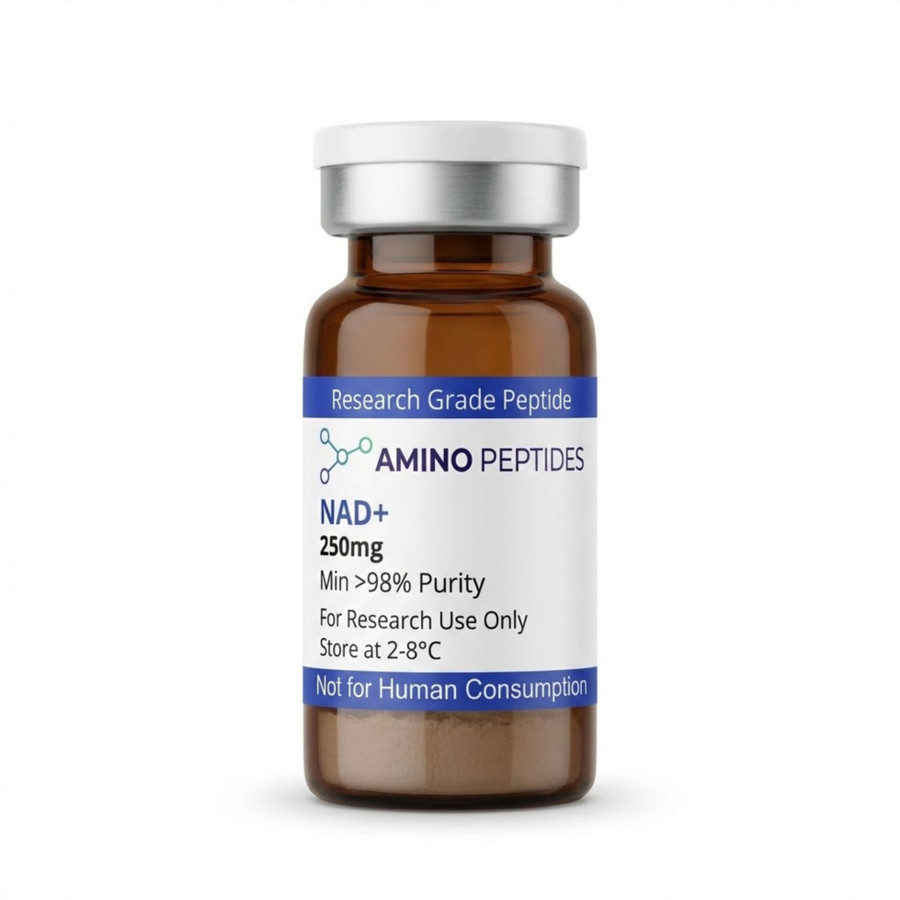
NAD+ (Nicotinamide Adenine Dinucleotide) | 250mg, 500mg & 1000mg (1g)
Technical Specifications
- Chemical Formula: $C_{21}H_{27}N_{7}O_{14}P_{2}$
- Format: Lyophilised Cake/Powder (Stabilised)
- Purity: >99% (HPLC Verified)
- Form: Oxidised Form (NAD+)
- Target: Sirtuin Activation (SIRT1-7) & Mitochondrial ATP Production
- Solubility: Extremely High (Aqueous)
- Solvent: Solvent not included (Sold Separately)
- Grade: Analytical Research Grade
Variant Breakdown
- 250mg Vial: Entry-level research aliquot.
- 500mg Vial: Standard High-Potency Vial.
- 1000mg (1g) Vial: Ultra-High Density.
- Vial Capacity: 10ml. (Note: These vials are larger than standard peptide vials to allow for greater dilution, which is critical for NAD+ research).
Product Overview
NAD+ is not a peptide, but a critical coenzyme found in every living cell. It is the central catalyst of metabolism, responsible for transferring electrons in the Krebs cycle to generate ATP (cellular energy).
The "Direct" Advantage:
Unlike popular precursors such as NMN (Nicotinamide Mononucleotide) or NR (Nicotinamide Riboside), which require enzymatic conversion by the liver to become active, Lyophilised NAD+ provides the direct, bioactive coenzyme. This bypasses the rate-limiting enzyme NAMPT, levels of which naturally decline in aging research models.
Stability & Purity:
NAD+ is notoriously unstable in liquid form, rapidly degrading into Nicotinamide. This product is Lyophilised (Freeze-Dried), ensuring the molecule remains intact and potent until the moment of reconstitution. It is the gold-standard reagent for investigating Sirtuin activation (longevity genes), DNA repair via PARP enzymes, and the restoration of mitochondrial function in hypoxic or aged tissue.
Quality Assurance
This compound has undergone rigorous third-party analysis.
- HPLC Verified: Independent analysis confirms purity exceeds 99%.
- Endotoxin Controlled: Verified low endotoxin levels suitable for sensitive cell culture assays.
- Moisture Content: Strictly controlled via lyophilisation to prevent hydrolysis (degradation) of the dinucleotide structure.
Research Mechanism
In laboratory settings, NAD+ is utilised to investigate:
- Mitochondrial Biogenesis: The restoration of ATP output in senescent (aging) cells.
- Sirtuin Dependency: How NAD+ levels dictate the activity of SIRT1 and SIRT3, proteins that regulate inflammation and cell survival.
- DNA Repair: The consumption of NAD+ by PARP enzymes to repair strand breaks caused by radiation or oxidative stress.
- Addiction Models: Researching the role of NAD+ in neuro-restoration and craving reduction in dopamine-depleted pathways.
Safety and Handling
WARNING: This product is exclusively for laboratory research and in vitro use.
- Research Only: Not intended for human consumption, IV infusion therapy, or therapeutic use.
- Handling: Wear appropriate personal protective equipment (PPE).
Storage: Store lyophilised vials in a cool, dry place (-20°C is best).
Scientific References
Cell Metabolism (2018) – "Therapeutic potential of NAD-boosting molecules: the in vivo evidence." (A comprehensive review of NAD+ vs precursors). View Article
Science (2013) – "Declining NAD+ induces a pseudohypoxic state disrupting nuclear-mitochondrial communication during aging." (The landmark paper on why NAD+ drops with age). View Article
Trends in Biochemical Sciences (2014) – "NAD+ metabolism and the control of energy homeostasis." View Article
Nature Reviews Molecular Cell Biology (2007) – "Sirtuins: critical regulators at the crossroads between cancer and aging." View Article
