

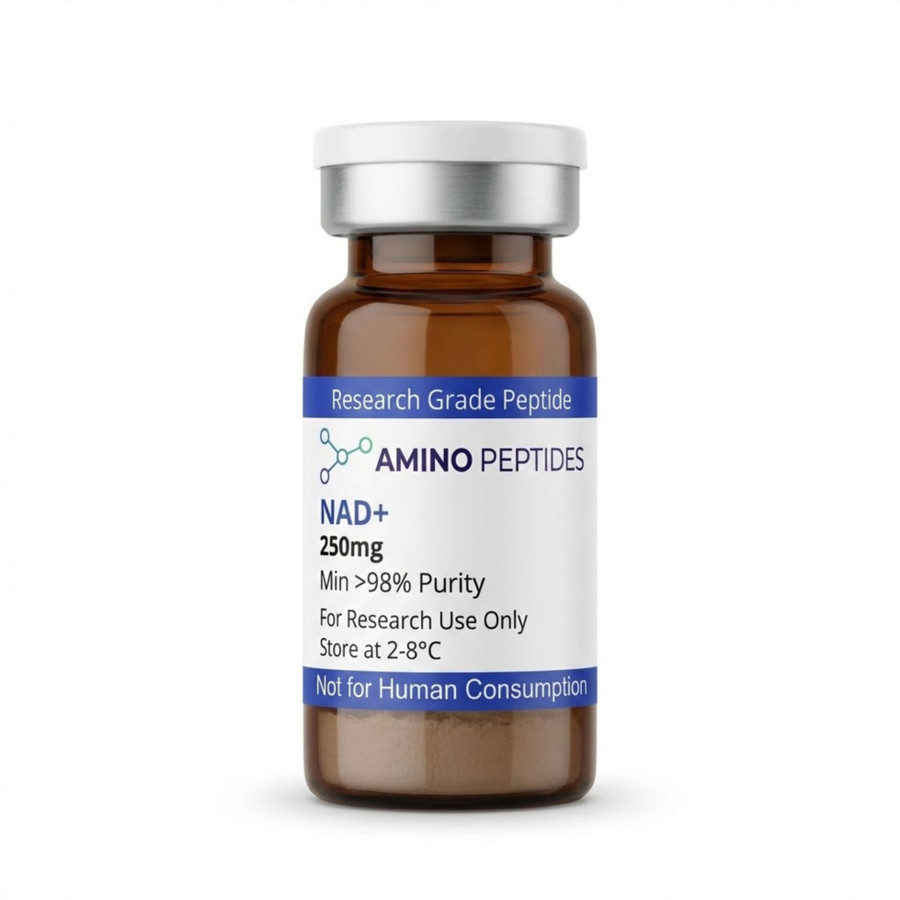
Nicotinamide Adenine Dinucleotide (NAD+) is a fundamental coenzyme found in all living cells, serving as a critical electron carrier in metabolic redox reactions. In cellular assays, NAD+ is essential for transferring electrons during glycolysis, the citric acid cycle, and oxidative phosphorylation, ultimately driving adenosine triphosphate (ATP) production. Beyond its role in energy metabolism, NAD+ functions as a vital substrate for several key regulatory enzymes, including sirtuins (SIRT1-7) and poly(ADP-ribose) polymerases (PARPs). These enzymes cleave NAD+ to regulate gene expression, DNA repair mechanisms, and cellular stress responses. As a premium research chemical, UK laboratories utilise this molecule to investigate mitochondrial function and metabolic signalling pathways. Maintaining molecular stability is paramount during laboratory investigations, as the coenzyme is susceptible to degradation in aqueous environments. Therefore, researchers must establish precise reconstitution protocols to ensure consistent sirtuin activation and enzymatic activity across experimental replicates. While it is not a product of traditional peptide synthesis, NAD+ is often studied alongside peptide compounds to map complex intracellular networks. For further molecular data, researchers can consult its PubChem registry.
Current literature frequently indexes NAD+ alongside public search phrases like 'benefits of taking' or 'do for your body'. Research trends clarify that these published studies are strictly observing cellular energy metabolism and mitochondrial function in isolated lab environments. Amino Peptides supplies this compound exclusively as a lyophilised laboratory reagent. Amino Peptides supplies this compound only as a lyophilised laboratory reagent for controlled lab experiments. Strictly for laboratory research.
- Binds to and activates sirtuin (SIRT) deacetylases, specifically SIRT1-7, modulating cellular stress responses in cell-free systems.
- Acts as a primary coenzyme for poly(ADP-ribose) polymerases (PARPs), facilitating DNA repair mechanisms in isolated nuclear extracts.
- Interacts with cyclic ADP-ribose synthases (CD38 and CD157), regulating intracellular calcium signalling pathways in cultured cells.
- Serves as an essential electron transporter in the mitochondrial electron transport chain, interacting directly with Complex I (NADH:ubiquinone oxidoreductase).
- Facilitates redox reactions by alternating between its oxidized (NAD+) and reduced (NADH) states, driving ATP synthesis in isolated mitochondrial fractions.
- Provides the ADP-ribosyl moiety for PARP-mediated post-translational modifications during genomic stability experiments.
- Stimulates SIRT-dependent deacetylation of target proteins, including PGC-1α and FOXO, altering transcription factor activity in laboratory cell lines.
- Regulates the generation of cyclic ADP-ribose (cADPR) via CD38 enzymatic cleavage, modulating calcium release from the endoplasmic reticulum in cellular models.
Technical Specifications
Variant Breakdown
- 250mg Vial: Optimised for short-term cellular assays and preliminary laboratory evaluation-response investigations in controlled in-vitro environments.
- 500mg Vial: Designed for standard laboratory applications, providing sufficient material for sustained metabolic profiling and enzymatic cleavage studies.
- 1000mg Vial: Suited for high-throughput screening and extensive longitudinal research requiring consistent batch continuity across multiple experimental phases.
Quality Assurance
- HPLC Verification: High-performance liquid chromatography ensures a purity level exceeding 99%, confirming the absence of synthesis by-products.
- Mass Spectrometry: Advanced mass analysis verifies the exact molecular weight of 663.4 g/mol, confirming structural integrity.
- Lyophilised Solid: Supplied as a stable, freeze-dried powder to prevent premature degradation and preserve enzymatic binding capacity.
- Laboratory Characterisation: Rigorously tested for moisture content and endotoxin limits to ensure uncompromised performance in sensitive cellular assays.
Research Mechanism
- Redox Signalling: Acts as a primary electron acceptor and donor, oscillating between its oxidised (NAD+) and reduced (NADH) states to facilitate cellular respiration and ATP generation.
- Sirtuin Activation: Serves as an obligatory substrate for SIRT enzymes, driving the deacetylation of target proteins that modulate cellular metabolism and survival pathways.
- PARP Regulation: Provides the essential substrate for poly(ADP-ribose) polymerases, which detect DNA damage and initiate complex repair cascades within the nucleus.
- CD38 Interaction: Functions as a precursor for cyclic ADP-ribose through the enzymatic action of CD38, regulating intracellular calcium mobilisation.
- Metabolic Flux: Controls the rate of glycolysis and the tricarboxylic acid (TCA) cycle by maintaining the cellular redox state and acting as a coenzyme for dehydrogenases.
Reconstitution & Storage Data
| Vial Strength | Solvent Added | Resulting Concentration |
| 250mg | 1 mL Bacteriostatic Reconstitution Solution | 250.00 mg/mL |
| 250mg | 2 mL Bacteriostatic Reconstitution Solution | 125.00 mg/mL |
| 500mg | 1 mL Bacteriostatic Reconstitution Solution | 500.00 mg/mL |
| 500mg | 2 mL Bacteriostatic Reconstitution Solution | 250.00 mg/mL |
| 1000mg | 1 mL Bacteriostatic Reconstitution Solution | 1000.00 mg/mL |
| 1000mg | 2 mL Bacteriostatic Reconstitution Solution | 500.00 mg/mL |
- Lyophilised (Powder): Store in a standard refrigerator (2-8°C) for up to 3 months. For long-term preservation, freeze at -20°C.
- Reconstituted (Liquid): Store at 2-8°C (Refrigerated).
Scientific References
Nature Reviews Molecular Cell Biology: "NAD+ metabolism and the control of energy homeostasis" View Study
Cell Metabolism: "Therapeutic potential of boosting NAD+ in aging and age-related diseases" View Study
Science: "NAD+ in aging, metabolism, and neurodegeneration" View Study
Annual Review of Biochemistry: "The diverse and dynamic roles of mammalian sirtuins" View Study
Molecular Cell: "PARPs and ADP-ribosylation in DNA damage response and structural alteration" View Study
