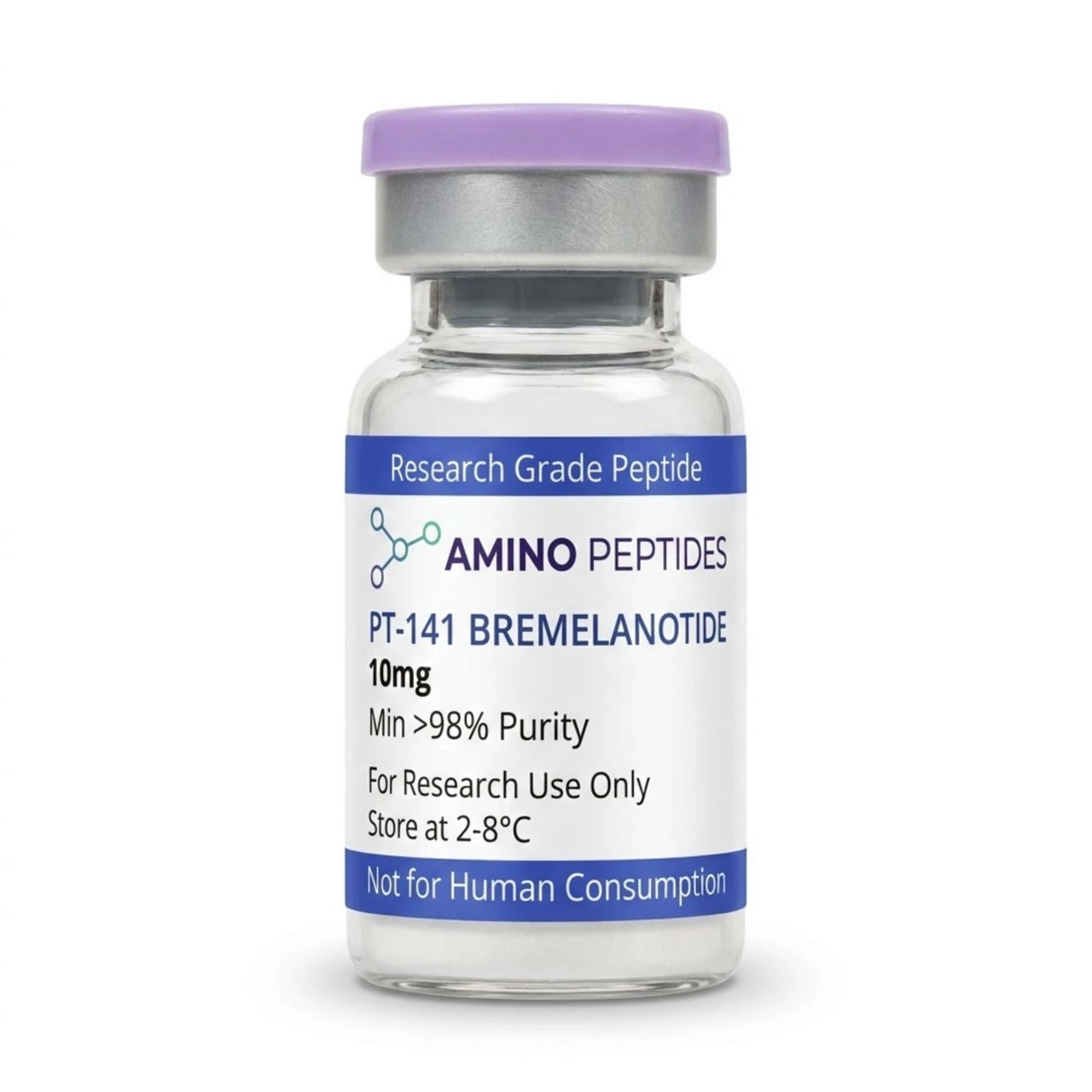

PT-141 (Bremelanotide) | 10mg
Technical Specifications
- Sequence: Ac-Nle-Asp-His-D-Phe-Arg-Trp-Lys-OH (Cyclic)
- Chemical Name: Bremelanotide (De-amidated Melanotan II metabolite)
- Format: Lyophilised Cake/Powder
- Purity: >99% (HPLC Verified)
- Receptor Affinity: Agonist of MC3R & MC4R (Melanocortin Receptors)
- Solubility: High (Aqueous)
- Solvent: Solvent not included (Sold Separately)
- Grade: Analytical Research Grade
Variant Breakdown
- 10mg Vial: Contains 10mg PT-141 (Bremelanotide).
- Vial Capacity: 3ml.
Product Overview
PT-141, chemically known as Bremelanotide, is a synthetic cyclic heptapeptide and a specific metabolite of Melanotan II.
Unlike its parent compound, PT-141 does not possess the C-terminal amide group, which significantly alters its pharmacological profile. While Melanotan II is primarily researched for melanogenesis (pigmentation), PT-141 is investigated for its potent affinity for the Melanocortin-3 (MC3) and Melanocortin-4 (MC4) receptors in the Central Nervous System (CNS).
Research Distinction:
PT-141 is a unique reagent in neuroscience because it acts directly on the Hypothalamus (specifically the paraventricular nucleus). This distinguishes it from vascular research agents (like PDE5 inhibitors) that act on the circulatory system. Consequently, PT-141 is the primary peptide used to study the central neural pathways involved in homeostasis and autonomic signaling, independent of vascular mechanics.
Quality Assurance
This compound has undergone rigorous third-party analysis.
- HPLC Verified: Independent analysis confirms peptide purity exceeds 99%.
- Mass Spectrometry: Confirms accurate molecular weight (approx. 1025.2 Da).
- TFA Removal: Processed via acetate exchange to remove inflammatory trifluoroacetic acid salts, ensuring high viability in sensitive cell culture applications.
Research Mechanism
In laboratory settings, PT-141 is utilised to investigate:
- Hypothalamic Signaling: The downstream effects of MC4 receptor activation in the paraventricular nucleus (PVN) of the hypothalamus.
- Neural vs. Vascular: Comparative studies isolating central nervous system responses from peripheral vascular responses.
- Receptor Mapping: Mapping the distribution and density of melanocortin receptors in neural tissue models.
Safety and Handling
WARNING: This product is exclusively for laboratory research and in vitro use.
- Research Only: Not intended for human consumption, diagnostic, or therapeutic use.
- Handling: Wear appropriate personal protective equipment (PPE).
Storage: Store lyophilised vials in a cool, dry place. For long-term preservation, freezing at -20°C is recommended.
Scientific References
Annals of the New York Academy of Sciences (2003) – "Central melanocortin receptors: a new mechanism for the regulation of energy homeostasis and other autonomic functions." View Article
British Journal of Pharmacology (2004) – "The melanocortin system: from receptor biology to pharmacological agents." (Detailed review of the MC3/MC4 pathways). View Article
Peptides (2005) – "Discovery and development of melanocortin receptor agonists for the treatment of CNS disorders." View Article