

The parallel evaluation of Tesamorelin (GHRH Analogue) and Ipamorelin in isolated cellular models provides critical insights into somatotroph receptor activation. Tesamorelin acts as a growth hormone-releasing hormone analogue, binding to the GHRH receptor, while Ipamorelin functions as a selective ghrelin/growth hormone secretagogue receptor (GHSR) agonist. When evaluated in parallel-arm laboratory designs, these separate mechanisms demonstrate a complementary activation of intracellular cAMP and calcium signalling cascades, allowing researchers to map intersecting pathways without the confounding variables of whole-organism physiology.
The molecular stability of both peptides is a critical factor during co-incubation assays. Laboratories investigating research chemicals in the UK often examine how the distinct structural modifications of each peptide influence their degradation kinetics in aqueous environments. Tesamorelin (GHRH Analogue) features a trans-3-hexenoic acid group that resists dipeptidyl peptidase-4 (DPP-4) cleavage, whereas Ipamorelin is a pentapeptide synthesised with a high degree of resistance to enzymatic breakdown. Together, their concurrent application in cell-free systems allows for the study of sustained receptor occupancy and parallel pathway engagement.
Advanced peptide synthesis techniques ensure that both Tesamorelin (GHRH Analogue) and Ipamorelin maintain high purity for precise in-vitro characterisation. Establishing standardised reconstitution protocols using Bacteriostatic Reconstitution Solution is essential for preserving the conformational integrity of these separate lyophilised vials. By evaluating the synergistic overlap of GHRH and GHSR pathway activation, laboratory models can map the downstream transcriptional targets that mediate cellular lipolysis and protein synthesis, providing a comprehensive view of how these two distinct peptide classes intersect at the cellular level.
Public search data frequently clusters around the phrase "Tesamorelin (GHRH Analogue) Ipamorelin stack" when discussing these compounds. While research trends group them together, the published literature actually records separate laboratory experiments rather than a combined product. The underlying papers describe cellular or molecular models of the individual compounds. Amino Peptides supplies these compounds only as separate lyophilised laboratory reagents. Strictly for laboratory research.
- Tesamorelin is characterised as a synthetic analogue of growth hormone-releasing hormone (GHRH), exhibiting high-affinity binding to the GHRH receptor (GHRHR) expressed on isolated somatotroph membranes.
- Ipamorelin functions as a selective agonist of the growth hormone secretagogue receptor (GHSR-1a), demonstrating targeted binding in cell-free receptor saturation experiments.
- Parallel laboratory investigations indicate that while Tesamorelin and Ipamorelin target distinct transmembrane receptors (GHRHR and GHSR-1a, respectively), their binding profiles converge on the modulation of intracellular cAMP levels.
- Upon binding to GHRHR, Tesamorelin initiates a stimulatory G-protein (Gs) coupled cascade, upregulating adenylate cyclase activity and subsequently elevating intracellular cyclic AMP concentrations in isolated cellular models.
- Ipamorelin engagement with GHSR-1a triggers a Gq/11-coupled pathway, stimulating phospholipase C (PLC) to generate inositol triphosphate (IP3) and diacylglycerol (DAG), culminating in transient intracellular calcium mobilization.
- The concurrent activation of these distinct signalling pathways in parallel cell-culture studies demonstrates a synergistic convergence, where elevated cAMP and intracellular calcium collectively facilitate enhanced exocytotic vesicle fusion.
Technical Specifications
Variant Breakdown
- Tesamorelin (GHRH Analogue): Supplied as a 10mg lyophilised vial, this synthetic GHRH analogue is prepared for precise dilution and evaluation in cellular receptor assays.
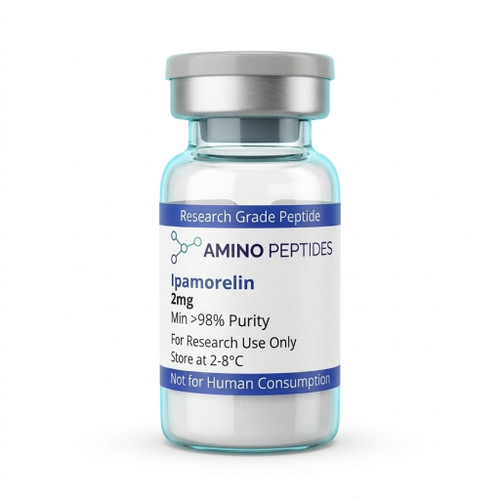
- Ipamorelin: Supplied as a 2mg lyophilised vial, this selective pentapeptide is provided as a stable laboratory stock for parallel-arm incubation studies.
Quality Assurance
- HPLC Verification: Each batch undergoes high-performance liquid chromatography to confirm the purity and structural integrity of the lyophilised peptides.
- Mass Spectrometry: Independent mass spectrometry characterisation verifies the exact molecular weight and sequence fidelity of the synthesised compounds.
- Lyophilisation Stability: The peptides are supplied as separate lyophilised powders to optimise long-term molecular stability prior to laboratory preparation.
- Independent Batch Analysis: Rigorous third-party testing ensures that all vials meet analytical research grade standards devoid of synthesis truncations.
Research Mechanism
- Receptor Synergy: In isolated pituitary cell cultures, the concurrent application of Tesamorelin (GHRH Analogue) and Ipamorelin demonstrates dual-receptor activation, converging on both GHRH and GHSR pathways to amplify intracellular signalling.
- cAMP and Calcium Crosstalk: Co-incubation models reveal that while Tesamorelin (GHRH Analogue) primarily elevates cyclic AMP levels, Ipamorelin triggers intracellular calcium release, creating a complementary signalling cascade in vitro.
- Enzymatic Resistance: Parallel-arm degradation assays indicate that both Tesamorelin (GHRH Analogue) and Ipamorelin exhibit significant resistance to dipeptidyl peptidase-4 (DPP-4) cleavage, ensuring sustained receptor occupancy in cell-free environments.
- Transcriptional Activation: Laboratory profiling of somatotroph cell lines shows that the combined presence of Tesamorelin (GHRH Analogue) and Ipamorelin upregulates gene expression associated with lipolysis and protein synthesis more effectively than either peptide alone.
- Binding Affinity Modulation: Receptor binding assays demonstrate that the structural stability of Ipamorelin does not competitively inhibit the binding of Tesamorelin (GHRH Analogue), allowing parallel pathway engagement without steric hindrance.
Reconstitution & Storage Data
| Peptide | Vial Strength | Solvent Added | Resulting Concentration |
| Vessel: 3mL Borosilicate Crimp Vial (10mg lyophilised mass — max vessel capacity 3.0 mL) | |||
| Tesamorelin (GHRH Analogue) | 10mg | 1.0 mL Bacteriostatic Reconstitution Solution | 10.00 mg/mL |
| Tesamorelin (GHRH Analogue) | 10mg | 2.0 mL Bacteriostatic Reconstitution Solution | 5.00 mg/mL |
| Vessel: 3mL Borosilicate Crimp Vial (2mg lyophilised mass — max vessel capacity 3.0 mL) | |||
| Ipamorelin | 2mg | 1.0 mL Bacteriostatic Reconstitution Solution | 2.00 mg/mL |
| Ipamorelin | 2mg | 2.0 mL Bacteriostatic Reconstitution Solution | 1.00 mg/mL |
- Lyophilised (Powder): Store in a standard refrigerator (2-8°C) for up to 3 months. For long-term preservation, freeze at -20°C.
- Reconstituted (Liquid): Store at 2-8°C (Refrigerated).
Scientific References
European Journal of Endocrinology: "Ipamorelin, the first selective growth hormone secretagogue" View Study
Expert Opinion on Investigational laboratory evaluation: "Tesamorelin, a human growth hormone-releasing hormone analogue" View Study
Endocrinology: "Growth hormone secretagogues and their receptors" View Study
Peptides: "Pharmacological characterization of the growth hormone secretagogue receptor" View Study