
AOD-9604: Isolating the Lipolytic Domain of Human Growth Hormone
9th Sep 2026

What You Need to Know About AOD-9604
- AOD-9604 is the stocked analogue of the C-terminal HGH fragment 176-191, searched for lipolytic signalling.
- In plain English, published models watch how fat cells release stored lipid when this sequence is in the assay.
- Study timelines separate an early signalling window from later changes in lipid handling.
- A 99%+ HPLC-verified, freeze-dried vial kept at 2°C–8°C is the variable a laboratory can hold constant.
Scientists studying fat metabolism have long focused on human growth hormone (hGH). Intact hGH breaks down fat effectively in the laboratory. However, researchers struggle to use the whole hormone in isolated studies because it triggers multiple biological chain reactions. It causes insulin resistance in cellular models and increases insulin-like growth factor 1 (IGF-1) production in liver cells. To avoid these unwanted variables, researchers isolated the exact section of the hGH molecule that controls fat breakdown. This isolation process produced the synthetic peptide fragment AOD-9604.
Scientists isolated a specific 15-amino acid sequence from the tail end of the hGH molecule, known as residues 177 to 191. They then added a tyrosine molecule to the front end to stabilise the structure. This creates a compound that activates fat-breakdown pathways in isolated cells without setting off broader growth hormone signals. The modified fragment does not bind to the primary growth hormone receptor. This article examines the structural design of AOD-9604, its interactions with cellular receptors, and its performance in controlled laboratory tests.
 Structural Engineering of hGH 177-191
Human growth hormone contains 191 amino acids in a single chain. Early structural mapping showed that different sections of this protein control different biological actions. The front section mainly drives growth and cell division via the primary growth hormone receptor. The back section controls how cells process and clear fats. Researchers identified the specific sequence from amino acid 177 to 191 as the exact engine driving fat breakdown.
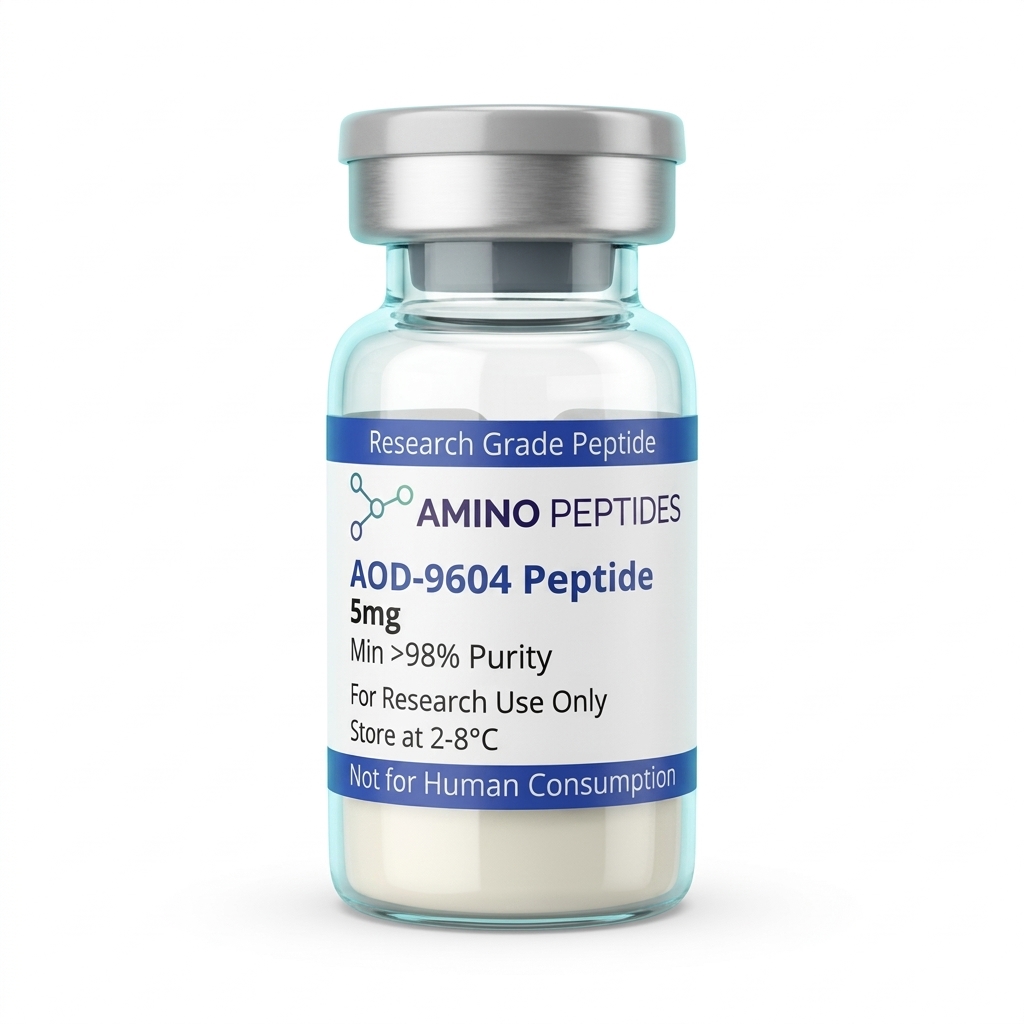
AOD-9604 Peptide
From £55
Supplied as a sealed freeze-dried vial (stable 12–24 months at 2°C–8°C in a standard refrigerator).
Shop AOD-9604 Peptide →Native hGH is a round protein containing four coiled structures called alpha-helices. For hGH to activate its primary receptor, it must connect at two distinct binding sites simultaneously. This double connection forces two receptor molecules to join together. This joining process is necessary to start signals inside the cell. The amino acids that connect to these two sites sit deep inside the coiled core and the front loop of the hormone.
The tail section, spanning residues 177 to 191, sits far away from these primary receptor connection points. This physical separation explains why the isolated fragment cannot force the main receptors to join together. It fails to activate the standard growth pathways in cell cultures. Instead, the synthetic peptide floats as a flexible chain in liquid solutions. The added tyrosine molecule at position 177 physically blocks enzymes that would otherwise break the peptide apart. This modification keeps the peptide intact during long testing periods in laboratory cell cultures.
Researchers modified the amino acid sequence to improve how long the fragment lasts in laboratory environments. Adding the tyrosine molecule to the front end stops rapid chemical breakdown. The final modified peptide, AOD-9604, has a molecular formula of C78H123N23O23S2 and a molecular weight of 1815.1 Daltons. This specific structural change ensures the peptide survives long enough in a petri dish to interact with isolated cells. It gives researchers a reliable way to study fat metabolism without other interfering variables.
Laboratory investigators require high-purity materials to ensure exact analytical readings. Researchers source these verified chemical sequences from established UK suppliers to maintain strict experimental controls.
Isolating the fat-processing action from the growth-promoting action allows researchers to model cellular metabolism with much greater accuracy.
Reconstitution calculator
Choose a vial mass and a bacteriostatic reconstitution solution volume. The figure is the resulting concentration.
Concentration: 2.50 mg/mL
Per 0.01mL (10µL): 25.0 mcg
Open the full calculatorBacteriostatic reconstitution solutionThe aod-9604 peptide primarily stimulates lipolysis, which is the breakdown of stored fats in cellular models. It also stops cells from forming new fatty acids, a process called lipogenesis. Full-length hGH binds to the primary growth hormone receptor and starts a complex chemical chain reaction in cells. AOD-9604 lacks a strong connection to this classical receptor. Because of this weak connection, it fails to trigger the production of IGF-1 in isolated liver cells.
Laboratory data shows that the lipolytic aod-9604 sequence interacts instead with beta-3 adrenergic receptors (ADRB3). When the peptide activates ADRB3 on isolated fat cells, it stimulates an enzyme called adenylyl cyclase. This enzyme increases the amount of cyclic adenosine monophosphate (cAMP) inside the cell. Higher cAMP levels activate protein kinase A (PKA). This active kinase then adds phosphate groups to hormone-sensitive lipase (HSL) and a protective protein called perilipin. The modified HSL moves to the surface of the fat droplet, where it breaks down stored triglycerides into free fatty acids and glycerol.
This chemical chain reaction is standard across multiple cellular models. When the peptide connects to the beta-3 receptor on the cell membrane, a specific protein subunit breaks away. This subunit switches on the membrane-bound adenylyl cyclase. The enzyme then converts adenosine triphosphate (ATP) energy molecules into cAMP. As cAMP builds up inside the cell, it binds to the blocking sections of protein kinase A (PKA). This binding releases the active parts of the PKA enzyme to do their work.
The active PKA enzyme then modifies specific target proteins inside the isolated fat cell. One major target is perilipin. Perilipin normally coats the fat droplet and blocks chemical breakdown. When PKA modifies perilipin, the protein changes shape and exposes the stored fats. At the same time, PKA modifies hormone-sensitive lipase (HSL). This change forces HSL to move from the cellular fluid to the surface of the fat droplet. Once there, HSL works with other enzymes to cut fatty acid chains away from their core structure.
Scientists primarily test AOD-9604 in laboratory models to map its metabolic effects. In studies using genetically modified obese mice, regular administration of the peptide reduced fat mass over time. It achieved this without changing how much the animals ate and without triggering overall body growth. This differs completely from whole hGH, which frequently causes water retention, blood sugar issues, and abnormal organ growth during long-term laboratory testing.
Beyond fat metabolism, researchers test AOD-9604 on isolated joint tissue. Joint degradation involves the steady breakdown of cartilage and the surrounding cellular matrix. Because full-length growth hormone alters cartilage development, researchers tested whether this isolated fragment could trigger similar cell repair without the systemic risks of the whole hormone.
Laboratory tests using cartilage cells extracted from animal joints show measurable structural changes. When researchers grew these isolated cells alongside AOD-9604, they recorded an increase in proteoglycan molecules. They also measured higher activity in the genes that produce type II collagen. These structural proteins are necessary for keeping joint cartilage thick and elastic.
Investigators track new laboratory data on these secondary cellular effects through reference databases like the knowledge hub, which collects peer-reviewed data on peptide chemistry.
Comparative Analysis: hGH vs. AOD-9604Comparing AOD-9604 with native human growth hormone shows how the isolated fragment behaves differently in a laboratory setting.
First, researchers measure growth-promoting activity. Native hGH binds to the primary receptor, driving cell division and causing isolated liver cells to release IGF-1. AOD-9604 physically lacks the section needed to activate this primary receptor. Laboratory tests confirm it displays zero growth-promoting activity and does not increase IGF-1 production. This gives researchers a clean model for experiments where cell division would ruin the data.
Second, the two molecules alter sugar metabolism differently. Native hGH blocks insulin pathways and stops isolated muscle cells from absorbing glucose. AOD-9604 does not interfere with the insulin receptor. It maintains normal glucose processing in cell cultures. This stability allows scientists to study fat breakdown over longer periods without the complication of artificial insulin resistance.
Third, they handle fat breakdown differently. Both chemical structures force isolated cells to break down stored fats, but AOD-9604 acts with extreme chemical specificity. Because it only triggers the specific fat-processing pathway, it bypasses the feedback loops that typically shut down whole hGH during long-term laboratory testing.
Frequently Asked Questions in Peptide Research
What are the primary mechanisms observed during aod 9604 lipolysis studies?In cellular testing, aod 9604 lipolysis begins when the sequence connects to beta-3 adrenergic receptors on the fat cell wall. This connection starts a chain reaction that increases cyclic AMP levels inside the cell, which then activates protein kinase A. This enzyme adds phosphate to hormone-sensitive lipase, causing the cell to break stored triglycerides into free fatty acids and glycerol. The peptide also stops the cell from storing new fat by blocking specific enzymes like acetyl-CoA carboxylase.
How do researchers evaluate aod-9604 results in laboratory settings?Scientists measure aod-9604 results by testing the liquid surrounding the cultured fat cells. They look for increases in glycerol and free fatty acids floating in this medium. Investigators also track cell volume, detect fat-processing enzymes using Western blot tests, and measure changes in specific fat-storing genes using quantitative polymerase chain reaction (qPCR). In animal tests, researchers measure total body fat and local tissue changes using dual-energy X-ray absorptiometry (DEXA) scans.
How does the compound compare to other products, such as those from aod 9604 peptide sciences?When evaluating compounds from aod 9604 peptide sciences or other chemical distributors, laboratories look strictly at purity and physical structure. High-grade research materials must test above 98% purity. Laboratories confirm this standard using High-Performance Liquid Chromatography (HPLC) and Mass Spectrometry (MS). Maintaining this exact chemical standard prevents random cellular reactions and ensures that experimental results remain accurate.
Summary of Current Research DirectionsLaboratory testing of AOD-9604 now includes more than just fat metabolism studies. Investigators run cellular assays to test how the sequence affects connective tissue and bone density. Scientists design in-vitro models to measure if the peptide changes how bone-forming cells mature and build mineral deposits. Other research teams use computer modelling to map exactly how the physical peptide structure locks into the beta-3 adrenergic receptor. By isolating the specific fat-processing section of human growth hormone, scientists created a precise chemical tool to study cellular metabolism without the interfering side effects of whole somatotropin.
- Ng, F. M., et al. (2000). Metabolic studies of a synthetic lipolytic fragment (AOD9604) of human growth hormone. International Journal of Obesity, 24(11), 1415-1422. View published research
- Heffernan, M. A., et al. (2001). Effects of oral administration of a synthetic fragment of human growth hormone on lipid metabolism in rats. American Journal of Physiology-Endocrinology and Metabolism, 280(3), E501-E507. View published research
- Heffernan, M. A., et al. (2001). Increase in lipid oxidation and reduction in body fat in obese mice by a synthetic fragment of human growth hormone. International Journal of Obesity, 25(10), 1442-1449. View published research
- Heffernan, M. A., et al. (2000). The effects of human GH and its lipolytic fragment (AOD9604) on lipid metabolism in obese mice. Journal of Endocrinology, 165(3), 420-428. View published research
- Ng, F. M., et al. (1993). Lipolytic activity of a synthetic fragment (177-191) of human growth hormone. General Pharmacology: The Vascular System, 24(6), 1383-1388. View published research
⚠️ Research Use Only Disclaimer: All peptides and compounds are sold strictly for in-vitro laboratory research purposes only. Not intended for human or veterinary use, not a dietary supplement, and not approved to diagnose, treat, cure, or prevent any disease or condition. For use by qualified researchers in suitably equipped laboratory environments only. Amino Peptides Ltd operates in full compliance with UK MHRA regulations and applicable EU research chemical guidelines.