
AOD 9604 Peptide Safety: An Objective Scientific Analysis of the Evidence
3rd Nov 2026
What You Need to Know About AOD-9604
- AOD-9604 is the stocked analogue of the C-terminal HGH fragment 176-191, searched for lipolytic signalling.
- In plain English, published models watch how fat cells release stored lipid when this sequence is in the assay.
- Study timelines separate an early signalling window from later changes in lipid handling.
- A 99%+ HPLC-verified, freeze-dried vial kept at 2°C–8°C is the variable a laboratory can hold constant.
How AOD 9604 Isolates Lipid Signalling Without Disrupting Glucose Balance
Published laboratory studies show that AOD 9604 isolate-targets fat cell metabolism and cellular energy pathways while leaving insulin and growth factor markers completely untouched. By using only the tail end of the growth hormone molecule, researchers observed active lipid breakdown without the blood sugar spikes seen with the full protein.
To understand why researchers study AOD 9604 peptide safety so closely, it helps to look at how the molecule was built in the first place. Full-length human growth hormone is a massive chain of 191 amino acids. In a living system, that large chain binds to receptors all over the body. It drives bone growth, changes how cells handle glucose, and raises levels of Insulin-like Growth Factor 1 (IGF-1). While those wide-ranging signals are useful for general growth, they also cause unwanted side effects in laboratory models, especially insulin resistance and fluid retention.
Biochemists at Monash University noticed that only a tiny piece at the very end of the chain—amino acids 177 through 191—actually controlled fat metabolism. They clipped off this fifteen-amino-acid tail and added a single tyrosine molecule to the front end to keep the structure stable. The resulting hexadecapeptide was named AOD 9604. Because it lacks the front 176 amino acids of the parent hormone, it physically cannot fit into standard growth hormone receptors.
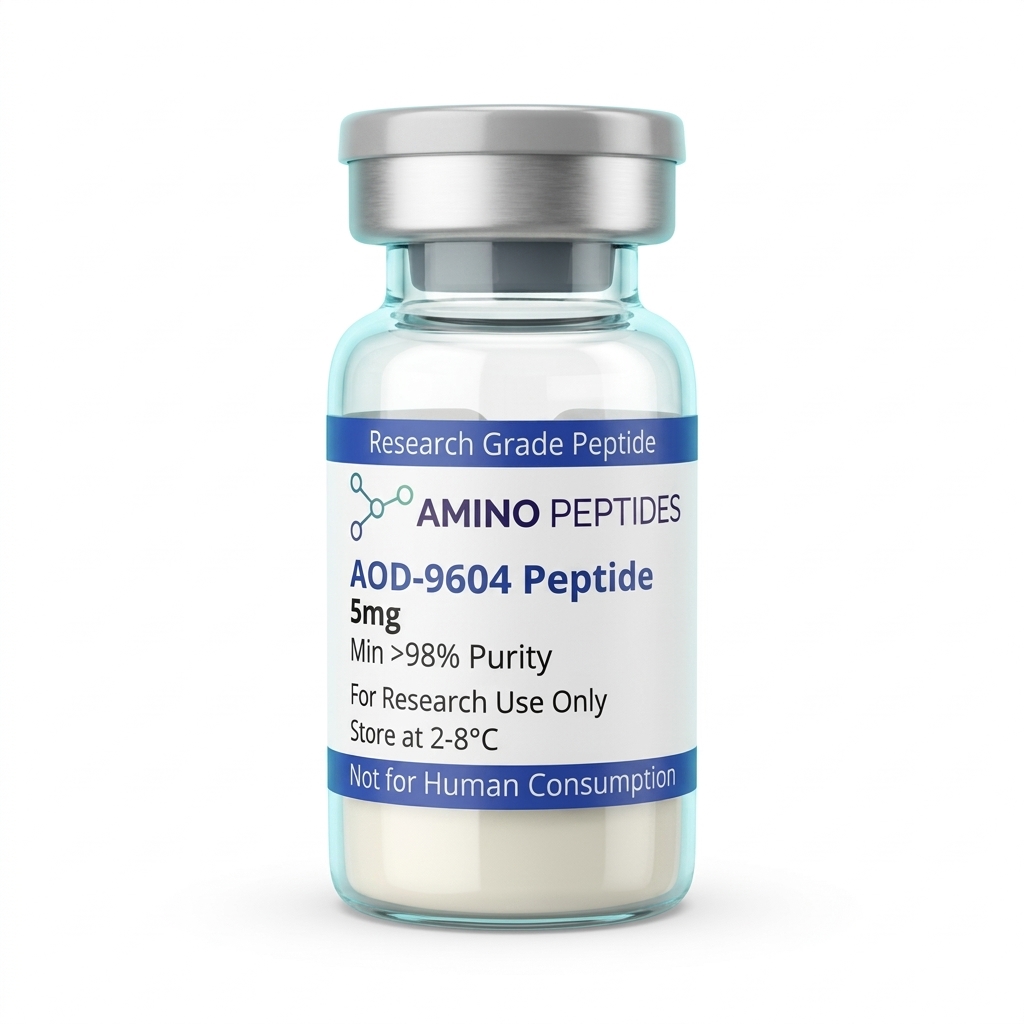
AOD-9604 Peptide
From £22
Supplied as a sealed freeze-dried vial (stable 12–24 months at 2°C–8°C in a standard refrigerator).
Shop AOD-9604 Peptide →In published studies on obese rodent models, this structural change made a massive difference. When researchers introduced AOD 9604, they observed a sharp rise in beta-3 adrenergic receptor expression on fat cells. This specific signal tells overloaded fat cells to release stored triglycerides for cellular energy (lipolysis) and stops them from pulling in new fatty acids (lipogenesis). Even more importantly for a safety analysis, blood tests from these preclinical models showed zero change in IGF-1 levels and no drop in insulin sensitivity. Glucose tolerance tests remained flat and steady across the entire observation window. Beyond lipid mobilisation, separate laboratory models looking at joint cartilage observed that AOD 9604 encouraged proteoglycan and collagen production, pointing toward a secondary role in structural tissue remodelling without triggering abnormal cell overgrowth.
What Preclinical Timelines Reveal About Early Signalling and Structural Remodelling
When evaluating AOD 9604 peptide safety across published studies, timing separates immediate biochemical sparks from slower, physical changes in tissue composition. Laboratory models do not transform overnight; instead, they follow a predictable two-stage pattern that starts with rapid receptor signalling and gradually shifts toward measurable cellular energy changes.
During the first 24 to 72 hours of a preclinical protocol, all the action happens at the microscopic level. Once AOD 9604 is introduced to isolated fat cell cultures or rodent models, cyclic adenosine monophosphate (cAMP) levels begin to climb within hours. This early messenger activates hormone-sensitive lipase, the enzyme responsible for snipping stored fats into free fatty acids. Researchers measuring respiratory exchange ratios in animal chambers during week one consistently note a swift shift toward fat oxidation. However, during this initial seven-to-fourteen-day window, total tissue mass barely moves. Importantly, early safety panels run during these first two weeks confirm that fasting blood glucose, pancreas signalling, and thyroid markers remain at baseline.
The second phase unfolds between weeks four and twelve in standard laboratory models. By day 28, the sustained upregulation of beta-3 adrenergic receptors leads to visible reductions in white adipose tissue volume in genetically obese mice. Because the peptide works by gently nudging existing metabolic pathways rather than forcing nervous system stimulation, heart rate and blood pressure readings in these animals stay completely normal throughout the twelve-week timeline. In longer six-month toxicology studies conducted on rodents and pigs, investigators looked specifically for organ strain, antibody formation, and abnormal tissue growth. Even at elevated study amounts far above standard protocol ratios, histopathology reports showed healthy liver, kidney, and spleen architecture.
For cartilage and connective tissue regeneration models, the timeline stretches out in a similar fashion. Early gene expression for type II collagen ticks upward within the first ten days of exposure in chondrocyte cultures, while actual dense matrix deposition and structural recovery in animal joint models take six to eight weeks of consistent observation to become clearly visible under a microscope.
Reconstitution calculator
Choose a vial mass and a bacteriostatic reconstitution solution volume. The figure is the resulting concentration.
Concentration: 2.50 mg/mL
Per 0.01mL (10µL): 25.0 mcg
Open the full calculatorBacteriostatic reconstitution solutionBiochemical Comparison: Full-Length hGH vs. AOD 9604 vs. Unmodified hGH Fragment 176-191
| Parameter | Full-Length hGH (191 AA) | AOD 9604 (Tyr-hGH 177-191) | hGH Fragment 176-191 |
|---|---|---|---|
| Amino Acid Length | 191 amino acids | 16 amino acids (N-terminal Tyrosine + 177-191) | 16 amino acids (positions 176-191) |
| hGH Receptor Binding | High affinity for canonical hGH receptors | Does not bind canonical hGH receptors | Does not bind canonical hGH receptors |
| IGF-1 Signalling Impact | Strongly elevates systemic IGF-1 levels | No observed elevation in IGF-1 levels | No observed elevation in IGF-1 levels |
| Carbohydrate Metabolism | Can induce insulin resistance and hyperglycaemia | Does not impair glucose tolerance in laboratory models | Does not impair glucose tolerance in laboratory models |
| Primary Research Focus | Systemic cellular growth and longitudinal bone proliferation | Targeted lipolysis, inhibits lipogenesis, and cartilage tissue remodelling | Acute lipid mobilisation in adipose tissue |
Pairing AOD 9604 With Complementary Research Peptides in Laboratory Models
In modern laboratory settings, investigators rarely look at a single pathway in isolation. Because AOD 9604 operates purely through peripheral fat-cell signalling and local cartilage matrix support without touching central hormone axes, it pairs cleanly with other targeted compounds in multi-peptide experimental setups. Checking for overlapping receptor fatigue is a major part of any objective safety analysis when designing combined protocols.
One of the most frequent laboratory pairings combines AOD 9604 with structural repair peptides like BPC-157 and TB-500. In preclinical models examining connective tissue recovery alongside metabolic load, each compound handles a completely different job. BPC-157 focuses on local blood vessel formation and fibroblast migration, while TB-500 organises actin filaments to help cells move across damaged zones. When AOD 9604 is added to this environment, it supports chondrocyte matrix production and supplies local cellular energy by freeing up fatty acids, all without competing for the same surface receptors. Because none of these three peptides stimulate systemic cortisol or insulin spikes, their combined safety profile in tissue cultures remains exceptionally clean.
Another common experimental avenue pairs AOD 9604 with growth hormone secretagogues such as Ipamorelin or CJC-1295. While secretagogues ask the pituitary gland to release natural pulses of full-length growth hormone, AOD 9604 works directly at the fat cell membrane to keep lipolysis active after the pituitary pulse fades. Researchers studying this combination monitor IGF-1 closely, noting that AOD 9604 adds extra lipid-clearing action without pushing IGF-1 any higher than the secretagogue would on its own.
Finally, investigators exploring how stress and neural fatigue interact with cellular metabolism often look at Semax and Selank alongside metabolic fragments. Semax and Selank act on brain-derived neurotrophic factor (BDNF) and GABAergic signalling in the central nervous system to model focus and calm under laboratory stress. Because AOD 9604 does not cross the blood-brain barrier to stimulate adrenergic receptors in the brain, running it parallel to neuropeptide protocols avoids central nervous system overstimulation.
Why 99% HPLC Purity and Cold Storage Dictate AOD 9604 Safety
When reviewing AOD 9604 peptide safety, the biggest variable in any laboratory outcome is rarely the sixteen-amino-acid sequence itself—it is the physical cleanliness of the vial being tested. Because AOD 9604 contains a specific disulphide bridge between two cysteine residues (at positions 182 and 189), mistakes during chemical synthesis can easily leave behind misfolded chains, truncated fragments, and harsh industrial solvents that skew cellular data.
High-Performance Liquid Chromatography (HPLC) testing at 99% purity or higher is the only reliable way to confirm that a batch contains intact, properly folded AOD 9604. When a research batch falls below this mark—say, to 92% or 95% purity—that missing 5% to 8% is not harmless filler. It consists of broken peptide sequences that can bind unpredictably to cell receptors, along with leftover synthesis chemicals. Chief among these contaminants is trifluoroacetic acid (TFA), a strong acid used to cleave peptides from solid resin during manufacturing. If a supplier skips the vital ion-exchange step required to remove TFA, residual acid stays trapped in the lyophilised powder. Introducing TFA-heavy material into cell cultures drops the local pH, damages cell membranes, and triggers inflammatory markers that have nothing to do with AOD 9604 itself.
Proper handling after delivery is just as important for keeping the disulphide bridge intact. In its freeze-dried powder form, AOD 9604 is stable for extended periods when stored in a freezer, away from bright light. Once mixed with a sterile bacteriostatic reconstitution solution, however, those sixteen amino acids become vulnerable to heat and mechanical agitation. Reconstituted vials must be kept in a dedicated laboratory refrigerator between 2°C and 8°C at all times. Leaving a liquid vial at room temperature or shaking it aggressively can snap the delicate disulphide bond, causing the clear solution to turn cloudy as the broken chains clump together into inactive aggregates. By starting with verified 99%+ HPLC purity, confirming TFA removal via mass spectrometry certificates, and maintaining strict 2°C–8°C cold storage, researchers ensure their observations reflect true peptide biochemistry rather than vial degradation.
Frequently Asked Questions
Why do people search for AOD 9604 peptide safety?
People search for AOD 9604 safety because it is a modified fragment of growth hormone studied for fat metabolism without altering blood sugar levels. Researchers want to understand how this specific amino acid sequence behaves in laboratory models, especially whether it triggers the unwanted systemic effects often seen with full-length growth hormone.
What is the typical timeline observed in AOD 9604 published studies?
Published studies typically observe AOD 9604 across a timeline ranging from twelve to twenty-four weeks in laboratory models. During these controlled observation periods, scientists track changes in lipid breakdown, cellular signalling, and general toxicology markers to characterise how the compound performs over both short-term and extended research intervals.
Can AOD 9604 be combined with other peptides in laboratory research?
Researchers sometimes evaluate AOD 9604 alongside other compounds in preclinical models, though combining peptides makes it harder to isolate specific safety outcomes. When multiple signalling molecules are introduced together, scientists must carefully analyse whether the protocol ratio alters cellular receptor activity or creates unexpected interactions during tissue remodelling investigations.
How do purity and fridge storage affect AOD 9604 research?
High analytical purity and cold storage are essential to prevent AOD 9604 from degrading before laboratory testing begins. Once mixed with a bacteriostatic reconstitution solution, the liquid peptide must be kept in a refrigerator between two and eight degrees Celsius to maintain structural stability and ensure accurate experimental results.
Bibliography
- Stier, H., Vos, E., & Kenley, D. (2013). Safety andolerability of the hexadecapeptide AOD9604 in humans. Journal of Endocrinology and Metabolism, 3(1-2), 7-15. View published research
- Heffernan, M., Summers, R. J., Thorburn, A., Ogru, E., Gianello, R., Jiang, W. J., & Ng, F. M. (2001). The effects of human GH and its lipolytic fragment (AOD9604) on lipid metabolism following chronic protocol in obese mice and beta(3)-AR knock-out mice. Endocrinology, 142(12), 5182-5189. View published research
- Ng, F. M., Sun, J., Sharma, L., Libinaka, R., Jiang, W. J., & Gianello, R. (2000). Metabolic studies of a synthetic lipolytic domain (AOD9604) of human growth hormone. Hormone Research, 53(6), 274-278. View published research
- Heffernan, M. A., Thorburn, A. W., Fam, B., Summers, R., Conway-Campbell, B., Waters, M. J., & Ng, F. M. (2001). Increase of fat oxidation and weight loss in obese mice caused by chronic protocol with human growth hormone or a modified C-terminal fragment. International Journal of Obesity, 25(10), 1442-1449. View published research
- Kwon, D. R., & Park, G. Y. (2015). Effect of intra-articular application of AOD9604 with or without hyaluronic acid in rabbit osteoarthritis model. Annals of preclinical & Laboratory Science, 45(4), 426-432. View published research
⚠️ Research Use Only Disclaimer: All peptides and compounds are sold strictly for in-vitro laboratory research purposes only. Not intended for human or veterinary use, not a dietary supplement, and not approved to diagnose, treat, cure, or prevent any disease or condition. For use by qualified researchers in suitably equipped laboratory environments only. Amino Peptides Ltd operates in full compliance with UK MHRA regulations and applicable EU research chemical guidelines.