
GHK-Cu: Exploring the Gene Regulatory Effects of Copper-Peptide Complexes
3rd Nov 2026
What You Need to Know About GHK-Cu
- Researchers in the UK and globally investigate this copper-peptide complex to understand how natural biological signals decline with age and whether food sources or endogenous synthesis drive its baseline levels.
- In simple terms, the GHK tripeptide acts like a molecular shuttle that picks up copper ions and delivers them into cells to flip genetic switches on or off.
- Published studies using Connectivity Map data show that GHK-Cu alters the expression of over four thousand human genes in cultured cells, resetting older cellular profiles toward younger states.
- Laboratory models demonstrate that this complex stimulates collagen synthesis, regulates metalloproteinases, and supports tissue remodelling and cellular recovery.
How Copper-Bound Tripeptides Influence Skin Elasticity and Cellular Recovery
GHK-Cu is a naturally occurring three-amino-acid sequence bound to a single copper ion that shifts thousands of human genes toward a younger, more active state in laboratory models. By ferrying bioavailable copper directly into cells, it supports collagen assembly, antioxidant defence, and overall tissue remodelling.
In plain English, the molecule acts like a tiny courier with a very specific cargo. The letters GHK stand for glycyl-L-histidyl-L-lysine, a small fragment naturally present in human plasma, saliva, and urine. On its own, the amino acid chain is simply an empty carrier. Once it binds to copper(II), it takes on a distinct blue tint and becomes biologically active. Published studies using the Broad Institute Connectivity Map showed that this complex can adjust the expression of roughly thirty-one percent of the human genome, nudging sluggish older cells to behave more like younger ones.
People searching for ghk cu peptide foods often wonder if eating copper-rich meals like shellfish, nuts, or dark chocolate does the same job. Dietary copper is essential for everyday health, yet raw minerals from food do not automatically form the exact tripeptide complex at the local tissue level. In preclinical models, the pre-formed GHK-Cu copper peptide delivers the metal ion right where fibroblasts can use it to power lysyl oxidase, an enzyme that cross-links collagen and elastin fibres for firmer skin elasticity.
Beyond structural proteins, the complex helps calm oxidative stress. Laboratory models demonstrate that it boosts superoxide dismutase activity while dialling down inflammatory signals such as interleukin-6. This dual action—building fresh extracellular matrix while clearing out damaged proteins through the ubiquitin-proteasome system—explains why researchers study it so closely for dermal recovery and cellular energy.
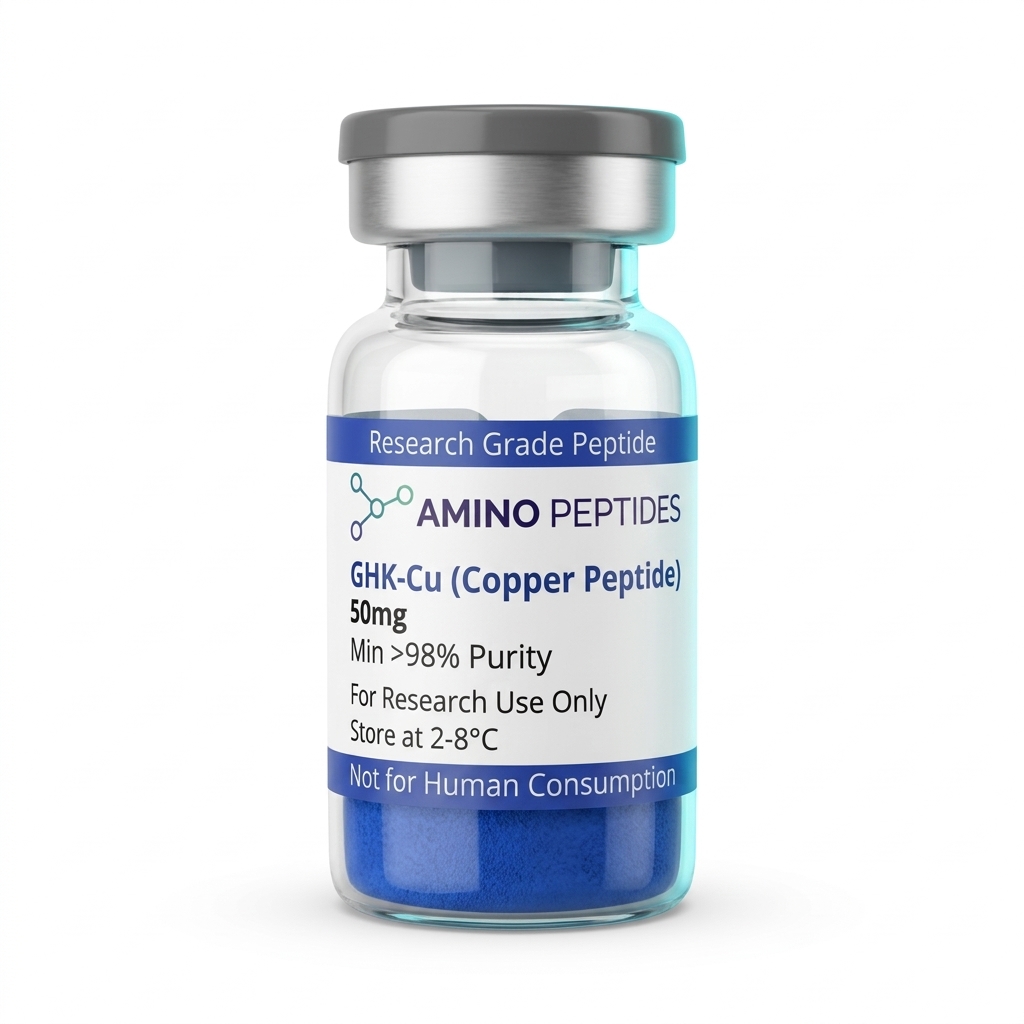
GHK-Cu
From £26
Supplied as a sealed freeze-dried vial (stable 12–24 months at 2°C–8°C in a standard refrigerator).
Shop GHK-Cu →What Published Studies Observe Across Early Signalling and Structural Remodelling
When scientists observe copper-peptide complexes in laboratory models, the biological response unfolds in distinct stages rather than all at once. Understanding the gap between immediate genetic signalling and visible structural change helps set realistic expectations for any experimental timeline.
During the first twenty-four to seventy-two hours in cell culture, the activity is purely chemical and transcriptional. Once the copper-bound tripeptide contacts fibroblasts or keratinocytes, it begins altering mRNA expression almost immediately. Genes tied to antioxidant defence, nerve outgrowth, and transforming growth factor-beta pathways start shifting within hours. At this early point, nothing looks different under a standard microscope, even though the internal cellular instructions have already changed.
Moving into days four through fourteen, preclinical models begin to show measurable protein output. Fibroblasts ramp up their production of type I and type III collagen alongside glycosaminoglycans like dermatan sulphate. In laboratory scratch assays, cell migration speeds up noticeably during this second week, and early capillary-like tubes start forming to bring nutrients to the remodelling site.
True architectural organisation takes considerably longer, typically spanning three to eight weeks in extended tissue models. Newly secreted collagen strands must be enzymatically cross-linked and aligned along tension lines, while metalloproteinases gently break down disorganised scar-like matrix. When comparing a topical ghk cu 1 percent concentration in cosmetic assays against a lyophilized ghk cu 20mg research vial prepared with bacteriostatic reconstitution solution, the underlying biological clock remains the same: genetic switches flip in hours, fresh proteins accumulate over weeks, and dense, elastic tissue architecture matures over months.
Biochemical Comparison of GHK-Cu and Related Laboratory Peptides
| Compound | Amino Acid Structure | Primary Metal Affinity | Main Laboratory Observation | Gene Expression Impact |
|---|---|---|---|---|
| GHK-Cu | Tripeptide (Gly-His-Lys) | High affinity for Copper(II) | Stimulates collagen and glycosaminoglycan synthesis in fibroblast cultures | Modulates over 4,000 genes linked to tissue remodelling and antioxidant defence |
| Metal-Free GHK | Tripeptide (Gly-His-Lys) | Unbound (chelator state) | Acts as a carrier molecule awaiting metal binding in biological fluids | Minimal direct genomic activity until complexed with divalent copper ions |
| AHK-Cu | Tripeptide (Ala-His-Lys) | Moderate to high affinity for Copper(II) | Studied in dermal papilla cell cultures for cellular proliferation signalling | Targeted upregulation of vascular endothelial growth factor in vitro |
| Palmitoyl-GHK | Lipopeptide (Pal-Gly-His-Lys) | Low metal affinity (lipid-modified) | Engineered for enhanced lipid membrane penetration in topical matrix assays | Narrower signalling profile focused primarily on extracellular matrix proteins |
| Thymosin Beta-4 (TB-500 fragment) | 43-amino acid polypeptide | None (actin-binding domain) | Regulates actin polymerisation and cell migration in preclinical models | Modulates cytoskeletal organisation and inflammatory cytokine pathways |
Pairing Copper Tripeptides with Complementary Sequences in Preclinical Models
In laboratory models of tissue remodelling, a single signalling molecule rarely handles every step of the recovery process alone. Because copper-peptide complexes focus heavily on gene regulation and extracellular matrix synthesis, researchers frequently pair them with sequences that target cell migration and local blood flow.
The most common partner in preclinical research is BPC-157, a fifteen-amino-acid fragment derived from gastric proteins. While the copper complex instructs fibroblasts to manufacture fresh collagen and elastin, BPC-157 is observed in published studies to upregulate growth hormone receptor expression on those very same fibroblasts and accelerate angiogenesis through the VEGFR2 pathway. Putting them together in an experimental design covers both the supply line (new micro-vessels) and the building materials (collagen and proteoglycans).
A second well-studied companion is TB-500, a synthetic version of the active region of Thymosin Beta-4. TB-500 works primarily by binding to actin, a structural protein inside cells that enables them to move and change shape. In laboratory models, TB-500 helps endothelial cells and keratinocytes travel quickly across a gap, while the copper tripeptide follows behind to organise the long-term matrix and remodel disorganised fibres.
Because these three pathways complement one another without competing for the same receptors, investigators often look for combined formats such as the glow tb500 10mg research bundle to study multi-stage recovery. In these stacked protocols, TB-500 initiates rapid cellular recruitment, BPC-157 supports vascular network formation, and the copper-peptide complex guides the final genetic and structural maturation of the tissue.
Reconstitution calculator
Choose a vial mass and a bacteriostatic reconstitution solution volume. The figure is the resulting concentration.
Concentration: 2.50 mg/mL
Per 0.01mL (10µL): 25.0 mcg
Open the full calculatorBacteriostatic reconstitution solutionWhy Analytical Verification and Cold Storage Matter for Copper-Peptide Vials
Anyone sourcing a ghk cu peptide uk vial for laboratory analysis quickly notices that copper complexes look very different from standard white lyophilized powders. An authentic, properly chelated GHK-Cu cake displays a vivid, royal-blue to deep-violet hue. That colour comes directly from the copper(II) ion sitting snugly inside the histidine-lysine pocket, and its purity directly determines whether an assay produces clean data or confusing background noise.
First, high-performance liquid chromatography (HPLC) verification at ninety-nine percent or higher is essential. If a batch contains unchelated free copper salts or truncated amino acid fragments, those impurities can trigger oxidative stress in cell cultures—the exact opposite of the antioxidant response researchers want to measure. Mass spectrometry alongside HPLC confirms that the molecular weight matches the intact copper-bound tripeptide rather than loose raw materials.
Second, the removal of trifluoroacetic acid (TFA) during manufacturing makes a substantial difference to vial quality. TFA is a harsh solvent commonly used to cleave peptides from solid resin, and trace residues left behind in cheaper batches can lower the pH of a solution and irritate delicate fibroblast lines. Choosing acetate-salt or desalted preparations keeps the chemical environment gentle and predictable.
Finally, temperature control protects the coordination bond between the peptide and its copper ion. Unreconstituted vials stay stable for long periods in a freezer at minus twenty degrees Celsius, away from bright light. Once mixed with a suitable bacteriostatic reconstitution solution, the vial belongs in a standard refrigerator between two and eight degrees Celsius and should never be shaken violently, ensuring the complex stays intact throughout the study window.
Frequently Asked Questions
Why are GHK-Cu peptide UK searches and GHK-Cu peptide foods queries so common?
Researchers search for GHK-Cu peptide UK sources because published studies show this copper complex influences over four thousand genes linked to tissue remodelling. While copper exists in everyday foods like shellfish and nuts, the specific GHK-Cu tripeptide complex is isolated in laboratory models rather than absorbed intact from food.
What timeline do published studies observe for GHK-Cu gene expression changes?
In laboratory models, GHK-Cu begins altering cellular signalling and gene expression within twenty-four to forty-eight hours of exposure. Structural markers associated with collagen synthesis and tissue regeneration are typically analysed across study timelines spanning two to twelve weeks, depending on whether researchers examine cell cultures or preclinical models.
Do laboratory protocols combine GHK-Cu 1 percent or 20mg vials with other peptides?
Yes, preclinical models frequently evaluate GHK-Cu alongside complementary research peptides such as BPC-157 or TB-500 to observe combined cellular signalling pathways. Whether starting with a GHK-Cu 20mg lyophilised vial or a 1 percent solution, researchers carefully control each study concentration to analyse distinct phases of extracellular matrix recovery.
How should a GHK-Cu 20mg vial be stored to maintain purity in the laboratory?
Unopened lyophilised GHK-Cu 20mg vials remain stable for extended periods when stored in a freezer at minus twenty degrees Celsius away from light. Once mixed with a bacteriostatic reconstitution solution, the liquid peptide complex should be kept refrigerated between two and eight degrees Celsius to prevent degradation during experiments.
Bibliography
- Pickart L, Margolina A. Regenerative and Protective Actions of the GHK-Cu Peptide in the Light of the New Gene Data. International Journal of Molecular Sciences. 2018;19(7):1987. View published research
- Pickart L, Vasquez-Soltero JM, Margolina A. GHK Peptide as a Natural Modulator of Multiple Cellular Pathways in Skin Regeneration. BioMed Research International. 2015;2015:648108. View published research
- Campbell JD, McDonough JE, Zeskind JE, et al. A gene expression signature of emphysema-related lung destruction and its reversal by the tripeptide GHK. Genome compound. 2012;4(8):67. View published research
- Pickart L, Vasquez-Soltero JM, Margolina A. The Human Tripeptide GHK-Cu in Prevention of Oxidative Stress and Degenerative Conditions of Aging: Implications for Cognitive Health. Oxidative compound and Cellular Longevity. 2012;2012:324832. View published research
- Maquart FX, Pickart L, Laurent M, Gillery P, Monboisse JC, Borel JP. Stimulation of collagen synthesis in fibroblast cultures by the tripeptide-copper complex glycyl-L-histidyl-L-lysine-Cu2+. FEBS Letters. 1988;238(2):343-346. View published research
⚠️ Research Use Only Disclaimer: All peptides and compounds are sold strictly for in-vitro laboratory research purposes only. Not intended for human or veterinary use, not a dietary supplement, and not approved to diagnose, treat, cure, or prevent any disease or condition. For use by qualified researchers in suitably equipped laboratory environments only. Amino Peptides Ltd operates in full compliance with UK MHRA regulations and applicable EU research chemical guidelines.