
GHK-Cu: What the Laboratory Data Actually Shows
28th Aug 2026

What You Need to Know About GHK-Cu
- Curious readers often search for GHK-Cu to understand how a simple three-amino-acid chain interacts with skin and hair follicle cells in laboratory dishes.
- The peptide acts like a microscopic delivery van that picks up copper ions and hands them over to enzymes responsible for building fresh collagen and elastin.
- Published studies observe that this copper-peptide complex can shift the activity of thousands of human genes, nudging older cells to behave more like younger ones in petri dish experiments.
- Preclinical models show that GHK-Cu supports tissue remodelling and calms oxidative stress markers without requiring complex receptor lock-and-key mechanisms.
How This Copper Tripeptide Signals Skin Elasticity and Cellular Repair
GHK-Cu works in laboratory models by picking up ionic copper and delivering it directly to cells that manage collagen synthesis, antioxidant defence, and tissue remodelling. In published studies, this tiny three-amino-acid sequence resets thousands of human genes toward a younger, more organised state of structural repair.
First isolated from human plasma in 1973, glycyl-L-histidyl-L-lysine (GHK) has a strong natural attraction to copper(II) ions. Once bound together as GHK-Cu, the complex takes on a deep blue hue and acts as a biological courier. Copper is required for enzymes like lysyl oxidase, which weaves individual collagen and elastin strands into a tight, flexible mesh. Without proper copper transport, newly formed fibres remain weak and disorganised.
Beyond simple mineral transport, Broad Institute connectivity mapping revealed that GHK-Cu influences over 4,000 genes at a very small concentration. It turns up the volume on genes that build fresh extracellular matrix while quieting genes linked to tissue breakdown and runaway oxidative stress. Simultaneously, it regulates metalloproteinases—the enzymes that clear away damaged, stiffened proteins—so fresh collagen can take their place cleanly.
When teams buy ghk-cu for dermal or fibroblast assays, they are usually examining this dual action: clearing out old cellular debris while laying down smooth, elastic scaffolding. Instead of forcing cells to divide recklessly, the tripeptide nudges dermal fibroblasts to restore the balanced architecture seen in younger tissue samples.
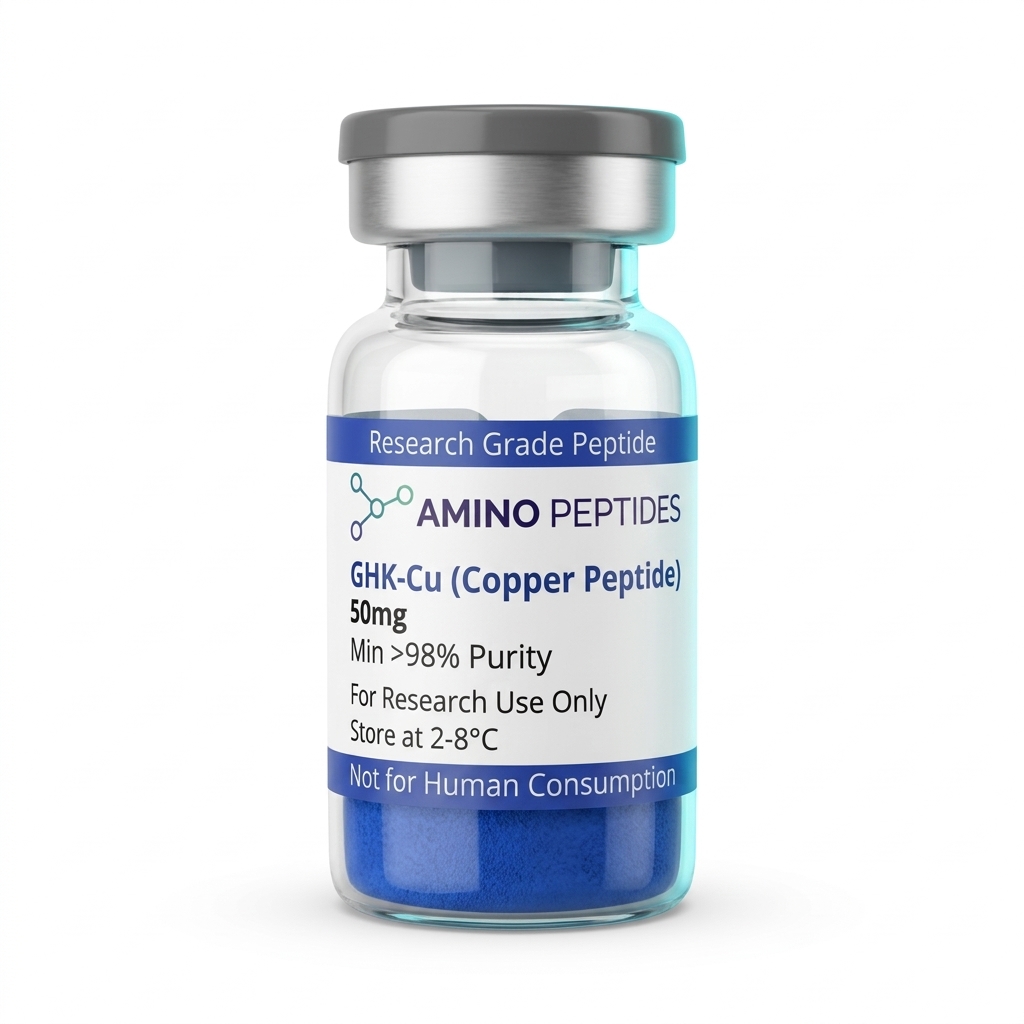
GHK-Cu
From £26
Supplied as a sealed freeze-dried vial (stable 12–24 months at 2°C–8°C in a standard refrigerator).
Shop GHK-Cu →Observed Laboratory Timelines: Early Gene Shifts Versus Structural Remodelling
In controlled laboratory models, GHK-Cu does not produce visible structural changes overnight; its activity unfolds in two distinct phases starting with rapid genetic signalling and finishing with slower physical matrix assembly. Understanding this gap helps researchers design experiments with realistic observation windows.
During the first 24 to 72 hours of exposure in cell culture, the action is almost entirely biochemical. Gene expression arrays show rapid changes in messenger RNA levels within the first day. Antioxidant enzymes such as superoxide dismutase begin to rise, free radical byproducts drop, and anti-inflammatory signalling molecules start to quiet down local cellular stress. At this early stage, nothing looks different under a standard microscope because the cells are still reading the new instructions and gathering raw amino acids.
The second phase—actual tissue remodelling—takes considerably longer. In preclinical models examining dermal thickness, fibroblast migration, and collagen density, measurable structural shifts typically appear between day 7 and day 21. Fibroblasts must first migrate into the target zone, secrete pro-collagen strands, and then use copper-dependent enzymes to cross-link those strands into durable fibres. Keratinocyte proliferation and new capillary budding follow a similar multi-week schedule.
Studies extending out to four or eight weeks show the clearest improvements in skin elasticity, collagen-to-elastin ratios, and hair follicle size. Short-term assays capture the initial spark of gene modulation, whereas multi-week protocols are necessary to observe the finished architectural repair.
GHK-Cu Compared to Related Laboratory Peptides
| Compound | Amino Acid Length | Primary Laboratory Focus | Key Signalling Target | Metal Ion Binding |
|---|---|---|---|---|
| GHK-Cu | 3 amino acids (tripeptide) | Dermal matrix synthesis and gene expression | TGF-beta and Broad Gene Modulation | High affinity for Copper(II) |
| Unbound GHK | 3 amino acids (tripeptide) | Copper chelation and baseline peptide signalling | Extracellular copper scavenging | Binds free copper ions on contact |
| BPC-157 | 15 amino acids (pentadecapeptide) | Tendon, gut lining, and blood vessel recovery models | VEGFR2 and Nitric Oxide pathways | None observed |
| TB-500 (Thymosin Beta-4 fragment) | 43 amino acids (full peptide) | Cell migration and structural actin organisation | Actin sequestration and cell motility | None observed |
| Palmitoyl Tripeptide-1 | 3 amino acids linked to a fatty acid | Topical cosmetic barrier penetration studies | Collagen fragment mimicry | None (stabilised with palmitic acid) |
Complementary Peptide Combinations Observed in Tissue Recovery Models
Laboratory investigators frequently pair GHK-Cu with complementary signalling molecules to observe how different repair pathways interact within the same tissue model. Because GHK-Cu specialises in copper delivery, gene modulation, and collagen cross-linking, it pairs naturally with sequences that handle blood vessel formation or broader growth factor release.
The most common laboratory combination pairs GHK-Cu with BPC-157 and TB-500 (a synthetic fragment of Thymosin Beta-4). In these multi-peptide protocols, each compound covers a distinct stage of tissue recovery. TB-500 regulates actin, a structural protein that allows cells to physically move and migrate toward a damaged site. BPC-157 supports endothelial nitric oxide pathways and encourages fresh micro-vessel outgrowth, ensuring the area receives oxygen and nutrients. Once the cells have arrived and the supply lines are open, GHK-Cu oversees the final remodelling phase—organising collagen fibres and preventing ragged scar formation.
Other experimental designs look at how local matrix repair interacts with systemic anabolic signalling. For instance, researchers comparing localized dermal regeneration against broader protein synthesis pathways may run parallel assays using a ghrp research peptide to study how growth hormone secretagogue receptor activation influences overall nitrogen retention and connective tissue turnover.
When combining GHK-Cu with other sequences in the lab, researchers pay close attention to pH and ionic charge. Because GHK-Cu carries a bound copper ion, mixing it carelessly in the same syringe or vessel with sulphur-rich or strongly acidic peptides can occasionally knock the copper loose, which is why separate reconstitution vials are often preferred.

Figure: GHK-Cu: What the Laboratory Data Actually Shows
Reconstitution calculator
Choose a vial mass and a bacteriostatic reconstitution solution volume. The figure is the resulting concentration.
Concentration: 2.50 mg/mL
Per 0.01mL (10µL): 25.0 mcg
Open the full calculatorBacteriostatic reconstitution solutionWhy 99%+ HPLC Purity and Cold Storage Define Reliable GHK-Cu Vials
The reliability of any GHK-Cu experiment depends heavily on how cleanly the raw powder was synthesised, purified, and stored before it ever reaches the workbench. Because GHK is a small tripeptide complexed with a transition metal, sloppy manufacturing leaves behind unbound copper salts, truncated amino acid fragments, and harsh acidic residues.
High-Performance Liquid Chromatography (HPLC) testing at 99% purity or higher is the clearest indicator of a properly finished batch. Lower-grade powders often contain excess free copper, which can trigger oxidative stress in sensitive cell cultures and ruin a study amount calculation. Equally important is the removal of trifluoroacetic acid (TFA). TFA is routinely used to cleave peptides during synthesis, but if it is not swapped out for a gentler acetate salt during purification, residual TFA lowers the pH of the solution and irritates delicate cell membranes.
Once the lyophilised blue cake is mixed with a bacteriostatic reconstitution solution, temperature control becomes the main factor keeping the bond between the tripeptide and its copper ion intact. Lyophilised vials stay stable for months in a freezer at -20°C, shielded from bright light and moisture. After liquid is added, the vial belongs in a standard refrigerator maintained strictly between 2°C and 8°C.
Leaving a reconstituted vial at room temperature or exposing it to repeated freeze-thaw cycles causes the peptide chain to hydrolyse and drop its copper ion. Checking the Certificate of Analysis for mass spectrometry confirmation and 99%+ HPLC purity ensures the vial delivers clean, predictable laboratory data.
Frequently Asked Questions
Why is GHK-Cu so widely searched right now?
People search for GHK-Cu because published studies highlight its role in cellular signalling and tissue remodelling. Researchers discovered this naturally occurring copper peptide in the 1970s, and modern laboratory models show it influences genes linked to collagen production, antioxidant defence, and structural repair without triggering harsh inflammatory responses.
What is the typical timeline observed in GHK-Cu laboratory studies?
In laboratory models, measurable shifts in cellular signalling and gene expression often appear within 24 to 72 hours. However, visible tissue remodelling and structural recovery in preclinical models usually require two to twelve weeks of consistent observation, depending on the specific concentration and protocol design.
Why do researchers combine GHK-Cu with other peptides in laboratory models?
Scientists often pair GHK-Cu with compounds like BPC-157 or TB-500 in preclinical models to observe how different signalling pathways interact. While GHK-Cu focuses on copper delivery and collagen organisation, combining it with other peptides lets researchers analyse whether multiple pathways work together during complex tissue recovery.
How is GHK-Cu purity verified and how should it be stored?
Reputable suppliers verify GHK-Cu purity using High-Performance Liquid Chromatography and Mass Spectrometry to confirm a 99 percent or higher grade. Lyophilised powder remains stable in a freezer, while a sample mixed with bacteriostatic reconstitution solution must be kept in a dark fridge between 2 and 8 degrees Celsius.
Bibliography
- Pickart L, Margolina A. Regenerative and Protective Actions of the GHK-Cu Peptide in the Light of the New Gene Data. International Journal of Molecular Sciences. 2018; 19(7):1987. View published research
- Pickart L, Vasquez-Soltero JM, Margolina A. GHK Peptide as a Natural Modulator of Multiple Cellular Pathways in Skin Regeneration. BioMed Research International. 2015; 2015:648108. View published research
- Pickart L, Vasquez-Soltero JM, Margolina A. The Human Tripeptide GHK-Cu in Prevention of Oxidative Stress and Degenerative Conditions of Aging: Implications for Cognitive Health. Oxidative compound and Cellular Longevity. 2012; 2012:324832. View published research
- Maquart FX, Pickart L, Laurent M, Gillery P, Monboisse JC, Borel JP. Stimulation of collagen synthesis in fibroblast cultures by the tripeptide-copper complex glycyl-L-histidyl-L-lysine-Cu2+. FEBS Letters. 1988; 238(2):343-346. View published research
See our UK peptide research guides & COA briefings first in Google Search.
Add Amino Peptides UK as a Preferred Source on Google⚠️ Research Use Only Disclaimer: All peptides and compounds are sold strictly for in-vitro laboratory research purposes only. Not intended for human or veterinary use, not a dietary supplement, and not approved to diagnose, treat, cure, or prevent any disease or condition. For use by qualified researchers in suitably equipped laboratory environments only. Amino Peptides Ltd operates in full compliance with UK MHRA regulations and applicable EU research chemical guidelines.