
An In Vitro Investigation into the Cytoprotective Action of Epitalon Against Hydrogen Peroxide-Induced Apoptosis
13th Oct 2026
What You Need to Know About Epitalon
- Epitalon and Epithalon are two spellings of the same tetrapeptide, Ala-Glu-Asp-Gly.
- Published models follow telomerase activity and pineal-cell signalling, which is why readers search it for cellular ageing markers.
- Those papers separate early gene-expression changes from later cellular-ageing readouts.
- The comparison is only as good as the vial: 99%+ HPLC verification and storage at 2°C–8°C.
Hydrogen peroxide (H2O2) serves as a classic standard inducer of oxidative stress in cell culture models, initiating cascades of reactive oxygen species (ROS) that lead to mitochondrial dysfunction and cell death. Laboratory investigations evaluating potential cytoprotective compounds frequently focus on short-chain synthetic bioregulatory peptides. Among these reagents, Epitalon—a synthetic tetrapeptide consisting of L-alanyl-L-glutamyl-L-aspartyl-glycine (Ala-Glu-Asp-Gly)—has drawn attention for its distinct ability to attenuate cellular damage, upregulate antioxidant enzyme transcription, and stabilize mitochondrial membrane potential under oxidative challenge.
2>Scientific AbstractScientific Abstract: Exogenous administration of hydrogen peroxide to mammalian cell cultures precipitates acute intracellular ROS accumulation, causing rapid oxidation of lipids, proteins, and nucleic acids. This oxidative surge triggers the opening of mitochondrial permeability transition pores, loss of membrane potential, and activation of executioner caspases, culminating in apoptotic demise. Experimental models demonstrate that pre-incubation with Epitalon significantly decreases ROS levels, upregulates gene expression for superoxide dismutase (SOD) and glutathione peroxidase (GPx), and preserves cell viability. Furthermore, Epitalon displays protective capabilities by limiting chromatin condensation and DNA fragmentation. This review analyses the cellular mechanisms, signal transduction pathways, and experimental parameters associated with Epitalon cytoprotection in vitro.
IUPAC Name: L-alanyl-L-alpha-glutamyl-L-alpha-aspartylglycine
Molecular Formula: C14H22N4O9
Molecular Mass: 390.35 g/mol
Sequence: H-Ala-Glu-Asp-Gly-OH
CAS Registry Number: 307297-39-8
Solubility Profile: Highly soluble in aqueous buffers and standard bacteriostatic reconstitution solution.
Mechanisms of ROS Scavenging and Antioxidant Enzyme Upregulation
In vitro models of hydrogen peroxide toxicity reveal that H2O2 freely permeates cell membranes, undergoing Fenton reactions in the presence of intracellular ferrous iron to yield highly toxic hydroxyl radicals. These radical species attack membrane phospholipids, giving rise to lipid peroxidation products such as malondialdehyde (MDA). When cells are pre-incubated with Epitalon prior to H2O2 exposure, researchers observe a marked reduction in intracellular free radical concentration.
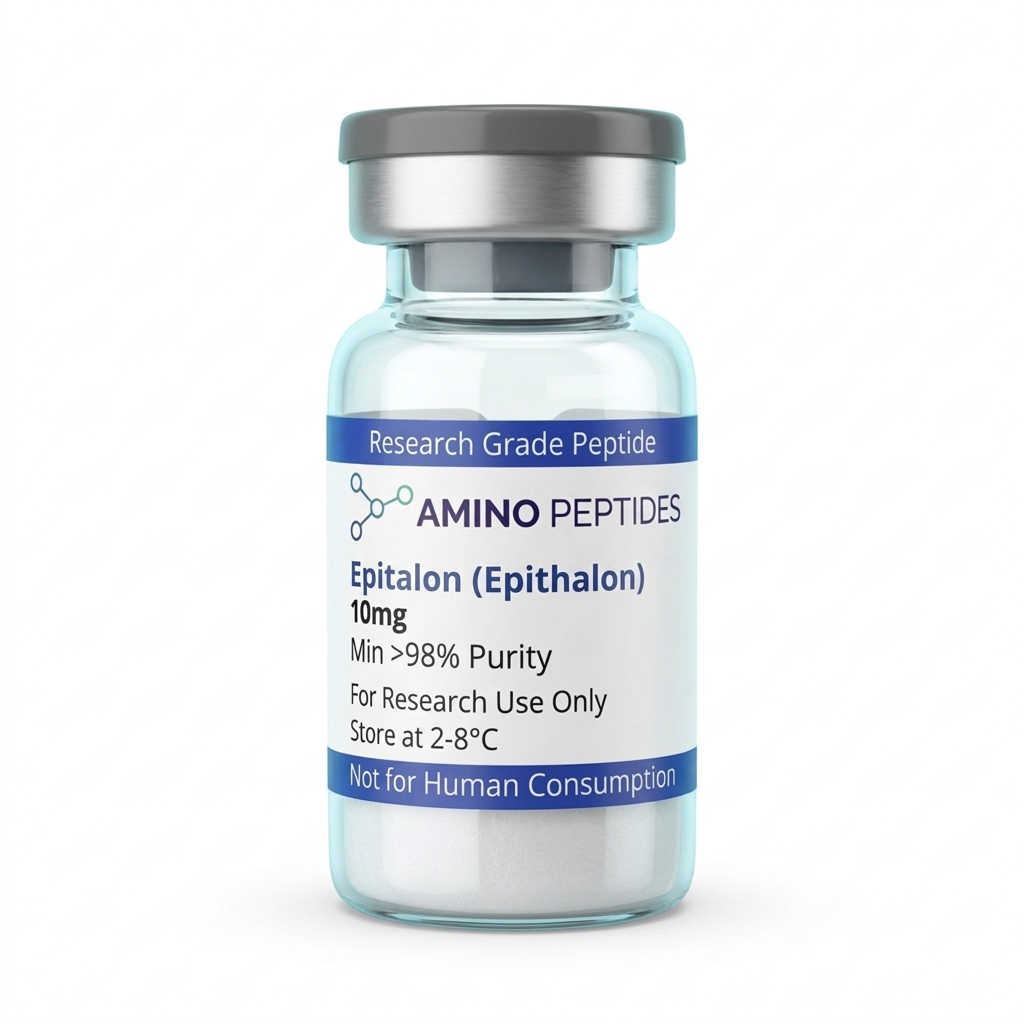
Epitalon
From £19
Supplied as a sealed freeze-dried vial (stable 12–24 months at 2°C–8°C in a standard refrigerator).
Shop Epitalon →Rather than functioning merely as a direct chemical radical scavenger, Epitalon operates primarily through epigenetic and transcriptional modulation. Biochemical assays demonstrate that Epitalon interacts with specific promoter regions of DNA, encouraging the transcription of primary antioxidant enzyme systems. Key enzymatic targets identified in laboratory studies include:
- Cu/Zn-Superoxide Dismutase (SOD1): Catalyses the dismutation of superoxide anions into oxygen and hydrogen peroxide within the cytoplasm.
- Mn-Superoxide Dismutase (SOD2): Provides critical defense within the mitochondrial matrix against electron transport chain ROS generation.
- Glutathione Peroxidase (GPx): Converts hydrogen peroxide and lipid hydroperoxides into water and harmless alcohols, preserving cellular redox balance.
- Catalase (CAT): Accelerates the breakdown of high-concentration H2O2 surges into water and molecular oxygen.
By augmenting the endogenous production of these protective enzymes, Epitalon prepares cultured cells to resist acute oxidative insults, preventing the accumulation of cytotoxic lipid peroxides and preserving structural integrity.
Mitochondrial Membrane Stabilization and Caspase Suppression
The primary target during H2O2-induced cell death is the mitochondrion. Excessive intracellular ROS leads to the collapse of the mitochondrial membrane potential (ΔΨm), opening the mitochondrial permeability transition pore (mPTP) and releasing pro-apoptotic proteins such as cytochrome c into the cytosol. Once in the cytosol, cytochrome c interacts with Apaf-1 to form the apoptosome, initiating a cleavage cascade through pro-caspase-9 and downstream executioner pro-caspase-3.
In vitro flow cytometry studies using JC-1 dye show that cell cultures pre-incubated with Epitalon maintain a higher ΔΨm following H2O2 exposure compared to unexposed control groups. This preservation of mitochondrial membrane integrity limits cytochrome c efflux into the cytoplasm. Consequently, western blot analyses reveal a proportional decrease in active, cleaved caspase-3 and caspase-9 proteins. Similar cytoprotective pathways have been examined across various laboratory peptides, including tissue-protective compounds like the BPC-157 reagent, illustrating the importance of cellular stability under chemical stress.
Additionally, Epitalon influences the ratio of Bcl-2 family proteins. The anti-apoptotic protein Bcl-2 acts to stabilize mitochondrial outer membranes, whereas the pro-apoptotic protein Bax promotes membrane permeabilisation. Exposure to H2O2 normally reduces Bcl-2 while escalating Bax expression. In vitro experiments demonstrate that Epitalon counteracts this shift, restoring a favourable Bcl-2/Bax balance that suppresses apoptotic signals.
Reconstitution calculator
Choose a vial mass and a bacteriostatic reconstitution solution volume. The figure is the resulting concentration.
Concentration: 2.50 mg/mL
Per 0.01mL (10µL): 25.0 mcg
Open the full calculatorBacteriostatic reconstitution solutionIn Vitro Research Protocols and Experimental FAQ
To assist laboratory investigators planning research into peptide-mediated cytoprotection, the following technical queries address common considerations in cellular models:
1. What does epitalon peptide science show regarding cellular longevity in vitro?
In vitro science indicates that Epitalon activates telomerase transcription in somatic cells, leading to telomere elongation and extended proliferative capacity. In stress models, it reduces baseline genomic instability caused by oxidative agents like H2O2.

2. How is an epitalon peptide protocol designed for cell culture assays?
Standard in vitro assay protocols involve preparing stock solutions of Epitalon dissolved in sterile bacteriostatic reconstitution solution. Cells are pre-incubated with concentrations ranging from 0.1 nM to 100 nM for 24 to 48 hours prior to adding toxic concentrations of H2O2 (typically 100 μM to 500 μM for 2 to 6 hours).
3. How does epitalon peptide cancer research evaluate neoplastic cell responses in vitro?
In vitro oncology studies investigate how Epitalon affects transformed cell lines compared to non-transformed somatic cells. Research focuses on whether Epitalon alters apoptotic thresholds, chromatin architecture, or telomerase expression differently depending on the cell line's malignant status.
4. What data exists regarding epitalon safety and toxicity in laboratory assays?
Toxicity assays using MTT, LDH release, and trypan blue exclusion demonstrate that Epitalon exhibits extremely low cytotoxicity across a wide range of concentrations (up to micromolar levels). Cell cultures display normal morphology and proliferation rates in the absence of exogenous oxidative toxins.
Conclusion
In summary, Epitalon exerts strong cytoprotective effects in cell culture models subjected to H2O2-induced oxidative stress. Through the dual mechanisms of endogenous antioxidant enzyme upregulation and mitochondrial membrane preservation, Epitalon effectively halts apoptotic cascades, reduces ROS accumulation, and preserves genomic stability in vitro.
References
- Khavinson VKh, et al. Epithalon induces telomerase activity and telomere elongation in human somatic cells. Bull Exp Biol Med. 2003. View published research
- Anisimov VN, et al. Effect of Epitalon on biomarkers of aging, life span and spontaneous tumor incidence in mice. Biogerontology. 2003. View published research
- Khavinson VKh, et al. Peptidergic regulation of gene expression and protein synthesis in cellular aging. Geronto-geriatrics. 2020. View published research
- Sibarov DA, et al. Epitalon reduces glutamate-induced intracellular calcium toxicity in cultured rat cortical neurons. Neurosci Behav Physiol. 2007. View published research
- Khavinson VKh, et al. Synthetic tetrapeptide epitalon restores melatonin secretion in senescent monkeys. Neuro Endocrinol Lett. 2002. View published research
- Kozina LS, et al. The effect of short peptides on the activity of antioxidant enzymes in cell culture. Bull Exp Biol Med. 2008. View published research
- Khavinson VKh, et al. Short synthetic peptides regulate gene expression in human cell cultures. First Break Med Sci. 2014. View published research
⚠️ Research Use Only Disclaimer: All peptides and compounds are sold strictly for in-vitro laboratory research purposes only. Not intended for human or veterinary use, not a dietary supplement, and not approved to diagnose, treat, cure, or prevent any disease or condition. For use by qualified researchers in suitably equipped laboratory environments only. Amino Peptides Ltd operates in full compliance with UK MHRA regulations and applicable EU research chemical guidelines.