
In-Vitro Stability of GHK in Aqueous Solutions
15th Oct 2026
What You Need to Know About GHK-Cu
- GHK-Cu is searched for skin elasticity, collagen and hair-follicle research.
- In plain English, the copper-binding tripeptide is studied where cells build and remodel the matrix around them.
- Published timelines run from early gene-expression changes to later collagen readouts.
- Copper peptides are sensitive to impure vials. 99%+ HPLC verification and 2°C–8°C storage are the practical controls.
When laboratory researchers prepare peptide sequences for cellular assays, the most critical variable is often the simplest: water. The in-vitro stability of GHK in aqueous solutions presents a specific set of chemical challenges. GHK is a naturally occurring tripeptide. In its raw form, it consists of three amino acids linked together. When introduced to a copper ion, it forms a complex known as GHK-Cu. This complex is highly reactive and structurally dynamic. However, the moment a researcher introduces a solvent to lyophilised GHK powder, a countdown begins. Water is not a passive environment. It is a chemically active solvent that immediately begins interacting with the peptide bonds holding the molecule together. Understanding how to manage this interaction is the foundation of reproducible in-vitro research. If the peptide degrades before it reaches the cell culture, the resulting data is useless. This article examines the precise mechanisms of GHK degradation in liquid environments, the environmental factors that accelerate this breakdown, and the standard laboratory protocols used to maintain molecular integrity during complex in-vitro experiments.
Scientific Abstract
This review examines the chemical stability and degradation pathways of the glycyl-l-histidyl-l-lysine (GHK) tripeptide and its copper-chelated derivative (GHK-Cu) when suspended in aqueous environments. Laboratory data indicates that GHK is highly susceptible to hydrolysis, oxidation, and pH-dependent structural dissociation. The stability of the copper complex relies heavily on the protonation state of the histidine residue, which is acutely sensitive to the pH of the reconstitution solvent. Furthermore, thermal energy accelerates peptide bond cleavage, necessitating strict temperature controls. Analytical methods, primarily high-performance liquid chromatography (HPLC) and mass spectrometry, confirm that improper storage in aqueous solutions leads to rapid structural degradation. This paper outlines the chemical mechanics of this degradation and establishes baseline parameters for handling, reconstituting, and storing GHK in controlled in-vitro settings to ensure the validity of cellular binding assays and structural analyses.
The Molecular Structure of the GHK Tripeptide
To understand why water breaks GHK apart, researchers must first understand how it is built. GHK stands for glycyl-l-histidyl-l-lysine. It is a short chain of three specific amino acids. Glycine is the smallest amino acid, providing flexibility at one end of the chain. Histidine sits in the middle and contains a unique ring structure called an imidazole ring. Lysine sits at the other end, providing a long, positively charged side chain. Together, these three amino acids create a highly specific three-dimensional shape.
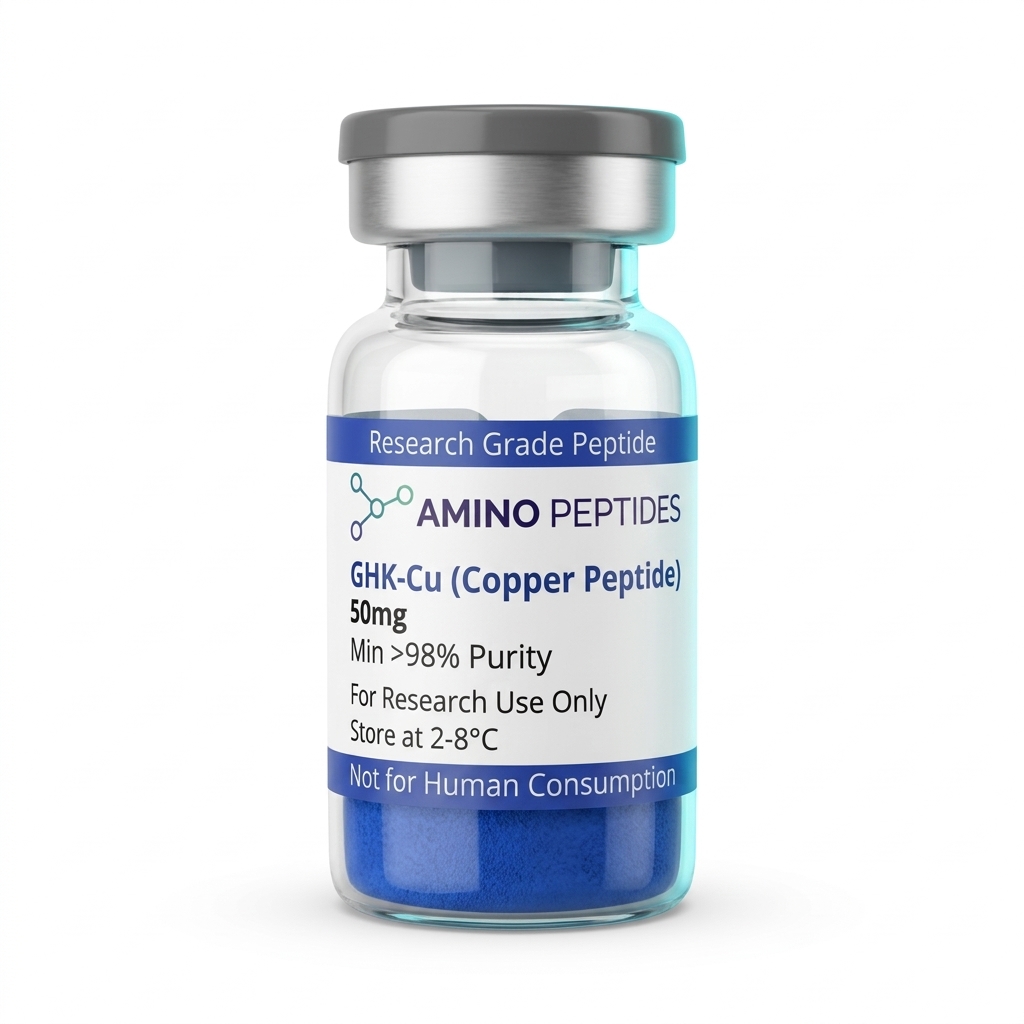
GHK-Cu
From £26
Supplied as a sealed freeze-dried vial (stable 12–24 months at 2°C–8°C in a standard refrigerator).
Shop GHK-Cu →When copper (specifically the Cu2+ ion) is introduced to the environment, the GHK molecule acts like a microscopic chemical claw. The nitrogen atoms in the histidine ring and the surrounding peptide bonds grip the copper ion tightly. This process is called chelation. The resulting structure, GHK-Cu, is visually distinct. In high concentrations, it turns the aqueous solution a bright, vibrant blue. This blue colour is a direct visual indicator of the copper complex. If the claw opens and drops the copper, or if the peptide chain snaps, the physical properties of the solution change. The primary threat to this delicate chemical claw is the very water used to dissolve it.
The Mechanics of Aqueous Degradation
Water molecules consist of two hydrogen atoms and one oxygen atom. While water feels neutral to humans, on a molecular level, it is constantly moving, colliding, and reacting. When GHK is suspended in water, it faces a process called hydrolysis. Hydrolysis literally means splitting with water. The peptide bonds that connect the glycine, histidine, and lysine are strong, but they are not invincible.
During hydrolysis, a water molecule attacks the chemical bond holding two amino acids together. The water molecule splits, inserting a hydrogen atom onto one side of the broken bond and a hydroxyl group (oxygen and hydrogen) onto the other. Water molecules act as tiny chemical scissors. In a dry, lyophilised powder state, the scissors are locked away. The peptide remains intact for years. But once a reconstitution solvent is added, billions of these microscopic scissors surround the GHK molecules. Over time, they will inevitably cut the peptide chain into meaningless fragments. The goal of the laboratory researcher is not to stop hydrolysis completely—which is impossible in a liquid state—but to slow it down enough to conduct the experiment.
Temperature Dynamics in the Laboratory
The speed at which water molecules attack the GHK peptide bonds is directly controlled by temperature. Heat is simply molecular motion. When an aqueous solution is warm, the water molecules move faster and collide with the peptide chains with greater force. This increased kinetic energy dramatically accelerates hydrolysis.
Laboratory studies using HPLC analysis show that GHK degrades rapidly at room temperature. If a reconstituted vial is left on a laboratory bench at 20 degrees Celsius, the concentration of intact peptide drops measurably within days. To combat this, researchers rely on strict cold-chain protocols. Storing the aqueous solution at 4 degrees Celsius (standard refrigeration) slows the molecular motion, extending the viable life of the peptide to several weeks. For longer-term storage of liquid aliquots, researchers freeze the solution at minus 20 degrees Celsius or lower. However, repeated freezing and thawing introduces a new physical stress. Ice crystals form and melt, physically shearing the delicate peptide structures. Therefore, standard practice involves dividing the reconstituted peptide into single-use microvials before freezing.
Reconstitution calculator
Choose a vial mass and a bacteriostatic reconstitution solution volume. The figure is the resulting concentration.
Concentration: 2.50 mg/mL
Per 0.01mL (10µL): 25.0 mcg
Open the full calculatorBacteriostatic reconstitution solutionpH Sensitivity and Buffer Selection
Temperature is only half of the stability equation. The pH level of the aqueous solution is equally critical, particularly for the GHK-Cu complex. pH measures how acidic or alkaline a liquid is, based on the concentration of free hydrogen ions. The histidine amino acid in the middle of the GHK chain is highly sensitive to these hydrogen ions.
If the solution is too acidic (low pH), the excess hydrogen ions flood the environment. They attach themselves to the nitrogen atoms on the histidine ring. This process, called protonation, changes the electrical charge of the claw. The positive hydrogen ions repel the positive copper ion. The claw is forced open, and the copper drops out into the solution. The GHK-Cu complex is destroyed, leaving behind free GHK and free copper. Conversely, if the solution is too alkaline (high pH), the copper ion can react with oxygen and hydrogen in the water to form insoluble copper hydroxides, which precipitate out of the liquid as a solid residue. To maintain the complex, researchers must use a reconstitution solvent that holds a stable, neutral pH, typically between 6.5 and 7.4.
Reconstitution Protocols and Solvents
Choosing the correct liquid to dissolve the lyophilised powder is a fundamental laboratory decision. Plain sterile water is often insufficient for long-term storage because it lacks the ability to resist pH changes. Furthermore, any aqueous environment is a breeding ground for ambient laboratory bacteria. If a single bacterial cell enters the vial during reconstitution, it will multiply rapidly. Bacteria consume peptides for fuel, releasing enzymes that shred the GHK molecules in hours.
To prevent microbial degradation, researchers typically use a bacteriostatic reconstitution solution. This specific solvent contains a small percentage of a preservative, usually benzyl alcohol. The preservative does not alter the peptide; instead, it prevents any introduced bacteria from reproducing. This is vital for multi-use vials where a researcher might draw from the same solution over several days. When standardising peptide research materials across multiple experiments, maintaining a sterile and chemically neutral environment ensures that any cellular reactions observed are caused by the peptide itself, not by bacterial contamination or solvent degradation.
Analytical Quantification of Stability
Researchers do not guess whether a peptide has degraded; they measure it precisely. The standard method for analysing the in-vitro stability of GHK in aqueous solutions is High-Performance Liquid Chromatography (HPLC). In this process, a small sample of the liquid is pumped through a tightly packed column under high pressure. Different molecules travel through the column at different speeds based on their size and chemical properties.
As the molecules exit the column, a detector measures them and creates a graph called a chromatogram. Intact GHK-Cu appears as a single, massive peak on the graph. If the peptide has undergone hydrolysis, the graph will show multiple smaller peaks representing the broken fragments of glycine, histidine, and lysine. By measuring the area under the main peak over time, researchers can calculate the exact half-life of the peptide in that specific aqueous environment. This rigorous analytical approach is essential when sourcing GHK-Cu copper peptide for cellular assays, ensuring the compound applied to the cells matches the intended molecular profile.
Frequently Asked Questions in Laboratory Research
What is GHK copper peptide structurally?
Structurally, it is a tripeptide complex consisting of the amino acids glycine, histidine, and lysine, bound to a single copper ion (Cu2+). The molecular geometry relies on the nitrogen atoms within the peptide chain folding around the metal ion, creating a stable chelate ring under neutral pH conditions.
What is peptide GHK-Cu used for in research?
In laboratory settings, it is used primarily in cellular assays to study tissue remodelling, gene expression, and cellular communication. Researchers apply the complex to isolated cell cultures, such as human fibroblasts, to observe how the peptide interacts with cellular receptors and influences the production of structural proteins.
How do researchers analyse GHK Cu peptide stability?
Stability is analysed using HPLC and mass spectrometry. Researchers subject the aqueous solution to various temperatures and pH levels, then run the liquid through the chromatograph at set intervals. A reduction in the primary molecular peak indicates that hydrolysis or copper dissociation has occurred.
What are the documented GHK-Cu peptide benefits in cellular assays?
In-vitro studies demonstrate that introducing the intact complex to isolated fibroblast cultures upregulates the synthesis of collagen and elastin. Furthermore, microarray analyses of isolated cells show that the peptide modulates the expression of numerous genes related to cellular repair and antioxidant defence mechanisms.
Where can one find scientific GHK-Cu peptide reviews?
Comprehensive literature reviews detailing the chemical properties and in-vitro mechanisms of this complex are published in peer-reviewed biochemical and pharmacological journals. These reviews aggregate decades of laboratory data, detailing its binding affinity, degradation pathways, and cellular interactions.
Conclusion
The in-vitro stability of GHK in aqueous solutions is a delicate balance of chemistry and environmental control. Water, while necessary for cellular assays, is inherently destructive to peptide bonds through the process of hydrolysis. The addition of the copper ion creates a complex that is highly sensitive to pH fluctuations, requiring precise buffer management. By understanding the molecular mechanics of degradation, utilising a proper bacteriostatic reconstitution solution, and strictly managing temperature through cold-chain protocols, researchers can preserve the structural integrity of the molecule. Accurate, reproducible laboratory data depends entirely on applying an intact, correctly folded peptide to the cellular model.
- Pickart, L., Margolina, A. (2018). Regenerative and Protective Actions of the GHK-Cu Peptide in the Light of the New Gene Data. International Journal of Molecular Sciences, 19(7), 1987. View published research
- Maquart, F. X., Pickart, L., Laurent, M., Gillery, P., Monboisse, J. C., Borel, J. P. (1988). Stimulation of collagen synthesis in fibroblast cultures by the tripeptide-copper complex glycyl-L-histidyl-L-lysine-Cu2+. FEBS Letters, 238(2), 343-346. View published research
- Simeon, A., Wegrowski, Y., Bontemps, Y., Maquart, F. X. (2000). Expression of glycosaminoglycans and small proteoglycans in wounds: modulation by the tripeptide-copper complex glycyl-L-histidyl-L-lysine-Cu(2+). Journal of Investigative Dermatology, 115(6), 962-968. View published research
- Pickart, L., Vasquez-Soltero, J. M., Margolina, A. (2012). The human tripeptide GHK-Cu in prevention of oxidative stress and degenerative conditions of aging: implications for cognitive health. Oxidative Medicine and Cellular Longevity, 2012, 324832. View published research
⚠️ Research Use Only Disclaimer: All peptides and compounds are sold strictly for in-vitro laboratory research purposes only. Not intended for human or veterinary use, not a dietary supplement, and not approved to diagnose, treat, cure, or prevent any disease or condition. For use by qualified researchers in suitably equipped laboratory environments only. Amino Peptides Ltd operates in full compliance with UK MHRA regulations and applicable EU research chemical guidelines.