
Joe Rogan Peptide Stack for Anti-Aging and Recovery: Fact vs. Fiction
14th Sep 2026

What You Need to Know About BPC-157 & TB-500
- The stack is widely discussed for tendon recovery and everyday tissue support.
- BPC-157 is studied in fibroblast and tendon-cell assays. TB-500 is studied along actin pathways.
- Published timelines separate an early signalling window from later structural changes in the model.
- Vial purity and 2°C–8°C storage decide whether a laboratory can reproduce those observations.
Podcast Claims Meet Laboratory Bench Data
Podcast discussions about the Joe Rogan Peptide Stack for Anti-Aging and Recovery: Fact vs. Fiction usually centre on four specific laboratory compounds: BPC-157, TB-500, Ipamorelin, and CJC-1295. In published studies, these short amino acid chains act as targeted cellular messengers that switch on tissue repair, blood vessel growth, and natural growth hormone signalling in preclinical models.
When listeners hear long-form conversations about physical recovery and cellular longevity, it is easy to assume these molecules work like an instant reset button. Laboratory observations tell a much more grounded story. Peptides are simply short chains of amino acids linked together in a specific sequence. Instead of forcing a cell to do something unnatural, they fit into microscopic surface receptors like a physical key sliding into a lock. Once that lock turns, the cell begins its own routine maintenance programme.
Take BPC-157, a fifteen-amino-acid fragment originally isolated from gastric proteins. In laboratory models of tendon and ligament strain, BPC-157 increases the expression of growth hormone receptors on fibroblasts, which are the builder cells responsible for laying down fresh collagen. At the same time, it nudges endothelial cells to release nitric oxide, widening tiny capillaries so oxygen and nutrients can reach damaged zones faster. It does not build new tissue out of thin air; it simply tells local builder cells to wake up and get to work.
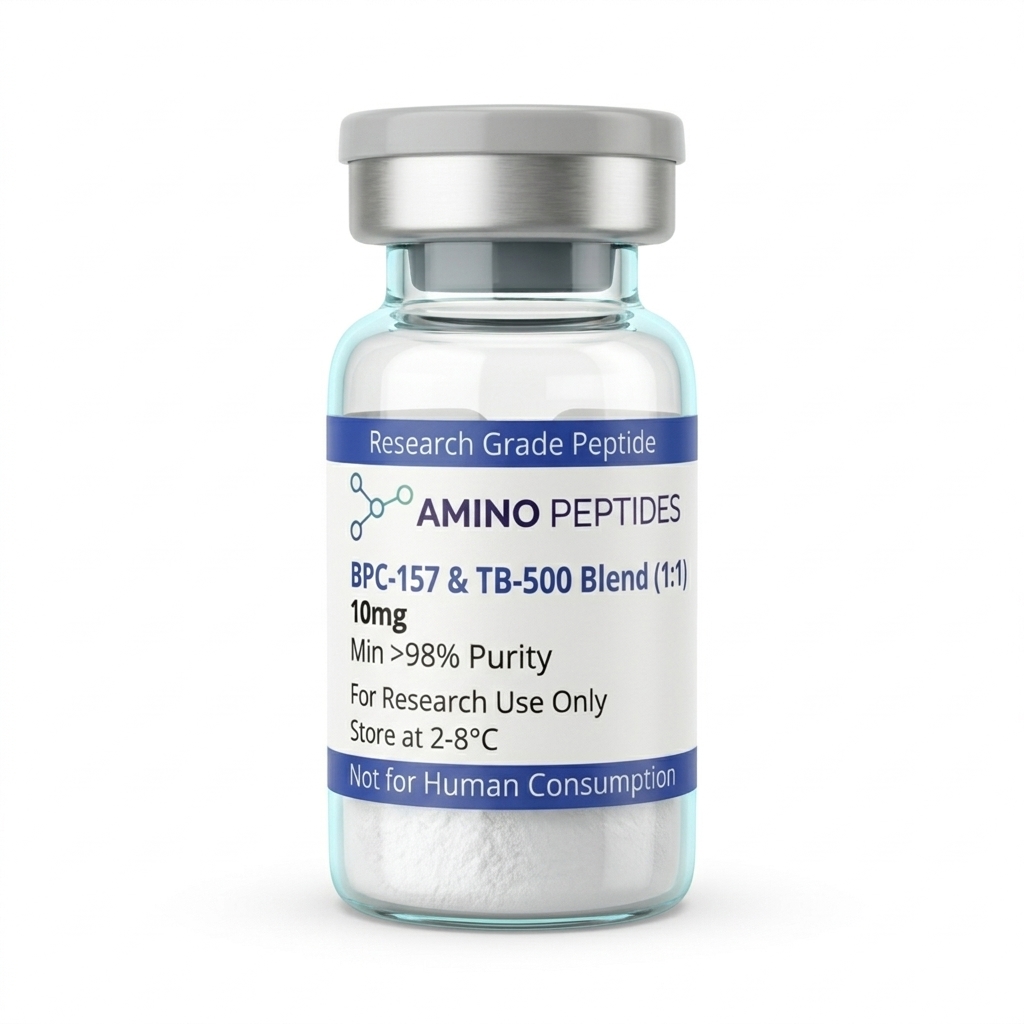
BPC-157 & TB-500 Blend
From £45
Supplied as a sealed freeze-dried vial (stable 12–24 months at 2°C–8°C in a standard refrigerator).
Shop BPC-157 & TB-500 Blend →The longevity side of the podcast conversation typically points toward CJC-1295 and Ipamorelin. In preclinical models, this pair targets the pituitary gland through two separate receptor sites to encourage a steady, wave-like pulse of endogenous growth hormone. Published studies show that maintaining these natural rhythms supports cellular energy, deeper slow-wave sleep patterns, and collagen synthesis in ageing skin models. Separating fact from fiction means recognising that every single one of these observations comes from controlled laboratory models where study amounts and receptor responses can be measured down to the nanogram.
Early Cellular Signals Versus Structural Tissue Remodelling
One of the biggest myths surrounding podcast-famous molecules is the idea that structural regeneration happens overnight. In reality, published studies show a clear split between early biochemical signalling and later physical tissue remodelling. Cells talk to each other in minutes, but laying down strong, organised collagen fibres takes weeks of steady work.
During the first 24 to 72 hours of a cell culture or rodent experiment, researchers mostly observe chemical traffic. When BPC-157 or TB-500 is introduced at a specific study amount, intracellular pathways like the FAK-paxillin system switch on almost immediately. Within hours, local inflammatory markers begin to quiet down, and nearby repair cells start migrating toward the target site. If you looked under a microscope during this early window, the tissue would not look rebuilt yet, even though the biochemical volume has been turned all the way up.
Between day four and day fourteen, preclinical models begin to show visible structural activity. This is the window where angiogenesis—the sprouting of fresh capillary networks—becomes measurable. With better blood flow established, fibroblasts start spinning out raw type III collagen to bridge microscopic gaps. In rodent tendon studies, researchers observe improved tensile strength during the second and third weeks as disorganized fibres slowly line up along the direction of physical pull.
For secretagogue pairs like CJC-1295 and Ipamorelin, the timeline in laboratory models follows an even longer arc. While a pulse of growth hormone signalling can be measured in blood samples within thirty minutes of receptor binding, downstream shifts in IGF-1 levels, cellular energy output, and skin elasticity markers develop gradually over four to eight weeks—meaning four to eight weeks of consistent protocol ratios. Understanding this gap between instant receptor binding and slow structural assembly keeps expectations anchored in real biology rather than podcast folklore.
Reconstitution calculator
Choose a vial mass and a bacteriostatic reconstitution solution volume. The figure is the resulting concentration.
Concentration: 2.50 mg/mL
Per 0.01mL (10µL): 25.0 mcg
Open the full calculatorBacteriostatic reconstitution solutionBiochemical Profile of Commonly Discussed Stack Compounds
| Compound Name | Amino Acid Length | Primary Signalling Pathway | Observed Preclinical Outcome |
|---|---|---|---|
| BPC-157 | 15 amino acids | VEGFR2 upregulation and nitric oxide synthase modulation | Enhanced angiogenesis and tendon fibroblast migration in rodent models |
| TB-500 (Thymosin Beta-4 fragment) | 43 amino acids (whole protein) or 7-amino-acid active fragment | G-actin sequestration and cytoskeletal organisation | Accelerated dermal and corneal cellular repair in laboratory models |
| Ipamorelin | 5 amino acids | Selective ghrelin/growth hormone secretagogue receptor (GHSR) agonism | Pulsatile growth hormone secretion without appetite or cortisol spikes in swine and rodent models |
| CJC-1295 | 29 amino acids (modified GHRH 1-29) | Growth hormone-releasing hormone receptor activation with albumin binding | Sustained elevation of circulating IGF-1 and growth hormone measured levels in preclinical models |
| GHK-Cu | 3 amino acids bound to a copper ion | Extracellular matrix gene expression and metalloproteinase regulation | Increased collagen and elastin synthesis in cultured dermal fibroblasts |
How Dual-Pathway Peptide Stacks Divide the Workload
Another major question readers ask when researching the Joe Rogan Peptide Stack for Anti-Aging and Recovery: Fact vs. Fiction is why investigators combine multiple peptides instead of testing just one at a higher concentration. In the lab, cells have a strict speed limit on each receptor type. Flooding a single receptor with a massive measured level just causes the cell to pull those receptors inside and stop listening. Combining two complementary compounds allows researchers to trigger two separate pathways at gentle, sustainable protocol ratios.
The most famous example of this teamwork is the pairing of bpc157 and tb500 in structural regeneration models. While BPC-157 focuses on local blood vessel sprouting and fibroblast receptor density, TB-500 (a synthetic piece of Thymosin Beta-4) works on the cell's internal skeleton. TB-500 binds to a protein called actin, which cells use to contract and crawl across microscopic gaps. Together, TB-500 helps repair cells travel to the target zone, while BPC-157 supplies the vascular plumbing and growth signals they need once they arrive.
A similar two-lane approach explains why CJC-1295 and Ipamorelin are almost always studied side by side. CJC-1295 mimics growth hormone-releasing hormone (GHRH), setting the baseline capacity for a pulse, while Ipamorelin mimics ghrelin to pull the actual release trigger—without spiking cortisol or prolactin signals in preclinical models.
Beyond structural and endocrine combinations, laboratory investigators also explore immune-modulating pairs such as KPV and LL-37 to see how surface defense peptides calm excess cytokine noise while structural fragments handle the physical rebuilding. Each molecule stays in its own biochemical lane, preventing receptor fatigue and producing cleaner data.
Figure: Joe Rogan Peptide Stack for Anti-Aging and Recovery: Fact vs. Fiction
Why Analytical Purity and Cold Storage Rule the Lab
When separating fact from fiction in peptide science, the most overlooked variable is not the amino acid sequence itself, but what else might be hiding inside the glass vial. Every observation published in peer-reviewed journals relies on reagents verified at 99% or higher purity through High-Performance Liquid Chromatography (HPLC) and Mass Spectrometry. If a sample drops below that benchmark, the leftover 3% or 5% is not harmless filler—it is a soup of truncated peptide chains and harsh chemical synthesis byproducts.
During solid-phase synthesis, chemists use Trifluoroacetic Acid (TFA) to cleave finished peptide chains off their resin beads. If a manufacturer skips the secondary ion-exchange step required to strip that acid away, residual TFA salts stay attached to the lyophilised powder. When introduced into cell cultures, excess TFA changes the local pH and damages delicate cell membranes, skewing recovery readouts and ruining the experiment before it even begins. High-grade research vials undergo thorough TFA removal, swapping toxic fluoride salts for clean acetate or chloride counter-ions.
Handling after the vial arrives is just as important for keeping the molecular structure intact. Lyophilised (freeze-dried) peptides are stable for transport, but once mixed with a sterile bacteriostatic reconstitution solution, the fragile hydrogen bonds holding the chain together become vulnerable to heat and light. Shaking a vial creates shear stress that can snap longer chains like CJC-1295; rolling the glass gently between the palms lets the powder dissolve cleanly.
Once reconstituted, storing the vial in a dedicated refrigerator between 2°C and 8°C slows down natural hydrolysis and oxidation. Keeping the focus on verified 99%+ HPLC certificates, clean salt profiles, and strict 2°C–8°C cold storage ensures that laboratory models reflect the true biology of the peptide rather than the side effects of degraded or contaminated glass vials.
Frequently Asked Questions
Why is the Joe Rogan peptide stack searched so heavily?
People search for this topic because podcast conversations popularised amino acid compounds like BPC-157 and TB-500 for tissue recovery and healthy ageing. Curious listeners want to separate celebrity anecdotes from actual data observed in published laboratory studies, checking what science really says about cellular regeneration.
What timeline do published studies observe for these compounds?
Published studies typically observe initial cellular signalling changes within a few days to two weeks in preclinical models. Full tissue remodelling and structural recovery protocols in laboratory settings generally run for four to eight weeks, depending on the specific compound concentration and the biological system analysed.
Why do researchers combine multiple peptides in laboratory stacks?
Researchers combine compounds like BPC-157 and TB-500 in laboratory models to observe complementary biological pathways at the same time. While one molecule may influence local blood vessel formation, another might organise actin proteins, allowing scientists to study how combined protocol ratios affect overall tissue repair.
How do laboratories verify purity and handle fridge storage?
Laboratories verify peptide purity above ninety-eight percent using High-Performance Liquid Chromatography and mass spectrometry before beginning any experiment. Once mixed with a bacteriostatic reconstitution solution, vials are kept in dark fridge storage between two and eight degrees Celsius to prevent fragile amino acid chains from degrading.
Bibliography
- Sikiric P, et al. Brain-gut Axis and Pentadecapeptide BPC 157: Theoretical and Practical Implications. Curr Neuropharmacol. 2016;14(8):857-865. View published research
- Goldstein AL, Hannappel E, Sosne G, Kleinman HK. Thymosin beta4: a multi-functional regenerative peptide. Basic properties and preclinical applications. Expert Opin Biol Ther. 2012;12(1):37-51. View published research
- Raun K, et al. Ipamorelin, the first selective growth hormone secretagogue. Eur J Endocrinol. 1998;139(5):552-561. View published research
- Teichman SL, et al. Prolonged stimulation of growth hormone (GH) and insulin-like growth factor I secretion by CJC-1295, a long-acting analog of GH-releasing hormone, in healthy adults. J Clin Endocrinol Metab. 2006;91(3):799-805. View published research
- Pickart L, Margolina A. Regenerative and Protective Actions of the GHK-Cu Peptide in the Light of the New Gene Data. Int J Mol Sci. 2018;19(7):1987. View published research
⚠️ Research Use Only Disclaimer: All peptides and compounds are sold strictly for in-vitro laboratory research purposes only. Not intended for human or veterinary use, not a dietary supplement, and not approved to diagnose, treat, cure, or prevent any disease or condition. For use by qualified researchers in suitably equipped laboratory environments only. Amino Peptides Ltd operates in full compliance with UK MHRA regulations and applicable EU research chemical guidelines.