
Mitochondrial Exhaustion: Using SS-31 to Mitigate Oxidative Phosphorylation Decay
26th Oct 2026

What You Need to Know About SS-31
- SS-31, also called elamipretide, is a mitochondria-targeted tetrapeptide studied at the inner membrane.
- Published models follow its interaction with cardiolipin and later changes in mitochondrial output.
- It is the third piece of the NAD+ and MOTS-c stack when a laboratory wants the membrane as well as the redox pool.
- A 99%+ HPLC-verified, freeze-dried vial at 2°C–8°C is what makes that three-way comparison repeatable.
Mitochondria are the power plants of the cell. They generate energy through a complex chemical process called oxidative phosphorylation. When isolated cells face extreme environmental stress, this process breaks down. The cellular power plant begins to leak. This phenomenon is known as mitochondrial exhaustion. Laboratory researchers are currently analysing a synthetic peptide known as SS-31 to see if it can halt this structural decay at the molecular level.
Scientific Abstract
SS-31, frequently identified in literature as Elamipretide, is a synthetic tetrapeptide. In controlled laboratory environments, it demonstrates a unique ability to penetrate cell membranes and target the inner mitochondrial membrane directly. Once inside the mitochondria, it binds specifically to cardiolipin, an essential structural lipid. In-vitro data indicates that this electrostatic binding stabilises the membrane architecture. By preserving the shape of the membrane, the peptide prevents the structural collapse that typically triggers oxidative phosphorylation decay and subsequent cellular death.
The Mechanics of Energy Decay
To understand how SS-31 functions in a petri dish, one must first look at how cells produce energy. The inner mitochondrial membrane houses a series of massive protein structures known as the electron transport chain. These complexes pass electrons down a line, much like a bucket brigade. This continuous movement generates adenosine triphosphate (ATP), the primary energy currency of the cell.
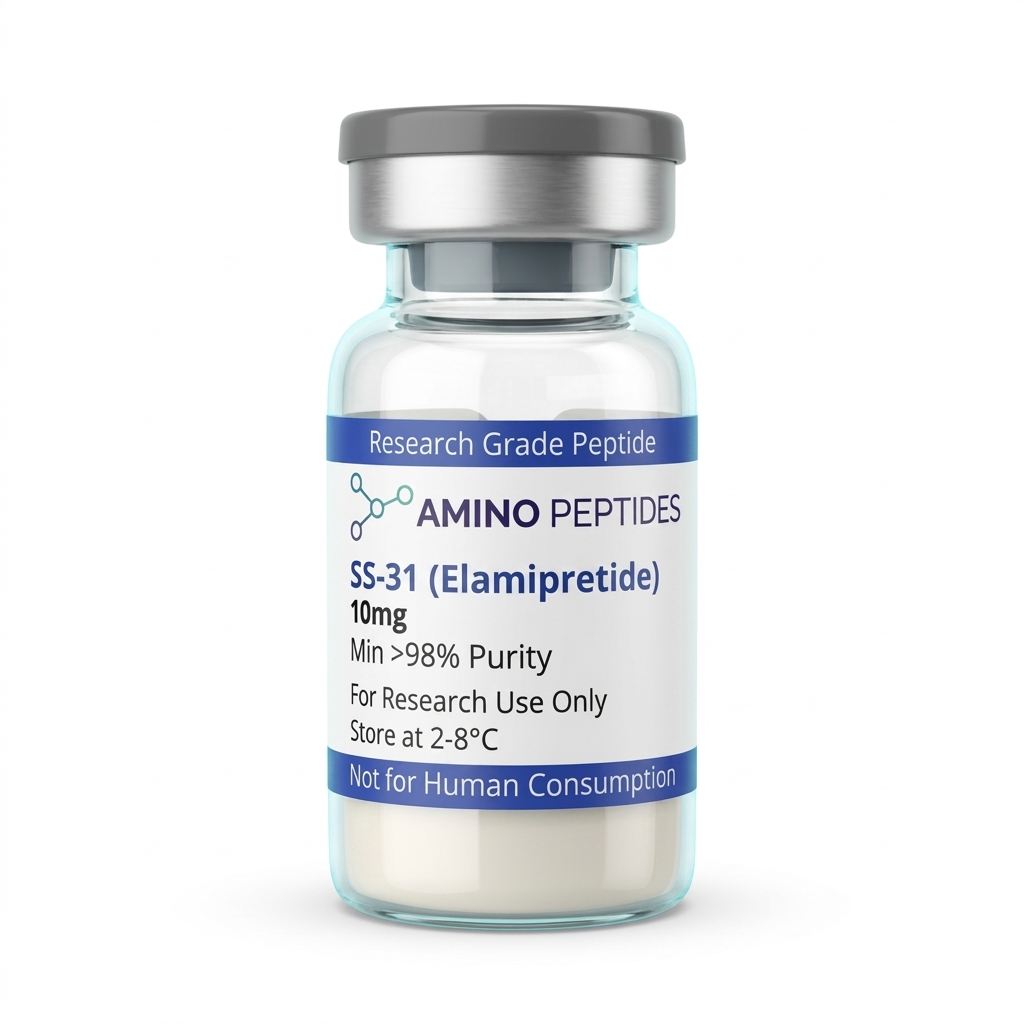
SS-31
From £41
Supplied as a sealed freeze-dried vial (stable 12–24 months at 2°C–8°C in a standard refrigerator).
Shop SS-31 →When a cell is placed under severe oxidative stress, the inner membrane loses its physical shape. The protein complexes drift apart. Instead of passing neatly down the line, electrons leak out into the surrounding cellular fluid. These rogue electrons form reactive oxygen species, commonly known as free radicals. These highly unstable molecules strip electrons from other cellular structures, causing rapid, cascading damage. The cell stops producing ATP, the energy grid fails, and the cell begins to dismantle itself.
The Role of Cardiolipin in Membrane Architecture
Cardiolipin is not a standard cellular fat. It is a highly specialised lipid found almost exclusively in the inner mitochondrial membrane. Its physical shape is unique. It has a conical structure that forces the membrane to fold into tight, microscopic ridges called cristae. These ridges are essential. They create the massive surface area required to house the electron transport chain.
In a healthy isolated cell, cardiolipin acts like a molecular glue. It binds the massive protein complexes of the electron transport chain into tight clusters called supercomplexes. This close proximity is what makes energy transfer efficient. When researchers expose these cells to toxins, the cardiolipin oxidises. It loses its conical shape. The cristae flatten out, the supercomplexes break apart, and the bucket brigade drops the electrons.
SS-31 in the Petri Dish
Standard antioxidants attempt to neutralise free radicals after they have already leaked from the chain. SS-31 operates differently in cellular assays. It does not sweep up the chemical mess; it attempts to fix the structural leak at the source.
SS-31 is a highly basic peptide, meaning it carries a positive electrical charge. Cardiolipin carries a negative charge. In laboratory models, this creates a strong electrostatic attraction. The peptide also contains specific aromatic amino acids that allow it to penetrate the water-repelling core of the lipid. This dual-action binding is what makes the compound unique in cellular research. It does not rely on cellular receptors to enter the mitochondria; its chemical structure drives it directly to the site of membrane failure.
Reconstitution calculator
Choose a vial mass and a bacteriostatic reconstitution solution volume. The figure is the resulting concentration.
Concentration: 2.50 mg/mL
Per 0.01mL (10µL): 25.0 mcg
Open the full calculatorBacteriostatic reconstitution solutionUnder a microscope, researchers observe that this binding acts like a molecular scaffold. It holds the cardiolipin in its correct conical shape, even when the cell is subjected to severe chemical stressors.
The peptide acts as a structural anchor for failing cellular machinery.
Because the membrane remains intact, the electron transport complexes stay close together. The electrons continue down the chain instead of leaking out into the fluid. ATP production remains stable, and the generation of reactive oxygen species drops significantly. This mechanism isolates the exact point of physical failure in mitochondrial exhaustion.
Laboratory Handling and Stability
For researchers conducting these cellular assays, maintaining the structural integrity of the peptide is critical. Laboratories sourcing research-grade SS-31 receive it as a lyophilised powder. To prepare the compound for in-vitro testing, it must be dissolved using a sterile bacteriostatic reconstitution solution. This ensures the delicate peptide bonds do not degrade before they can be introduced to the isolated mitochondria. Proper storage protocols dictate keeping the reconstituted solution at low temperatures to prevent premature molecular breakdown.

Scientific FAQs: In-Vitro Mechanisms
How does SS-31 cross the cell membrane without a transport receptor?
SS-31 is classified as a cell-penetrating peptide. Its alternating sequence of basic and aromatic amino acids allows it to pass directly through the lipid bilayer of the cell membrane. It naturally accumulates in the inner mitochondrial membrane due to the high concentration of negatively charged cardiolipin.
What markers indicate oxidative phosphorylation decay in cellular assays?
Researchers look for two primary markers: a sharp decline in ATP concentration and a rapid spike in reactive oxygen species. They also measure the physical swelling of the mitochondria, which indicates that the inner membrane has lost its folded structure.
Does SS-31 repair oxidised cardiolipin in laboratory models?
In-vitro data suggests SS-31 does not reverse oxidation that has already occurred. Instead, it binds to the cardiolipin to physically stabilise the membrane, preventing further oxidation and allowing the cell's natural maintenance systems to clear the damaged lipids.
Research Bibliography
- Szeto, H. H. (2014). First-in-class cardiolipin-protective compound as a therapeutic agent to restore mitochondrial bioenergetics. British Journal of Pharmacology, 171(8), 2029-2050. View published research
- Birk, A. V., et al. (2013). The mitochondrial-targeted compound SS-31 re-energizes ischemic mitochondria by interacting with cardiolipin. Journal of the American Society of Nephrology, 24(8), 1250-1261. View published research
- Chatzispyrou, I. A., et al. (2015). Cardiolipin in mitochondrial metabolism and dynamics. Biochimica et Biophysica Acta (BBA)-Molecular Cell Research, 1853(10), 2771-2778. View published research
- Kloner, R. A., et al. (2012). New translation of the mitochondrial-targeted peptide SS-31. Cardiovascular Drugs and Therapy, 26(4), 305-313. View published research
- Zhao, K., et al. (2004). Cell-permeable peptide antioxidants targeted to inner mitochondrial membrane inhibit mitochondrial swelling, oxidative cell death, and reperfusion injury. Journal of Biological Chemistry, 279(33), 34682-34690. View published research
- Eirin, A., et al. (2012). Mitochondrial targeted peptides attenuate residual myocardial damage after reversal of experimental renovascular hypertension. Journal of Hypertension, 30(8), 1553-1563. View published research
- Brown, D. A., et al. (2014). Expert consensus document: Mitochondrial function as a therapeutic target in heart failure. Nature Reviews Cardiology, 11(1), 21-33. View published research
⚠️ Research Use Only Disclaimer: All peptides and compounds are sold strictly for in-vitro laboratory research purposes only. Not intended for human or veterinary use, not a dietary supplement, and not approved to diagnose, treat, cure, or prevent any disease or condition. For use by qualified researchers in suitably equipped laboratory environments only. Amino Peptides Ltd operates in full compliance with UK MHRA regulations and applicable EU research chemical guidelines.