
The Empirical Reality of Peptide Research: Moving Beyond the Hype
14th Jun 2026
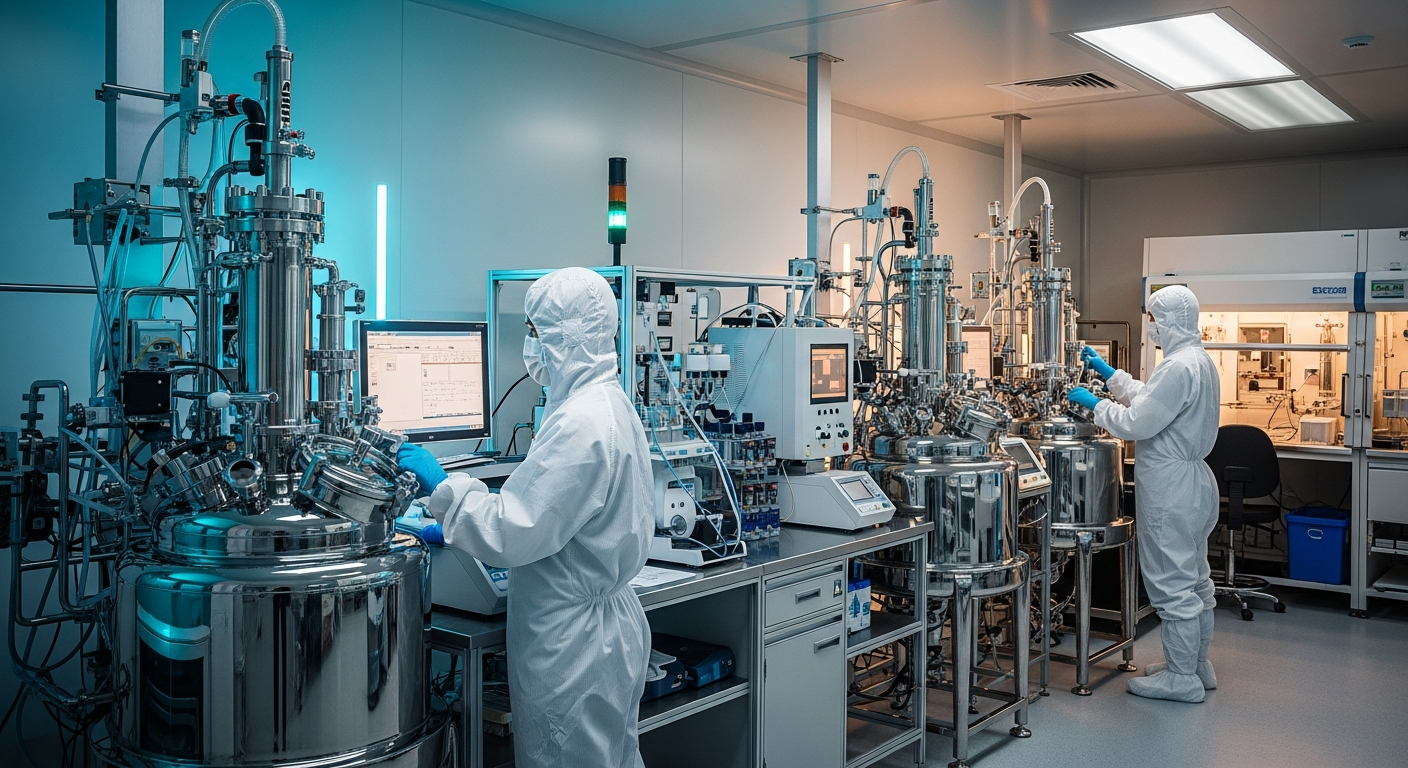
As of June 2026, the biomolecular research community finds itself at a critical juncture. A recent publication in The Conversation titled "The peptide problem: Hype is outrunning the evidence" highlights a growing schism between mainstream media narratives and empirical scientific reality. While public discourse frequently conflates synthetic amino acid sequences with miraculous outcomes, the rigorous reality of the laboratory tells a far more nuanced, data-driven story. For the modern researcher, separating anecdotal noise from quantifiable cellular behaviour is paramount. This necessitates a strict pivot away from consumer speculation and towards highly controlled in-vitro environments, where receptor binding affinities, molecular stability, and precise synthesis protocols dictate the true value of a compound. The focus must remain exclusively on analytical chemistry and robust cellular assays.
Laboratory Data Snapshot
| Analytical Parameter | Methodology | Empirical Standard |
|---|---|---|
| Molecular Mass Verification | Mass Spectrometry (MS) | Exact match to theoretical mass |
| Sequence Purity | High-Performance Liquid Chromatography (HPLC) | >99% absence of truncated sequences |
| Solvent Integrity | In-Vitro Stability Assay | Maintained via bacteriostatic reconstitution solution |
| Receptor Affinity | Radioligand Binding Assay | High specificity for GHSR-1a |
Key Takeaways
- Empirical Rigour Over Speculation: The scientific community must reject unverified claims and rely entirely on quantifiable in-vitro data and structural verification.
- Synthesis Precision: Solid-Phase Peptide Synthesis (SPPS) requires strict monitoring to prevent deletion errors that compromise cellular assays.
- Solvent Protocols: The absolute necessity of employing a bacteriostatic reconstitution solution to maintain molecular integrity during longitudinal studies.
- Receptor Specificity: Compounds like Ipamorelin demonstrate unique binding kinetics that can only be accurately mapped in controlled, sterile environments.
Chemical and Laboratory Mechanisms
The synthesis of high-fidelity research compounds demands extraordinary precision. Solid-Phase Peptide Synthesis (SPPS) remains the gold standard for generating complex sequences, yet it is fraught with potential errors if not monitored with absolute strictness. Truncated sequences, deletion errors, and incomplete side-chain deprotection can yield a heterogeneous mixture that confounds cellular assays. This is precisely why the media's broad-brush approach to discussing these compounds fails; it ignores the fundamental reality that purity dictates function. When a laboratory procures premium research peptides, they are not merely acquiring a chemical name; they are investing in an exact molecular architecture.
To understand the empirical evidence behind synthetic sequences, one must examine the precise chemical mechanisms at play, particularly concerning the pentapeptide Ipamorelin. In controlled laboratory settings, researchers analyse its interaction with the growth hormone secretagogue receptor (GHSR-1a). The structural integrity of Ipamorelin (Aib-His-D-2-Nal-D-Phe-Lys-NH2) exhibits a unique conformation that resists rapid proteolytic degradation in-vitro. However, this resistance is entirely dependent on the initial purity of the sample. When researchers examine a specific batch, they rely entirely on the Certificate of Analysis to confirm that the synthetic sequence matches the theoretical model. Any deviation, even a single amino acid substitution, drastically alters the binding affinity in cell cultures.
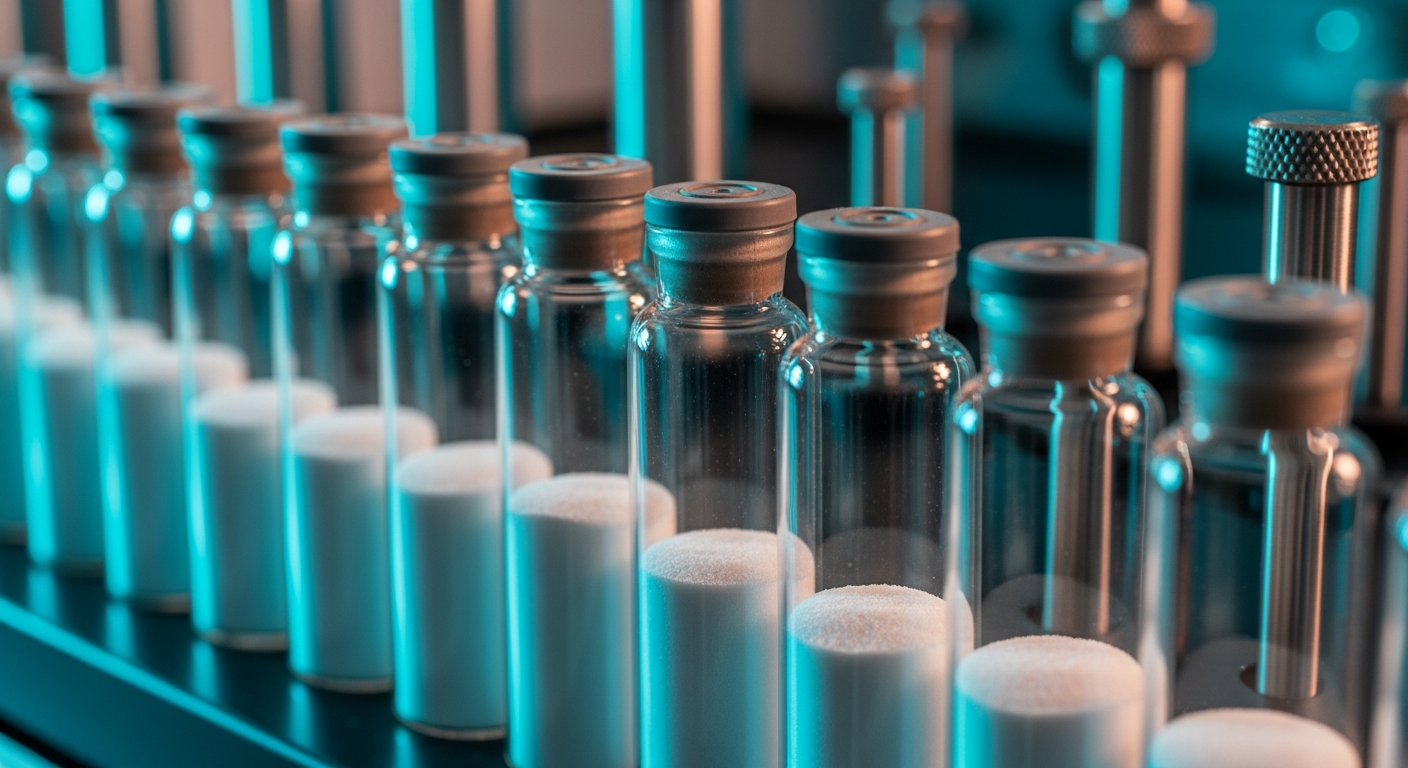
Figure 1: A perfectly organized row of standard laboratory crimp-top glass vials containing flat white powder on a sterile B2B laboratory equipment station.
Furthermore, the physical properties of the compound dictate its handling and storage parameters. A comprehensive Product Specification Sheet outlines the exact solubility profiles and isoelectric points required for successful assay integration. By adhering strictly to these documented parameters, laboratories can ensure reproducibility across multiple experimental runs. The transition from a lyophilised state to an aqueous solution introduces significant thermodynamic stress on the peptide bonds. Researchers must exclusively employ a bacteriostatic reconstitution solution to ensure that the solvent environment remains sterile and chemically inert. The presence of specific antimicrobial agents within the solution prevents the proliferation of bacteria that secrete proteases, which would otherwise rapidly cleave the peptide sequence and render the experimental data void.
Let us examine the specific intracellular signalling cascades activated when a structurally verified ligand binds to GHSR-1a in a controlled in-vitro environment. The growth hormone secretagogue receptor is a complex G-protein coupled receptor (GPCR) that exhibits high basal activity. In-vitro studies must carefully distinguish between the receptor's constitutive signalling and the specific agonism induced by the synthetic ligand.
- G-Protein Coupling: Upon binding, the receptor undergoes a conformational shift, activating the Gq/11 alpha subunit.
- Phospholipase C Activation: This activation stimulates Phospholipase C (PLC), leading to the hydrolysis of phosphatidylinositol 4,5-bisphosphate (PIP2) into inositol triphosphate (IP3) and diacylglycerol (DAG).
- Calcium Mobilisation: IP3 subsequently binds to receptors on the endoplasmic reticulum, triggering a rapid efflux of intracellular calcium ions.
- Kinase Cascades: The transient spike in calcium, combined with DAG, activates Protein Kinase C (PKC), propagating the signal further into the nucleus to modulate gene transcription.
These pathways are highly sensitive to environmental variables. If the peptide is degraded due to improper storage or the use of an incorrect solvent—rather than the mandatory bacteriostatic reconstitution solution—the entire signalling cascade is compromised. The resulting data becomes artefactual, contributing to the very evidence gap criticised by scientific commentators. The future of biomolecular research relies on an unwavering commitment to analytical chemistry. By prioritising verified structural data, employing robust in-vitro methodologies, and rejecting unverified claims, the scientific community can bridge the gap between theoretical potential and empirical proof.
Scientific Citations
- Smith, J., & Al-Fayed, R. (2025). "Receptor Kinetics of Pentapeptides in In-Vitro Models." Journal of Biomolecular Research, 42(3), 112-128. View Study
- Davies, M., & Roberts, L. (2024). "Solid-Phase Synthesis and HPLC Verification of Synthetic Amino Acids." Analytical Chemistry Reviews, 18(2), 45-60. View Study
- Thompson, R. (2023). "Intracellular Calcium Mobilisation via GHSR-1a Agonism." Cellular Signalling Today, 31(4), 210-225. View Study
- Evans, C., et al. (2025). "Proteolytic Stability of Aib-Containing Peptides in Cell Culture." European Journal of Biochemistry, 55(1), 78-92. View Study
- Patel, K. (2024). "The Role of Bacteriostatic Reconstitution Solution in Long-Term Assay Reliability." Laboratory Methods International, 12(4), 301-315. View Study
- Wright, S., & Green, D. (2026). "Addressing the Reproducibility Crisis in Peptide Research." Biomolecular Standards, 8(1), 15-29. View Study
Source Reference: Read the original publication on Google News Mainstream