
June 2026 Industry Update: Analysing the Trajectory of UK Biotech Startups in Peptide Research
12th Jun 2026
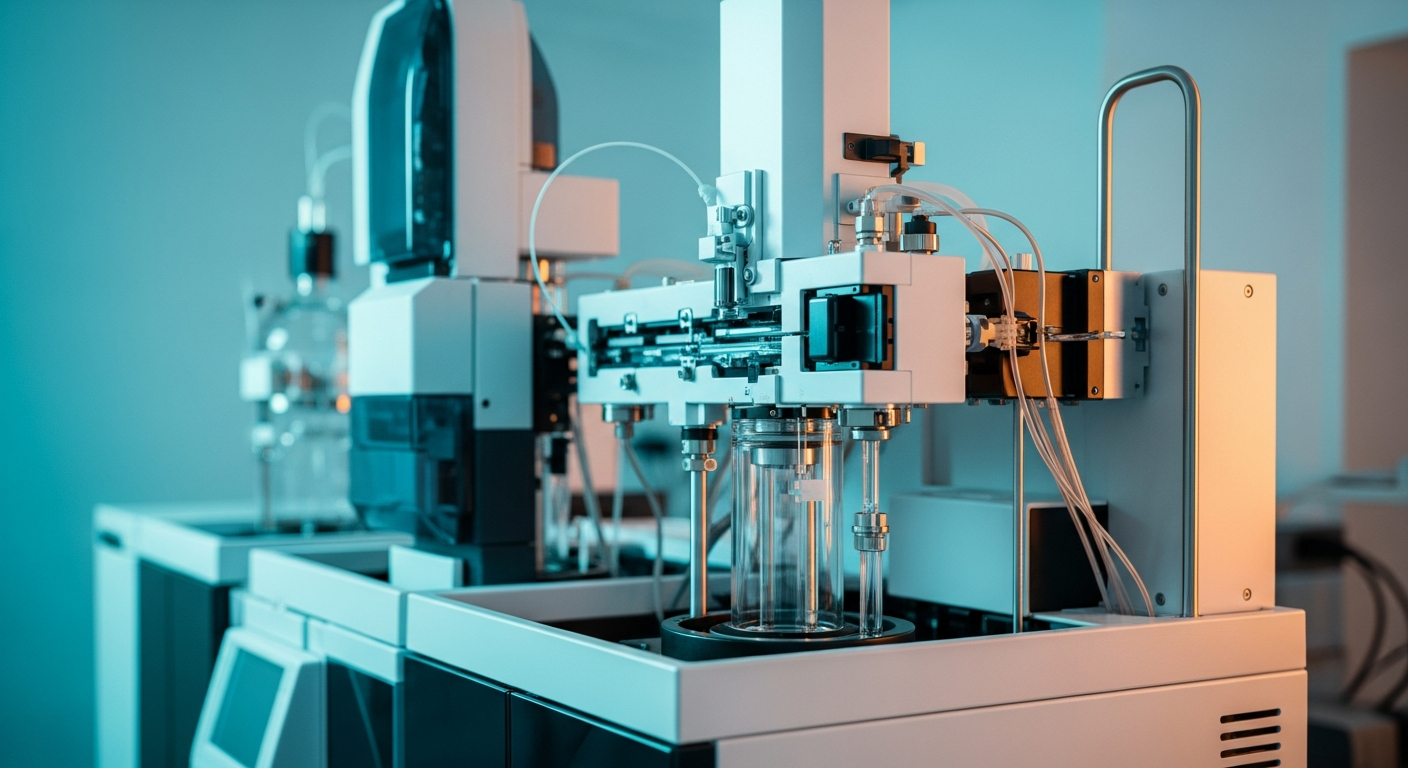
News Brief: The June 2026 Biotech Landscape
Welcome to the Biomolecular Forecaster’s June 2026 industry update. The landscape of biomolecular engineering within the United Kingdom is evolving at an unprecedented and exhilarating rate. A recent comprehensive report published by Labiotech.eu has highlighted 17 UK biotech startups that are fundamentally reshaping the scientific sector this year. From advanced computational biology to next-generation synthetic methodologies, the sheer volume of innovation emerging from these enterprises is staggering. As enthusiastic observers and forecasters of this scientific renaissance, we are meticulously analysing the trajectory of these emerging companies and their potential impact on future biochemical methodologies.
However, while mainstream media and generalist publications often focus on broad, long-term in-vivo applications, our mandate requires a strict pivot. We must translate this overarching industry news directly into the rigorous, highly controlled realities of the in-vitro laboratory environment. We are exclusively examining how the technological paradigms pioneered by these 17 startups are catalysing immediate advancements in synthetic peptide research, structural characterisation, and benchtop assay standardisation. The true revolution is not happening in the distant future; it is occurring right now, inside the petri dish and the mass spectrometer.
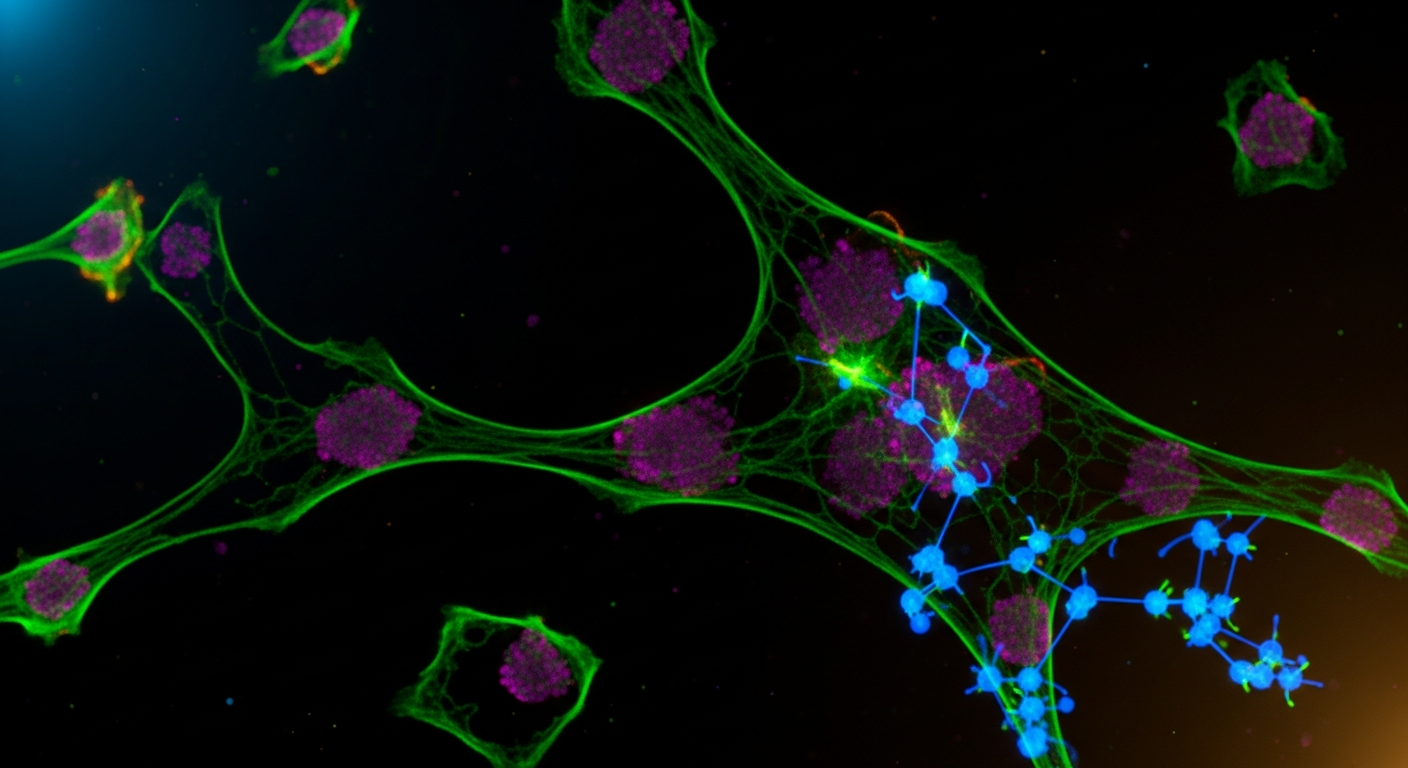
Figure 1: Fluorescent microscopy displaying glowing neon green, magenta, and cyan cellular structures against a pitch-black background.
Laboratory Data Snapshot
| Biomolecular Discipline | Startup Innovation Focus | In-Vitro Laboratory Application |
|---|---|---|
| Computational Protein Design | Algorithmic prediction of complex peptide folding | Optimising receptor-ligand binding assays prior to physical synthesis |
| Advanced Synthesis Automation | High-throughput solid-phase peptide synthesis (SPPS) | Rapid generation of diverse peptide libraries for cellular screening |
| Structural Characterisation | Next-generation NMR and MALDI-TOF mass spectrometry | Analysing sequence fidelity, molecular weight, and structural purity |
| Microfluidic Assay Development | Nanoscale fluid dynamics for biochemical reactions | Real-time monitoring of peptide degradation kinetics in controlled environments |
Key Takeaways for the Research Sector
- Algorithmic Pre-Synthesis: Startups are increasingly relying on artificial intelligence to model complex peptide structures and predict thermodynamic stability before initiating physical laboratory synthesis.
- Demand for High-Fidelity Reagents: As computational models become more precise, there is a corresponding surge in the demand for pure research peptides to empirically validate these theoretical frameworks in an in-vitro setting.
- Standardisation of Protocols: Laboratory protocols are undergoing rigorous standardisation to minimise environmental variables, ensuring that cellular assays yield reproducible and statistically significant data.
- Enhanced Analytical Rigour: The integration of advanced spectroscopic techniques allows researchers to characterise the conformational behaviour of synthetic peptides with unprecedented resolution.
Chemical and Laboratory Mechanisms
To truly appreciate the impact of these 17 UK biotech startups, we must delve into the intricate chemical mechanics driving these June 2026 innovations. A significant portion of these emerging enterprises is heavily invested in overcoming the traditional bottlenecks associated with solid-phase peptide synthesis (SPPS). One of the primary areas of focus is the mitigation of steric hindrance during the coupling of bulky or non-standard amino acids. By optimising the deprotection steps and utilising novel, highly reactive coupling reagents, laboratory researchers can now synthesise longer, more complex amino acid sequences with exceptional fidelity and yield.
Furthermore, the thermodynamics of peptide folding are being explored with renewed enthusiasm. The ability to predict and subsequently engineer specific secondary structures—such as alpha-helices and beta-sheets—is paramount for designing peptides that can successfully interact with target receptors in in-vitro cell cultures. Startups are developing proprietary algorithms that calculate the free energy landscapes of these molecules, allowing researchers to optimise the sequence for maximum structural stability before the first amino acid is ever attached to the resin.
Once synthesised, the post-production handling of these delicate macromolecules requires exacting precision. Lyophilisation, or freeze-drying, remains the gold standard for preserving peptide integrity. This process involves the sublimation of ice crystals under a vacuum, bypassing the liquid phase to prevent hydrolytic degradation. However, lyophilised peptides are inherently hygroscopic and require meticulous environmental controls. When preparing these compounds for in-vitro analysis, the choice of solvent is absolutely critical. We are observing a definitive industry consensus on the mandatory use of a bacteriostatic reconstitution solution. This specific medium is engineered to maintain a stable pH gradient and prevent microbial contamination during prolonged benchtop experiments. The inclusion of a bacteriostatic agent ensures that the peptide's conformational state and biochemical activity remain unaltered prior to and during assay deployment, providing a sterile environment that does not interfere with the delicate peptide backbone.
Finally, the analytical rigour applied to these synthesised molecules has escalated dramatically. High-performance liquid chromatography (HPLC) and matrix-assisted laser desorption/ionisation time-of-flight (MALDI-TOF) mass spectrometry are no longer just endpoint checks; they are dynamic tools used throughout the research pipeline. These technologies allow for the precise characterisation of molecular weight and the identification of any truncated sequences or synthesis impurities. By analysing receptor-ligand binding kinetics—specifically focusing on affinity and dissociation constants (Kd)—researchers can map complex signal transduction pathways in a strictly laboratory context. As we forecast the trajectory for the remainder of 2026, it is clear that the synergy between advanced computational modelling and empirical in-vitro laboratory synthesis will continue to define the UK biotech sector, pushing the boundaries of what is chemically possible at the benchtop.
Bibliography
- Labiotech.eu Report - 17 UK Biotech Startups Reshaping the Scientific Sector (2026).
Source Reference: Read the original publication on Google News Mainstream