
Peter Attia Centenarian Decathlon Peptide Recovery: Fact vs. Fiction
25th Aug 2026
What You Need to Know About BPC-157 & TB-500 Blend
- Longevity enthusiasts frequently search this topic to find out if popular podcast hosts endorse specific research peptides for maintaining physical performance into old age.
- The Centenarian Decathlon framework actually prioritises foundational movement, cardiovascular capacity, and strength training rather than relying on unapproved laboratory compounds.
- In a laboratory setting, these short amino acid chains work by sending signals that tell cells to build new blood vessels and organise structural proteins.
- Published studies in rodent and cell models show faster tendon and muscle tissue remodelling, though robust evidence in people remains largely absent.
How Centenarian Decathlon Goals Collide With Laboratory Recovery Models
The Centenarian Decathlon is a physical training philosophy focused on keeping muscle mass, grip strength, and joint stability intact for your final decade of life, while laboratory peptide research looks strictly at how isolated amino acid chains trigger cellular repair in preclinical models. While podcasts often blend these two worlds together, Peter Attia himself has publicly expressed strong scepticism toward unregulated peptide use due to a lack of long-term human data.
When listeners search for Peter Attia Centenarian Decathlon Peptide Recovery: Fact vs. Fiction, they are usually trying to separate podcast rumours from actual bench science. Attia's framework asks you to pick ten physical tasks you want to perform at age one hundred, like lifting a grandchild or climbing stairs, and train backwards from those targets today. Because heavy resistance training puts stress on ageing tendons and joints, online forums quickly connected his longevity goals with laboratory research on recovery compounds.
In published studies using rodent models, synthetic chains like BPC-157 and TB-500 are analysed for how they support tissue remodelling after mechanical strain. Specifically, BPC-157 is observed to upregulate growth hormone receptors on fibroblasts, which are the basic cells that build collagen. It also encourages angiogenesis, the formation of tiny new blood vessels in areas with poor circulation, such as dense tendon tissue. Meanwhile, TB-500 is studied for its ability to bind to actin, a structural protein inside cells, helping repair cells migrate faster to a site of physical stress. Understanding these laboratory mechanics explains why longevity enthusiasts talk about them, even though Attia emphasises physical training, sleep, and nutrition as the actual foundation of his decathlon.
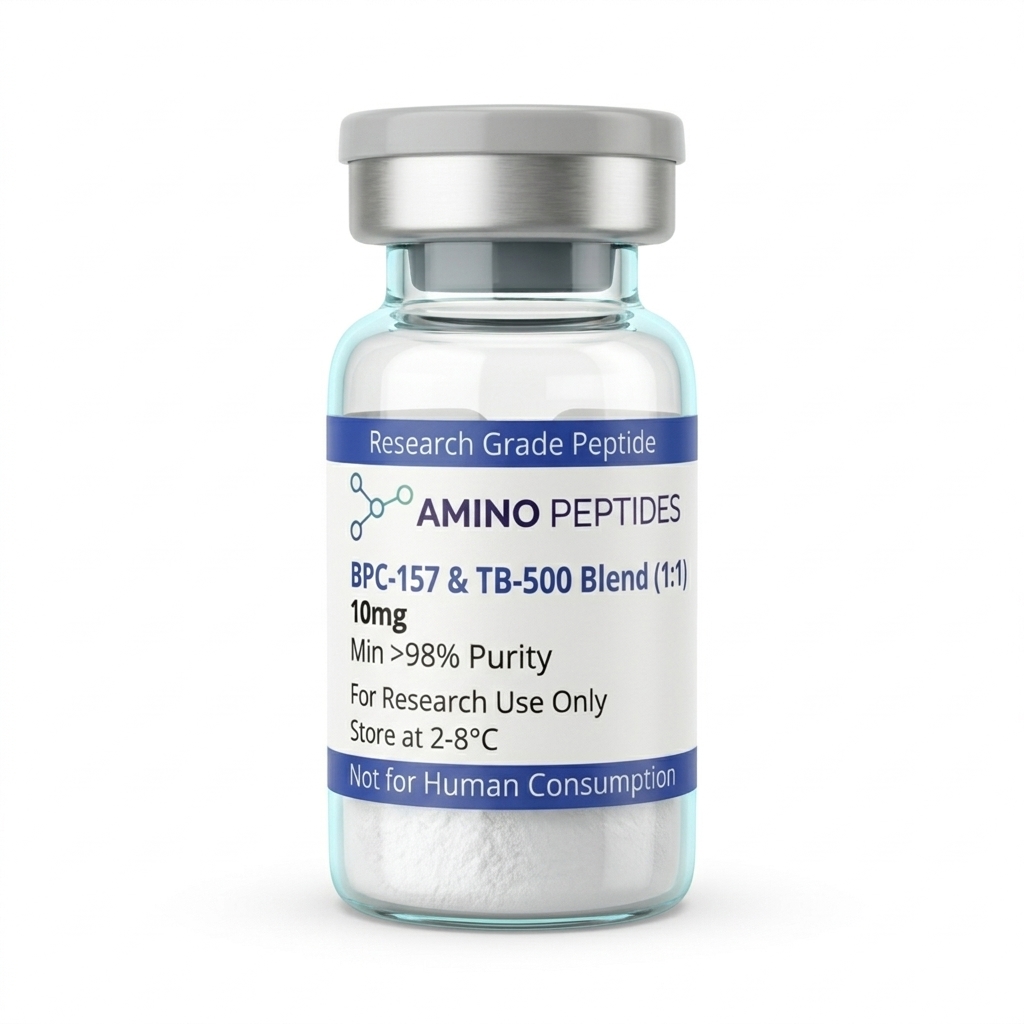
BPC-157 & TB-500 Blend
From £45
Supplied as a sealed freeze-dried vial (stable 12–24 months at 2°C–8°C in a standard refrigerator).
Shop BPC-157 & TB-500 Blend →Early Cellular Signalling Versus Long-Term Structural Tissue Remodelling
If you look at how tissue recovery unfolds in laboratory models, there is a clear split between immediate chemical signalling and slower structural changes. Online discussions often assume that introducing a peptide into a petri dish or an animal model produces instant structural repair, but published studies show a strictly phased timeline that takes weeks to complete.
During the first twenty-four to seventy-two hours of an experiment, researchers observe early signalling events. When a measured level of a peptide like BPC-157 interacts with damaged tissue in preclinical models, the immediate response is chemical rather than physical. Nitric oxide pathways switch on, local blood vessel dilation improves, and inflammatory cytokines begin to settle down. At this early stage, fibroblasts receive the chemical signal to wake up and multiply, and actin proteins start organising so cells can move toward the target area. Nothing is physically stronger yet; the cells are simply gathering their building materials.
True structural remodelling happens much later in the study timeline, typically spanning two to six weeks in rodent tendon and muscle models. During this second phase, the migrated fibroblasts actively lay down new collagen fibres. Initially, this collagen is disorganised and weak, known as type III collagen. Over several weeks, mechanical tension and ongoing cellular signalling help cross-link and align these fibres into stronger, tighter type I collagen bundles. When researchers examine the tissue under a microscope at the four-week mark, they measure improvements in tensile strength and elasticity. Knowing the difference between day-two signalling and week-four collagen alignment helps separate quick-fix myths from the actual pace of biological recovery.
Centenarian Decathlon Peptide Recovery: Popular Claims vs. Published Science
| Research Compound or Concept | Popular Internet Claim | Published Laboratory Observation | Evidence Status |
|---|---|---|---|
| Centenarian Decathlon Framework | Requires exotic research peptides to maintain elite joint and muscle function. | Built entirely on measurable aerobic efficiency, stability, and resistance training metrics. | Established exercise physiology |
| BPC-157 (Pentadecapeptide) | Acts as a miracle shortcut that instantly rebuilds torn ligaments in athletes. | Upregulates growth hormone receptor expression and nitric oxide signalling in rodent tendon fibroblasts. | Preclinical models only |
| TB-500 (Thymosin Beta-4 Fragment) | Permanently reverses age-related muscle loss and systemic joint wear. | Binds to G-actin to promote cell migration and new capillary formation in laboratory models. | Preclinical models only |
| GHK-Cu (Copper Tripeptide-1) | Completely halts connective tissue ageing across the entire body. | Modulates metalloproteinases and collagen synthesis genes in cultured skin and connective tissue cells. | In vitro and topical studies |
| CJC-1295 / Ipamorelin | Safely mimics youth hormone profiles with zero physiological trade-offs. | Stimulates pulsatile growth hormone release from the anterior pituitary in animal studies. | Limited laboratory research |
Complementary Peptide Pairings Studied for Tendon and Muscle Architecture
In laboratory settings, researchers rarely look at a single biological pathway in isolation because tissue regeneration requires several steps happening at once. This is why complimentary combinations, often called stacks in fitness circles, are frequently evaluated together to see how different mechanisms overlap without competing for the same cellular receptors.
The most common pairing examined in connective tissue research is bpc157 and tb500. In preclinical models, these two molecules act like different crews on a construction site. While the fifteen-amino-acid sequence of BPC-157 focuses on building new micro-vessels and turning on local growth factor receptors, TB-500 works directly on the cell's internal skeleton by regulating actin. By pairing a compound that improves blood supply with one that speeds up cell migration, laboratory models show more organised collagen deposition than when either compound is observed alone.
Beyond local tissue chains, investigators also examine how systemic signalling compounds interact with structural repair. Specifically, growth hormone secretagogues such as Ipamorelin and CJC-1295 are studied for how they prompt the pituitary gland in animal models to release natural pulses of somatotropin. When somatotropin levels rise, the liver produces more Insulin-like Growth Factor 1 (IGF-1), which governs whole-body protein synthesis and nitrogen retention. In theory, while local peptides upregulate the number of receptors waiting on a damaged tendon fibroblast, secretagogues increase the systemic supply of growth factors that bind to those very receptors. Studying these distinct classes side by side allows scientists to observe how local cellular migration and broader anabolic signalling support overall tissue architecture.
Figure: Peter Attia Centenarian Decathlon Peptide Recovery: Fact vs. Fiction
Reconstitution calculator
Choose a vial mass and a bacteriostatic reconstitution solution volume. The figure is the resulting concentration.
Concentration: 2.50 mg/mL
Per 0.01mL (10µL): 25.0 mcg
Open the full calculatorBacteriostatic reconstitution solutionWhy 99% HPLC Purity and Cold Storage Dictate Vial Reliability
One major point that Peter Attia frequently raises when discussing peptides is the risk of contaminated or poorly manufactured vials circulating online. In laboratory research, the outcome of any assay depends entirely on whether the vial actually contains the exact amino acid sequence on the label, free from leftover industrial solvents.
During solid-phase peptide synthesis, chemists use a harsh chemical called trifluoroacetic acid (TFA) to cleave the finished peptide chain from its resin bead. If a manufacturer rushes the purification step, residual TFA salts stay trapped in the freeze-dried powder. When that impure powder is mixed with a bacteriostatic reconstitution solution and placed onto living cells in a dish, the acidic TFA damages cell membranes and causes local inflammation. This ruins the experiment and leaves researchers wondering if the reaction came from the peptide or the toxic acid left behind. High-grade research facilities rely on High-Performance Liquid Chromatography (HPLC) and mass spectrometry to verify a purity level of ninety-nine per cent or higher, alongside dedicated ion-exchange steps for TFA removal.
Even a pure lyophilised powder will break down if stored carelessly. Peptide bonds are fragile and sensitive to heat and light. Once a vial arrives at a laboratory, keeping it in a refrigerator between 2°C and 8°C slows down molecular vibration and prevents the amino acid chain from snapping apart. After reconstitution with a sterile liquid, the links between amino acids become even more vulnerable to hydrolysis, meaning cold storage and gentle handling—never shaking the vial—are basic requirements for keeping the sample intact throughout a study.
Frequently Asked Questions
Why is Peter Attia Centenarian Decathlon Peptide Recovery: Fact vs. Fiction searched so often?
People search for Peter Attia Centenarian Decathlon Peptide Recovery: Fact vs. Fiction to separate popular podcast theories from published laboratory evidence on longevity. While the decathlon concept focuses on keeping physical strength for old age, online forums often mix these fitness goals with unverified claims about tissue repair compounds.
What does the published study timeline show for peptide tissue recovery?
Published studies show that peptide research remains strictly within preclinical models rather than approved human use. Over the past two decades, rodent and cell experiments observed accelerated tendon and muscle regeneration over two to four weeks, but scientists have not established safe protocol ratios for everyday athletic longevity.
Why do laboratory protocols combine or stack multiple research peptides?
Laboratory protocols often combine compounds like BPC-157 and TB-500 to observe how different cellular signalling pathways interact during tissue remodelling. In animal studies, researchers analyse whether pairing a localised fibroblast activator with a systemic actin-binding protein speeds up structural recovery better than a single isolated study amount.
How do purity and fridge storage affect research peptides after reconstitution?
High analytical purity and cold storage stop delicate amino acid chains from breaking down before laboratory testing begins. Once mixed with a bacteriostatic reconstitution solution, samples must stay refrigerated between two and eight degrees Celsius so the measured level remains stable and free from bacterial growth during experiments.
Bibliography
- Chang CH, et al. The promoting effect of pentadecapeptide BPC 157 on tendon outgrowth, cell survival, and cell migration. Journal of Applied Physiology (2011). View published research
- Seiwerth S, et al. BPC 157 and Standard Angiogenic Growth Factors. Gastrointestinal Tract repair, Lessons from Tendon, Ligament, Muscle and Bone. Current Pharmaceutical Design (2018). View published research
- Goldstein AL, Hannappel E, Sosne G, Kleinman HK. Thymosin beta4: a multi-functional regenerative peptide. Basic properties and emerging applications. Expert Opinion on Biological signalling (2012). View published research
- Pickart L, Margolina A. Regenerative and Protective Actions of the GHK-Cu Peptide in the Light of the New Gene Data. International Journal of Molecular Sciences (2018). View published research
- Teichman SL, et al. Prolonged stimulation of growth hormone (GH) and insulin-like growth factor I secretion by CJC-1295, a long-acting analog of GH-releasing hormone, in healthy adults. Journal of preclinical Endocrinology & Metabolism (2006). View published research
See our UK peptide research guides & COA briefings first in Google Search.
Add Amino Peptides UK as a Preferred Source on Google⚠️ Research Use Only Disclaimer: All peptides and compounds are sold strictly for in-vitro laboratory research purposes only. Not intended for human or veterinary use, not a dietary supplement, and not approved to diagnose, treat, cure, or prevent any disease or condition. For use by qualified researchers in suitably equipped laboratory environments only. Amino Peptides Ltd operates in full compliance with UK MHRA regulations and applicable EU research chemical guidelines.