
Sermorelin (GRF 1-29): Assessing the Pituitary Response in GHRH Research.
18th Sep 2026
What You Need to Know About Sermorelin
- Researchers frequently investigate Sermorelin to understand how the shortest fully functional fragment of growth hormone-releasing hormone interacts with pituitary cells.
- The peptide operates by binding directly to specific G-protein coupled receptors on somatotrophs, triggering cyclic AMP pathways that prompt pulsatile hormone release.
- Published studies in laboratory models demonstrate that this 29-amino-acid sequence retains the full biological activity of the native 44-amino-acid hormone while clearing rapidly via dipeptidyl peptidase-4 enzymes.
- Preclinical models show that preserving the natural negative feedback loop via somatostatin prevents receptor downregulation during extended observation periods.
How GRF 1-29 Wakes Up Pituitary Signalling and Recovery
Sermorelin (GRF 1-29) is a twenty-nine amino acid fragment that acts as a direct key for growth hormone-releasing hormone receptors on the pituitary gland. Published studies show it triggers natural, wave-like pulses of hormone output rather than forcing a flat, unnatural flood.
To see why this short chain matters, it helps to look at the full forty-four amino acid hormone made by the brain. Scientists found that the first twenty-nine building blocks do all the heavy lifting for receptor binding. By trimming away the extra fifteen pieces at the tail end, researchers created a lighter, faster molecule known in labs as GRF 1-29. When this sequence meets the front part of the pituitary gland, it docks onto specific surface receptors and flips an internal switch called cyclic AMP.
What makes sermorelin peptide uk studies so interesting to readers is how the body keeps its own safety brakes intact. Because the peptide works upstream, the brain can still use somatostatin—its natural off-switch—to stop the signal when measured levels get high enough. In preclinical models, this polite tug-of-war preserves normal receptor sensitivity over long periods. Instead of burning out the gland, the rhythmic bursts support deep sleep wave patterns, steady cellular energy, and overnight tissue remodelling. Researchers studying age-related declines in skin elasticity and muscle recovery often point to these clean, rhythmic pulses as the main reason the pituitary stays responsive without losing its natural rhythm.
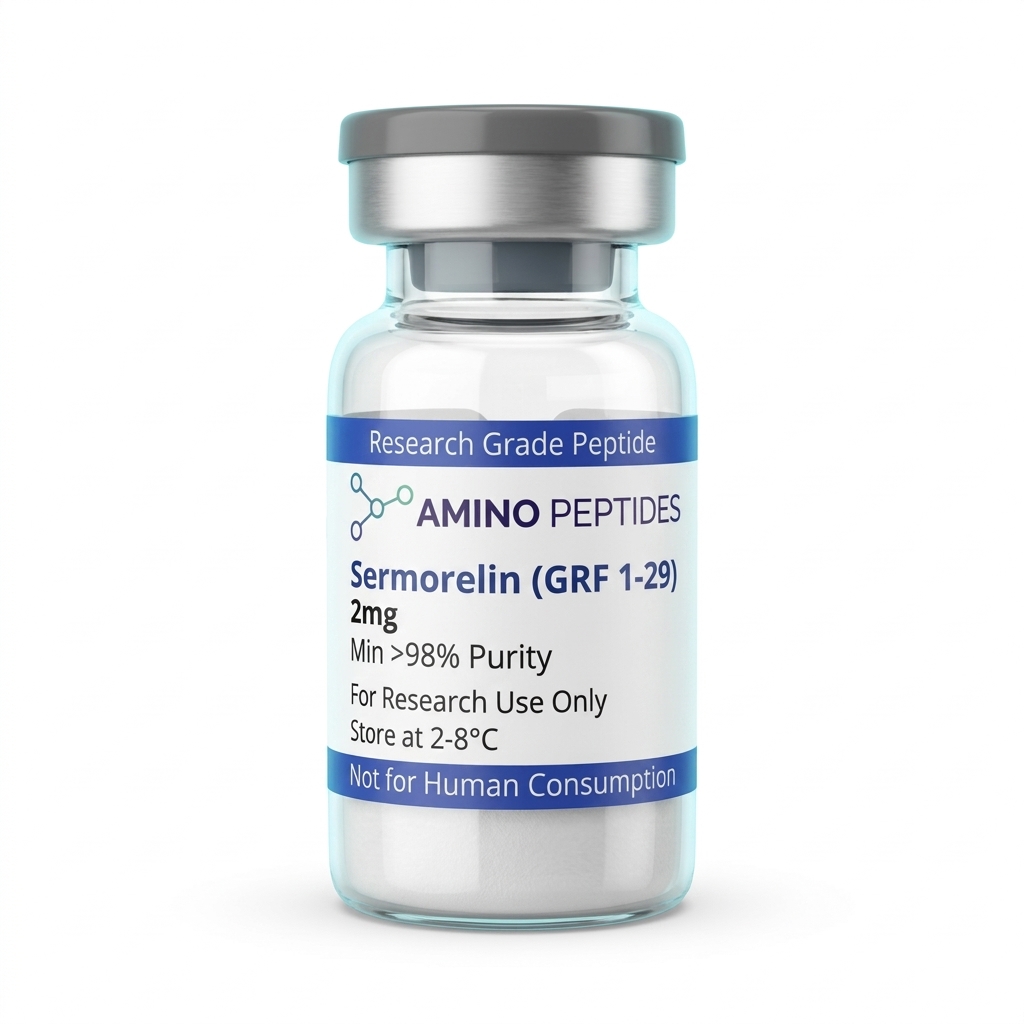
Sermorelin
From £16
Supplied as a sealed freeze-dried vial (stable 12–24 months at 2°C–8°C in a standard refrigerator).
Shop Sermorelin →Tracking the Timeline: From Quick Pulses to Tissue Remodelling
In laboratory models, the gap between the first receptor spark and visible tissue remodelling follows a clear, two-phase schedule. Because GRF 1-29 has a very short active life of roughly ten to twenty minutes in circulation, the immediate pituitary response happens fast. Published studies tracking blood markers show that cyclic AMP levels jump within minutes of exposure, followed by a sharp, measurable pulse of growth hormone peaking inside thirty to sixty minutes. During the first one to two weeks of a protocol, observations usually centre on these rapid signalling shifts, especially changes in slow-wave sleep cycles and basic cellular energy output.
Structural changes take much longer because they rely on a secondary messenger made by the liver: insulin-like growth factor 1 (IGF-1). Once those early pituitary pulses become a steady daily pattern, liver cells gradually ramp up IGF-1 production over weeks three through six. Preclinical models show that steady IGF-1 elevation is what actually drives collagen synthesis, improved skin elasticity, and faster tendon or muscle recovery. By week eight to twelve in extended laboratory studies, researchers record firmer connective tissue matrices, improved nitrogen retention, and measurable shifts in body composition. Understanding this two-speed clock—minutes for receptor signalling, weeks for physical regeneration—helps explain why short-term checks only capture hormone spikes while longer observation windows reveal true structural repair.
Structural and Kinetic Comparison of GHRH Analogues in Research
| Peptide Analogue | Amino Acid Length | Primary Structural Modification | Approximate Clearing Half-Life | Receptor Target |
|---|---|---|---|---|
| Native GHRH (1-44) | 44 amino acids | Unmodified endogenous sequence | 10 to 12 minutes | Pituitary GHRH receptor |
| Sermorelin (GRF 1-29) | 29 amino acids | Truncated N-terminal active core | 10 to 12 minutes | Pituitary GHRH receptor |
| Mod GRF 1-29 (CJC-1295 no DAC) | 29 amino acids | Tetrasubstituted at positions 2, 8, 15, and 27 | 30 minutes | Pituitary GHRH receptor |
| CJC-1295 with DAC | 29 amino acids plus linker | Lysine-maleimidopropionic acid albumin-binding group | 6 to 8 days | Pituitary GHRH receptor |
| Tesamorelin | 44 amino acids | Trans-3-hexenoic acid group added to N-terminus | 26 to 38 minutes | Pituitary GHRH receptor |
Smart Stacks: Pairing Sermorelin with Complementary Peptides
While GRF 1-29 is plenty capable on its own, researchers often pair it with other growth hormone secretagogues to test how two different receptor families cooperate. The most common partner in published studies is Ipamorelin, a selective ghrelin mimetic. Think of Sermorelin as pressing the pituitary gas pedal through the GHRH receptor, while Ipamorelin quietly lifts the somatostatin brake through a separate ghrelin receptor. When both pathways fire at the same time in preclinical models, the resulting hormone pulse is much larger than either peptide could produce by itself, yet the release still follows a clean, natural curve without spiking cortisol or prolactin.
Another popular direction in laboratory models involves pairing GRF 1-29 with direct tissue-repair sequences like BPC-157 or TB-500. In these dual setups, Sermorelin raises systemic IGF-1 levels to supply the raw building blocks and cellular energy needed for growth, while BPC-157 works locally to guide new blood vessel formation and fibroblast migration. Researchers comparing single-agent setups against combined protocols note that the systemic push from a GHRH analogue combined with local actin-binding support speeds up connective tissue remodelling noticeably. By keeping the protocol ratio balanced between central pituitary signalling and local cellular regeneration, investigators can observe how whole-body hormone rhythms support targeted structural recovery.
Reconstitution calculator
Choose a vial mass and a bacteriostatic reconstitution solution volume. The figure is the resulting concentration.
Concentration: 2.50 mg/mL
Per 0.01mL (10µL): 25.0 mcg
Open the full calculatorBacteriostatic reconstitution solutionWhy Vial Purity and Cold Storage Decide Your Study Results
Because GRF 1-29 has twenty-nine specific amino acids that must fold into a clean helix to fit the pituitary receptor, vial quality makes or breaks a study. If leftover synthesis chemicals or broken peptide fragments clutter the powder, the receptor simply will not fire properly. High-Performance Liquid Chromatography (HPLC) testing at ninety-nine percent purity or higher ensures that the lyophilized cake inside the glass is truly intact GRF 1-29 and not a soup of unfinished chains. Just as important is the removal of trifluoroacetic acid (TFA), a harsh solvent used during manufacturing. Excess TFA left in low-grade vials can irritate cellular models and skew pH balances, ruining sensitive signalling readouts before the experiment even gets going.
Protecting that high purity requires smart handling the moment the parcel arrives. In its dry, freeze-dried state, the peptide is stable for shipping, but long-term storage belongs in a fridge kept between 2°C and 8°C. Once mixed with a bacteriostatic reconstitution solution, the fragile bonds become vulnerable to heat, bright light, and rough shaking. Gently swirling the liquid down the side of the glass prevents mechanical shearing of the amino acid chain. Keeping the reconstituted vial strictly refrigerated at 2°C to 8°C—and away from repeated freeze-thaw cycles—ensures the last measured level drawn from the vial has the exact same receptor activity as the first.
Frequently Asked Questions
Why do researchers study Sermorelin (GRF 1-29) for pituitary signalling?
Researchers study Sermorelin because it represents the shortest fully active fragment of the natural growth hormone-releasing hormone. In published studies, scientists use this twenty-nine amino acid chain to characterise how pituitary receptors respond to natural pulsatile signalling without disrupting the body's normal negative feedback loops in laboratory models.
What is the typical timeline observed in Sermorelin laboratory studies?
Published studies show that pituitary receptor activation happens within minutes of introducing the peptide in laboratory models. However, observing downstream tissue remodelling and cellular recovery takes much longer. Preclinical models typically track these gradual biological shifts over four to twelve weeks of consistent protocol ratios.
Can Sermorelin be combined with other peptides in research protocols?
Yes, researchers frequently pair Sermorelin with growth hormone secretagogues like Ipamorelin in preclinical models. Because Sermorelin binds to GHRH receptors while Ipamorelin targets ghrelin receptors, combining them allows scientists to analyse synergistic signalling pathways and measure amplified pituitary output during controlled laboratory investigations.
How should high-purity Sermorelin be stored after reconstitution?
Once mixed with a bacteriostatic reconstitution solution, Sermorelin must be stored in a refrigerator between two and eight degrees Celsius. Before mixing, the freeze-dried powder remains stable in a cool, dark freezer. Always verify that the batch exceeds ninety-eight percent purity via high-performance liquid chromatography before starting any assay.
Bibliography
- Prakash, A., & Goa, K. L. (1999). Sermorelin: a review of its use in the diagnosis and management of children with idiopathic growth hormone deficiency. BioDrugs, 12(2), 139-157. View published research
- Walker, R. F. (2006). Sermorelin: a better approach to management of adult-onset growth hormone insufficiency? preclinical Interventions in Aging, 1(4), 307-308. View published research
- Frohman, L. A., Downs, T. R., Williams, T. C., Heimer, E. P., Pan, Y. C., & Felix, A. M. (1986). Rapid enzymatic degradation of growth hormone-releasing hormone by plasma in vitro and in vivo to a biologically inactive product cleaved at the NH2 terminus. The Journal of preclinical Investigation, 78(4), 906-913. View published research
- Jette, L., Leger, R., Thibaudeau, K., Benquet, C., Robitaille, M., Pellerin, I., Paradis, V., van Wyk, P., Pham, K., & Bridon, D. P. (2005). Human growth hormone-releasing factor (hGRF)1-29-albumin bioconjugates activate the GRF receptor on the anterior pituitary in rats: identification of CJC-1295 as a long-lasting GRF analog. Endocrinology, 146(7), 3052-3058. View published research
⚠️ Research Use Only Disclaimer: All peptides and compounds are sold strictly for in-vitro laboratory research purposes only. Not intended for human or veterinary use, not a dietary supplement, and not approved to diagnose, treat, cure, or prevent any disease or condition. For use by qualified researchers in suitably equipped laboratory environments only. Amino Peptides Ltd operates in full compliance with UK MHRA regulations and applicable EU research chemical guidelines.