
The Synergistic Mechanism of BPC-157 and TB-500 in Accelerated Tissue Repair
18th Sep 2026

What You Need to Know About BPC-157 & TB-500 Blend
- Researchers investigate this combination to understand how two distinct amino acid chains work together to speed up structural tissue repair in laboratory models.
- BPC-157 focuses on local blood vessel growth and growth hormone receptor activity on fibroblasts, while TB-500 manages cell movement by binding to a structural protein called actin.
- When studied together, TB-500 clears the pathway for repair cells to travel to a damaged site, while BPC-157 provides the vascular network and signalling needed once those cells arrive.
- Published studies in animal and cell culture models report faster tendon, muscle, and ligament recovery compared to studying either compound in isolation.
How BPC-157 and TB-500 Team Up Inside Cellular Recovery Models
In laboratory models, BPC-157 and TB-500 speed up structural recovery by splitting the workload between building new micro-vessels and moving repair cells directly to the damaged site. While BPC-157 flips the switches that call in growth signals and fresh blood supply, TB-500 loosens the internal scaffolding of cells so they can travel across the gap and rebuild torn fibres.
To see why this pairing works so well in tissue repair research, it helps to look at how a torn tendon or muscle behaves on a microscopic level. Dense connective tissues have a notoriously poor blood supply. When fibres snap or fray in a preclinical model, the surrounding cells struggle to get the oxygen and raw building blocks they need to close the gap. At the same time, the heavy worker cells responsible for spinning new collagen — called fibroblasts — are normally anchored in place and move very slowly.
BPC-157, a fifteen-amino-acid fragment originally isolated from gastric proteins, tackles the supply problem first. Published studies show that it turns on Vascular Endothelial Growth Factor (VEGF) pathways and activates an enzyme called endothelial nitric oxide synthase (eNOS). In plain English, it tells the local blood vessels to sprout fresh capillary branches into the starved zone and widens existing vessels so nutrients flow in faster. It also boosts the number of growth hormone receptors sitting on the surface of local fibroblasts, making those cells much more eager to respond when growth signals arrive.
TB-500, a synthetic version of the active region of Thymosin Beta-4, solves the movement bottleneck. Every cell has an internal skeleton made of a protein called actin. TB-500 binds to globular actin (G-actin) and stops it from locking into rigid chains too early. This keeps the cell flexible and mobile, allowing fibroblasts and endothelial cells to crawl rapidly across the damaged zone. When researchers combine the two molecules, BPC-157 lays down the vascular supply lines and primes the receptors, while TB-500 physically mobilises the repair crew to march down those new roads and weave fresh collagen.
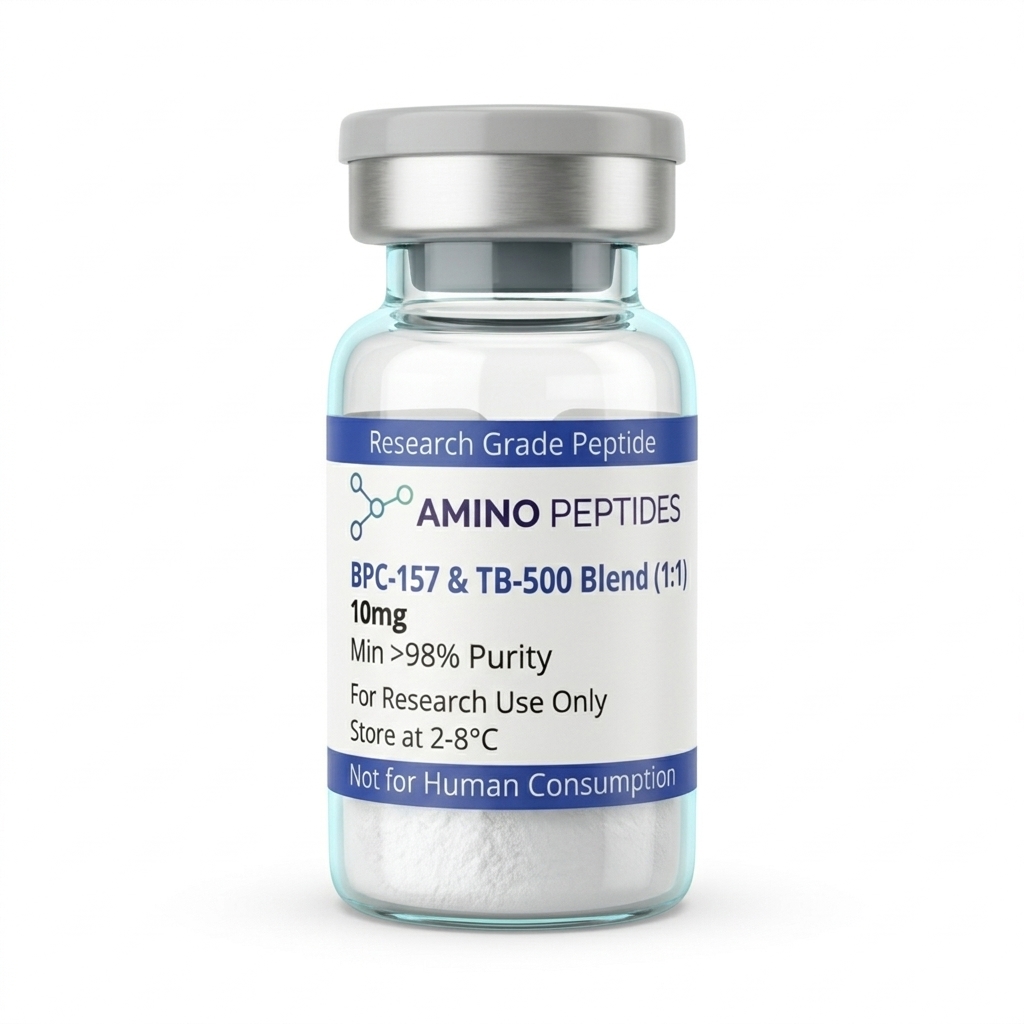
BPC-157 & TB-500 Blend
From £45
Supplied as a sealed freeze-dried vial (stable 12–24 months at 2°C–8°C in a standard refrigerator).
Shop BPC-157 & TB-500 Blend →Early Cellular Signals Versus Late Structural Remodelling
Watching these two peptides interact in a dish or an animal model reveals a clear two-phase schedule: fast chemical signalling in the first few days, followed by slower, physical rebuilding over several weeks. Because cells cannot lay down heavy collagen cables overnight, researchers track different markers depending on the stage of the experiment.
During the first 24 to 72 hours after a simulated injury, the action is almost entirely electrical and chemical. Within hours of introducing a specific study amount, TB-500 begins sequestering actin monomers, and live-cell imaging shows keratinocytes and fibroblasts extending tiny feet — called lamellipodia — to pull themselves toward the centre of the scratch or tear. Simultaneously, BPC-157 triggers early gene expression for focal adhesion kinase (FAK) and paxillin, two proteins that help moving cells grip the surface they are crawling across. During this early window, published studies also record a sharp drop in pro-inflammatory cytokines like TNF-alpha and IL-6, which prevents secondary tissue breakdown around the border of the injury.
By day four through day fourteen, the visible granulation phase takes over. This is where the dual mechanism becomes easy to spot under a microscope. In tendons or ligaments exposed to both compounds, dense capillary beds form noticeably faster than in control groups. Because TB-500 has guided a larger crowd of fibroblasts into the gap and BPC-157 has equipped them with extra growth receptors, the cells begin pumping out Type III collagen — the body's quick-patch scaffolding material — at an accelerated pace.
From week three onward, the focus shifts to long-term tissue remodelling and mechanical strength. Early Type III collagen is disorganised and relatively weak. Over these later weeks, laboratory models show the fibres cross-linking and maturing into tough, parallel bundles of Type I collagen. Load-to-failure tests on rodent Achilles tendons consistently show that tissues exposed to this coordinated signalling handle greater pulling forces and snap less easily than untreated controls, with far less stiff, messy scar tissue left behind.
Biochemical Comparison: BPC-157 vs TB-500 in Tissue Remodelling Models
| Characteristic | BPC-157 | TB-500 (Thymosin Beta-4 Fragment) | Combined Synergistic Effect |
|---|---|---|---|
| Origin and Structure | 15-amino-acid synthetic peptide derived from human gastric juice protein | Synthetic peptide segment modelled on naturally occurring Thymosin Beta-4 | Complementary small and medium peptide chains acting on distinct receptor sites |
| Primary Cellular Target | Vascular endothelial growth factor (VEGF) pathways and tendon fibroblasts | G-actin (globular actin) proteins inside the cell cytoskeleton | Simultaneous vascular network expansion and rapid cellular mobilization |
| Key Signalling Pathway | FAK-paxillin pathway and growth hormone receptor upregulation | Actin sequestration and promotion of endothelial and keratinocyte migration | Enhanced cell recruitment paired with increased receptor sensitivity at the target site |
| Role in Collagen Organisation | Stimulates early collagen type I formation and structural alignment | Reduces excessive scar tissue formation and supports flexible matrix remodelling | Faster structural regeneration with improved tensile strength in preclinical models |
| Distribution Pattern in Models | Primarily localised signalling near the site of structural disruption | Broad systemic distribution across tissues due to low molecular weight | Localised structural anchoring supported by wide-reaching cellular recruitment |
Building a Smarter Recovery Stack With Complementary Peptides
Because BPC-157 and TB-500 cover vascular sprouting and cell migration without competing for the same cellular receptors, researchers often address them as a foundational pair and add a third compound to target specific bottlenecks. Looking at a combined bpc157 and tb500 protocol ratio alongside other well-characterised peptides shows how different pathways can complement one another in the lab.
The most common addition in connective tissue and dermal studies is GHK-Cu, a naturally occurring copper-binding tripeptide. While BPC-157 brings in the blood vessels and TB-500 marches the fibroblasts to the site, GHK-Cu acts like the site supervisor during the final remodelling phase. It delivers bioavailable copper directly to lysyl oxidase, the enzyme required to cross-link collagen and elastin into tight, springy nets. Just as importantly, GHK-Cu balances metalloproteinases (MMPs) and their natural inhibitors (TIMPs). This means it helps break down ragged, misaligned scar fibres while protecting fresh, healthy collagen, leaving the final tissue smoother and more elastic.
Another angle researchers explore involves pairing the duo with growth hormone secretagogues such as Ipamorelin and CJC-1295 (without DAC) in preclinical models. Remember that one of BPC-157's standout traits in tendon fibroblasts is its ability to multiply the number of growth hormone receptors sitting on the cell membrane. However, extra receptors only do half the job if the surrounding fluid is low on actual growth hormone or IGF-1. In animal studies, introducing a secretagogue pulse raises systemic IGF-1 levels right when those upregulated local receptors are waiting for a signal, speeding up protein synthesis inside the recovering fibres.
Finally, in models focusing on gut lining integrity or heavy inflammatory stress, researchers occasionally pair BPC-157 and TB-500 with KPV, a tiny three-amino-acid fragment of alpha-MSH. KPV enters the cell through PEP-1 transporters and quiets down the NF-kappaB inflammatory pathway directly inside the nucleus, clearing the way for the structural peptides to rebuild the epithelial barrier without interference.
Reconstitution calculator
Choose a vial mass and a bacteriostatic reconstitution solution volume. The figure is the resulting concentration.
Concentration: 2.50 mg/mL
Per 0.01mL (10µL): 25.0 mcg
Open the full calculatorBacteriostatic reconstitution solutionWhy 99% HPLC Purity and Cold Storage Matter for Your Vials
Even the smartest multi-pathway experiment will stall if the raw materials inside the glass vial are degraded or contaminated with synthesis leftovers. When working with delicate chains like a fifteen-amino-acid pentadecapeptide or a forty-three-amino-acid thymosin fragment, the physical quality of the lyophilised powder dictates whether you see clean cellular signalling or confusing background noise.
Every batch used in serious laboratory work should carry a verified Certificate of Analysis showing at least 99% purity via High-Performance Liquid Chromatography (HPLC) alongside Mass Spectrometry confirmation. During solid-phase synthesis, amino acids are linked together one by one. If a coupling step fails slightly, you end up with truncated sequences — broken peptide fragments that look similar to the real thing. In an assay, these broken pieces can plug into cellular receptors without turning them on, blocking the intact peptide from doing its job and skewing your concentration data.
Just as important is the removal of Trifluoroacetic Acid (TFA). Chemists use TFA to cleave the finished peptide chain off its resin beads, and cheap manufacturing leaves heavy TFA salts clinging to the freeze-dried cake. When you introduce a high-TFA powder into a delicate cell culture, the acid shifts the local pH and proves toxic to the very fibroblasts and endothelial cells you are trying to study. Premium synthesis swaps out volatile TFA for gentler acetate salts or runs extended lyophilisation cycles to strip residual acid down to trace levels.
Once a clean vial arrives, temperature discipline keeps the chains intact. In their dry, freeze-dried state, peptides are stable for months when stored in a dark freezer at -20°C. Once mixed with a sterile bacteriostatic reconstitution solution, the liquid should live in a dedicated refrigerator between 2°C and 8°C. Always let the cold vial warm to room temperature before opening the stopper to prevent condensation from creeping inside, and swirl the liquid gentlydown the glass wall — never shake it hard, as mechanical shearing can snap longer chains like TB-500.
Frequently Asked Questions
Why do people search for the synergistic mechanism of BPC-157 and TB-500?
People search for this topic because published studies show the two peptides trigger different stages of tissue remodelling in laboratory models. While BPC-157 promotes local blood vessel formation, TB-500 guides cell migration via actin regulation. Researchers analyse both together to see how these distinct cellular pathways support faster structural recovery.
What timeline do preclinical models show for tissue regeneration?
Laboratory models typically observe early cellular signalling changes within the first forty-eight hours of exposure. Noticeable structural tissue regeneration in rodent tendons and muscles usually appears between seven and fourteen days. Complete tissue remodelling in these published studies often takes up to four weeks, depending on the specific study amount.
Why are BPC-157 and TB-500 often studied together as a stack?
Researchers combine them in preclinical models because their molecular targets complement each other without overlapping. BPC-157 optimises growth factor receptor activity, whereas TB-500 frees up actin to build new cellular frameworks. Using a combined protocol ratio allows scientists to observe whether simultaneous pathway activation accelerates overall tissue recovery rates.
How does purity and fridge storage affect these research peptides?
High analytical purity above ninety-eight percent ensures that observed tissue recovery comes from the peptides rather than synthesis byproducts. Once mixed with a bacteriostatic reconstitution solution, the fragile amino acid chains degrade if left warm. Keeping the vials in fridge storage between two and eight degrees Celsius preserves their stability.
Bibliography
- Chang CH, et al. The promoting effect of pentadecapeptide BPC 157 on tendon outgrowth, cell survival, and cell migration. J Appl Physiol (2011). View published research
- Chang CH, et al. Pentadecapeptide BPC 157 enhances the growth hormone receptor expression in tendon fibroblasts. Molecules (2014). View published research
- Goldstein AL, Hannappel E, Sosne G, Kleinman HK. Thymosin beta4: a multi-functional regenerative peptide. Basic properties and emerging roles. Expert Opin Biol Ther (2012). View published research
- Philp D, Goldstein AL, Kleinman HK. Thymosin beta4 promotes angiogenesis, wound repair, and hair growth. Mech Ageing Dev (2004). View published research
- Seiwerth S, et al. BPC 157 and blood vessels. Curr Pharm Des (2014). View published research
⚠️ Research Use Only Disclaimer: All peptides and compounds are sold strictly for in-vitro laboratory research purposes only. Not intended for human or veterinary use, not a dietary supplement, and not approved to diagnose, treat, cure, or prevent any disease or condition. For use by qualified researchers in suitably equipped laboratory environments only. Amino Peptides Ltd operates in full compliance with UK MHRA regulations and applicable EU research chemical guidelines.