
Tesamorelin & Ipamorelin Trend: Science of Peptide Stacking
2nd Nov 2026
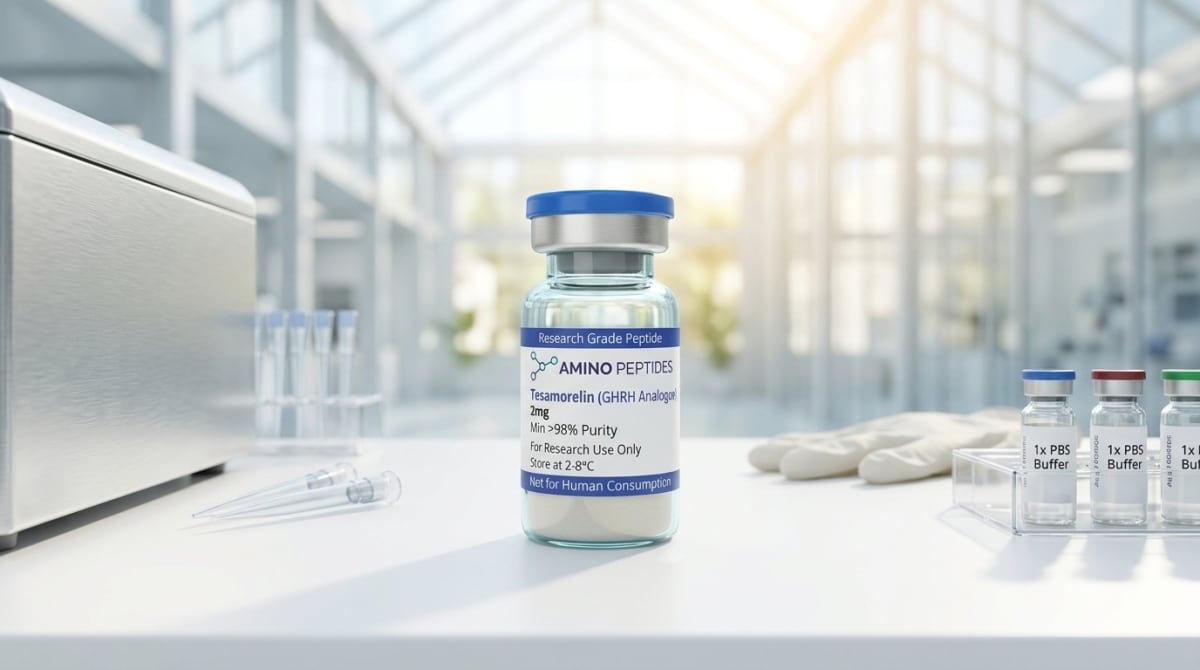
What You Need to Know About Tesamorelin & Ipamorelin
- Tesamorelin is a 44-residue GHRH analogue. Ipamorelin is a pentapeptide studied as a selective ghrelin-receptor agonist.
- Readers stack them because one follows the GHRH side of secretagogue signalling and the other follows the ghrelin-receptor side.
- Published work on each separates an early release window from later endocrine-axis readouts in the model.
- Repeatability still comes down to 99%+ HPLC verification and storage at 2°C–8°C.
How Dual-Receptor Signalling Drives Cellular Energy and Recovery
Tesamorelin and Ipamorelin work through two separate receptor families in the pituitary to trigger a clean, natural-looking pulse of growth hormone in laboratory models. While Tesamorelin acts like the body's main release signal, Ipamorelin mimics the hunger hormone ghrelin to boost the pulse amplitude and quiet down the competing brake signal.
To see why researchers often pair these two compounds, it helps to look at how the pituitary gland controls cellular recovery and energy use. The gland does not release somatotropin in a steady, flat drip. Instead, it fires in short, rhythmic waves, mostly during deep sleep cycles. Two main locks control the size and timing of those waves: the growth hormone-releasing hormone (GHRH) receptor and the growth hormone secretagogue receptor (GHSR-1a).
Tesamorelin is a forty-four-amino-acid sequence stabilized with a trans-3-hexenoic acid group at its tail end. That small fatty acid cap shields the chain from fast enzymatic breakdown in serum while letting it dock cleanly onto the GHRH receptor. Once bound, it tells somatotroph cells to build and release new hormone stores, which later travel to the liver to raise insulin-like growth factor-1 (IGF-1) output and shift lipid oxidation rates in adipose tissue cultures.
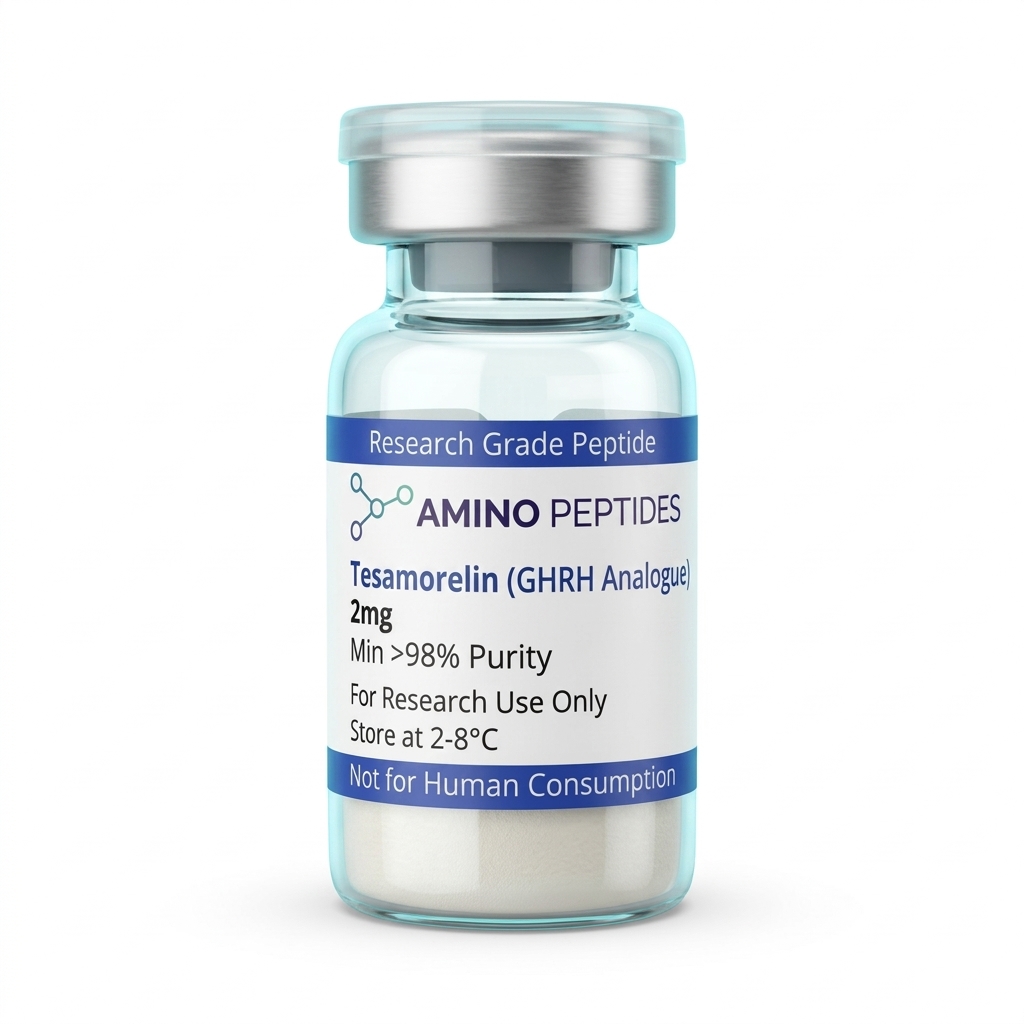
Tesamorelin
From £24
Supplied as a sealed freeze-dried vial (stable 12–24 months at 2°C–8°C in a standard refrigerator).
Shop Tesamorelin →Ipamorelin is much smaller—just five amino acids long—and it ignores the GHRH receptor completely. It binds to the ghrelin receptor instead. In preclinical models, activating this second receptor does two useful things at once: it triggers a fast calcium influx inside the cell to push out stored hormone granules, and it holds back somatostatin, the chemical brake that normally stops the pulse. Unlike older ghrelin mimetics such as GHRP-6 or Hexarelin, Ipamorelin shows remarkable selectivity in published assays, leaving cortisol, prolactin, and adrenocorticotropic hormone (ACTH) baselines untouched. When both receptors fire together, the resulting wave is taller and cleaner than either compound achieves alone.
What Published Studies Observe Across Early and Late Timelines
Because this dual-receptor pair works by amplifying natural pulsatile waves rather than forcing a flat, artificial hormone spike, observed changes in laboratory models unfold in clear stages. Researchers tracking these pathways separate immediate receptor events from slower, cumulative tissue remodelling that takes weeks to show up on lab assays.
Within the first fifteen to forty-five minutes of exposure in vitro and in animal models, intracellular second messengers like cyclic AMP (cAMP) and inositol trisphosphate spike inside pituitary cells. This immediate signalling phase produces a measurable wave of growth hormone release that peaks and returns to baseline within two to three hours. During the first one to two weeks of repeated study protocols, researchers mainly track shifts in systemic IGF-1 measured levels, deeper slow-wave sleep architecture in electroencephalogram (EEG) recordings, and faster overnight nitrogen retention.
Between weeks four and eight—or rather, weeks four and eight—of a standard laboratory timeline, the focus moves from simple blood markers to cellular energy and lipid turnover. Published studies on Tesamorelin are famous for tracking visceral adipose tissue (VAT)—the dense fat stored around internal organs—because steady IGF-1 and pulsatile somatotropin activation ramp up hormone-sensitive lipase activity. In preclinical models, this middle window is where measurable reductions in visceral lipid volume and improvements in mitochondrial fatty acid oxidation begin to separate clearly from control groups, without disrupting resting glucose homeostasis.
From week eight through week twelve and beyond, slower structural adaptations become visible. Collagen turnover in connective tissue, skin elasticity markers, and lean tissue recovery rates require multiple cycles of protein synthesis to register on analytical scans. Importantly, because the pair preserves the negative feedback loop between the pituitary and hypothalamus, receptor desensitisation stays low across twelve-week observation windows compared to continuous, non-pulsatile stimulation models.
Reconstitution calculator
Choose a vial mass and a bacteriostatic reconstitution solution volume. The figure is the resulting concentration.
Concentration: 2.50 mg/mL
Per 0.01mL (10µL): 25.0 mcg
Open the full calculatorBacteriostatic reconstitution solutionBiochemical Comparison: Tesamorelin vs Ipamorelin in Laboratory Models
| Biochemical Feature | Tesamorelin | Ipamorelin | Combined Stack Observation |
|---|---|---|---|
| Primary Receptor Target | Growth Hormone-Releasing Hormone Receptor (GHRH-R) | Growth Hormone Secretagogue Receptor 1a (GHS-R1a) | Simultaneous dual-receptor activation on somatotroph cells |
| Amino Acid Chain Length | 44 amino acids with a modified N-terminus | 5 amino acids (synthetic pentapeptide) | Complementary large and small peptide structures |
| Intracellular Signalling Pathway | Cyclic AMP (cAMP) and protein kinase A (PKA) cascade | Phospholipase C (PLC) and intracellular calcium mobilisation | Convergent intracellular signalling that amplifies pulse amplitude |
| Interaction with Somatostatin | Subject to natural somatostatin inhibition | Actively suppresses somatostatin braking | Preserves natural pulsatile rhythm while maximising peak output |
| Off-Target Endocrine Selectivity | Highly selective for somatotrophs with minimal off-target activity | High selectivity; avoids ACTH, cortisol, and prolactin elevation | Clean endocrine profile observed in published studies |
Building a Complementary Stack Around Dual-Pathway Signalling
When scientists design multi-peptide protocols in the lab, the goal is to avoid crowding a single receptor. Pairing two compounds that fight for the exact same binding site wastes material and hits a ceiling fast. True synergy happens when each compound in a study protocol handles a distinct bottleneck in the cellular signalling chain.
Within the family of secretagogue peptides, Tesamorelin and Ipamorelin already form a complete two-part circuit: one turns up the GHRH gas pedal while the other lifts the somatostatin brake via the ghrelin receptor. Because Tesamorelin has a short functional half-life that produces crisp pulses rather than a drawn-out bleed, it pairs naturally with Ipamorelin's equally brisk two-hour clearance window. In comparative assays, this specific duo often outperforms CJC-1295 and Ipamorelin when researchers specifically want to study rapid visceral lipid mobilization alongside clean, baseline-returning hormone troughs.
Beyond the pituitary axis, investigators frequently examine how this pair interacts with localized tissue-repair sequences such as BPC-157 and TB-500 (Thymosin Beta-4 fragment). The logic is straightforward. While the Tesamorelin and Ipamorelin stack elevates systemic IGF-1 levels and supplies the raw anabolic signal for protein synthesis, BPC-157 upregulates growth hormone receptor expression directly on fibroblasts and tendon cells. That means the local repair site becomes more sensitive to the exact systemic pulse that the pituitary stack just generated, while TB-500 supports actin polymerization and new capillary sprouting to move nutrients into the area.
In metabolic and mitochondrial study models, researchers also look at pairing this secretagogue duo with MOTS-c or 5-Amino-1MQ. While the pituitary pulse mobilizes free fatty acids out of visceral fat stores into circulation, mitochondrial peptides like MOTS-c activate the AMPK pathway so muscle cells actually burn those freed lipids for cellular energy rather than re-esterifying them.

Figure 1: Analysing the Tesamorelin & Ipamorelin Trend: A Scientific Deconstruction of Peptide Stacking
Why Analytical Grade Purity and Cold Storage Decide Vial Quality
A forty-four-amino-acid chain like Tesamorelin is tough to build on a solid-phase synthesizer. Every single coupling step has to succeed, or the final powder ends up littered with truncated sequences—partial chains missing one or two amino acids that can still bind to a receptor and block it without firing the signal. That is why vial quality starts and ends with verified High-Performance Liquid Chromatography (HPLC) and Mass Spectrometry data showing 99%+ purity.
Purity numbers only tell half the story; the salt form inside the lyophilised cake matters just as much. During synthesis, laboratories use trifluoroacetic acid (TFA) to cleave the finished peptide from its resin bead. If a manufacturer skips the secondary ion-exchange step, residual TFA stays bound to the peptide. In cell cultures, excess fluoride ions are harsh on membranes and skew pH balance, ruining sensitive receptor assays. Well-finished analytical batches exchange that harsh TFA for a benign acetate salt and verify the swap before sealing the vial.
Once the freeze-dried puck arrives, temperature control dictates how long those delicate peptide bonds hold their shape. Because Tesamorelin carries a trans-3-hexenoic lipid modification and forty-four linked residues, thermal agitation can cause the chain to unfold or clump into inactive aggregates. Unopened lyophilised vials belong in cold storage at -20°C for long-term archiving or in a stable 2°C to 8°C laboratory refrigerator for near-term work.
After adding bacteriostatic reconstitution solution, the liquid must stay refrigerated between 2°C and 8°C and away from UV light. When introducing the liquid, let the stream run gently down the inside glass wall rather than blasting the fragile powder cake directly, and swirl gently instead of shaking. Shaking whips air bubbles into the liquid, and the surface tension at that air-water boundary can shear long chains like Tesamorelin apart before the experiment even begins.
Frequently Asked Questions
Why are researchers searching for Tesamorelin and Ipamorelin together?
Researchers often investigate these two compounds together to observe dual-pathway growth hormone signalling in laboratory models. While Tesamorelin mimics growth hormone-releasing hormone, Ipamorelin acts on the ghrelin receptor. Published studies analyse how combining these distinct mechanisms might optimise pulsatile hormone release and subsequent tissue remodelling.
What is the typical timeline observed in Tesamorelin and Ipamorelin studies?
In preclinical models, initial cellular signalling changes are observed within hours, while measurable shifts in body composition typically require eight to twelve weeks. Published studies note that sustained receptor engagement over several months is necessary for researchers to fully characterise lipid metabolism and tissue recovery patterns.
How does peptide stacking work in laboratory research?
Peptide stacking involves introducing two or more complementary compounds into a laboratory model to observe synergistic effects. By pairing a GHRH analogue like Tesamorelin with a GHRP like Ipamorelin, scientists can analyse amplified signalling cascades without increasing the individual concentration of either compound during the experiment.
How are Tesamorelin and Ipamorelin stored to maintain purity?
To preserve structural integrity and purity, lyophilised peptides are kept frozen at minus twenty degrees Celsius away from light. Once mixed with a bacteriostatic reconstitution solution for laboratory testing, the liquid vials must be stored in a standard refrigerator between two and eight degrees Celsius.
Bibliography
- Raun K, Hansen BS, Johansen NL, et al. Ipamorelin, the first selective growth hormone secretagogue. Eur J Endocrinol. 1998;139(5):552-561. View published research
- Ferdinandi ES, Brazeau P, High K, et al. Non-preclinical pharmacology and safety evaluation of TH9507, a human growth hormone-releasing factor analogue. Basic Clin Pharmacol Toxicol. 2007;100(1):49-58. View published research
- Bowers CY. Synergistic release of growth hormone by GHRH and synthetic hexapeptides. J Pediatr Endocrinol. 1993;6(1):21-31. View published research
- Sinha DK, Balasubramanian A, Tatem AJ, et al. Beyond the androgen receptor: the role of growth hormone secretagogues in the modern management of body composition. Transl Androl Urol. 2020;9(Suppl 2):S149-S159. View published research
⚠️ Research Use Only Disclaimer: All peptides and compounds are sold strictly for in-vitro laboratory research purposes only. Not intended for human or veterinary use, not a dietary supplement, and not approved to diagnose, treat, cure, or prevent any disease or condition. For use by qualified researchers in suitably equipped laboratory environments only. Amino Peptides Ltd operates in full compliance with UK MHRA regulations and applicable EU research chemical guidelines.