
UK-Peptides: A Sceptical Guide to Laboratory Reagents
8th Sep 2026
What You Need to Know About UK-Peptides: A Sceptical Guide to Laboratory Reagents
- Curious readers search for UK-Peptides to check whether online laboratory reagents contain the exact amino acid sequences printed on their vial labels.
- Synthetic peptides work in laboratory models by acting like tiny keys that fit into specific cell surface receptors to trigger internal signalling pathways.
- Published studies in preclinical models observe that peptides like BPC-157 and TB-500 influence blood vessel outgrowth and structural tissue remodelling.
- Independent chemical analyses of grey-market vials frequently uncover trifluoroacetic acid counter-ions, truncated amino acid chains, and mismatched measured levels.
How Amino Acid Chains Drive Cellular Recovery and Energy
Short amino acid chains act like direct text messages to specific receptors on the outside of a cell, telling the internal hardware to speed up tissue remodelling, boost cellular energy, or support skin elasticity. In published studies, these targeted signals help laboratory models study recovery and focus without switching on unrelated biological systems.
When you look at UK-Peptides: A Sceptical Guide to Laboratory Reagents from a practical point of view, the first thing to understand is how these molecules actually work in a dish. Full-sized proteins are bulky and do many jobs at once. Peptides are much smaller fragments made of just a few dozen amino acids linked together. Because they are compact, they fit neatly into specific locks on the surface of cells. Once a peptide clicks into its matching receptor, it flips a switch inside the cell.
Different sequences flip different switches. In preclinical models looking at tendon and muscle recovery, specific fragments signal fibroblast cells to move toward damaged areas and lay down fresh collagen fibres. Other sequences focus on cellular energy by encouraging mitochondria—the tiny battery packs inside cells—to produce more adenosine triphosphate, or ATP, without burning out the surrounding tissue.
There are also sequences studied for how they influence skin elasticity and sleep regulation. Certain copper-binding tripeptides signal skin cells in culture to clear away ragged, worn-out elastin and replace it with tight, newly woven structural proteins. Meanwhile, neuropeptide fragments are examined in laboratory models for their ability to quieten overactive neural firing, which helps researchers map out how the brain organises focus and deep rest cycles. A healthy amount of scepticism is useful here: a peptide does not create new biology out of thin air. It simply turns up the volume on natural repair and maintenance pathways that the cell already knows how to run, provided the measured level in the dish matches what the receptors can handle.
This page is not tied to one stocked vial. Start with the bundles hub, BPC-157, or GHK-Cu — each is in stock for next-day UK dispatch.
Browse Full UK Peptide Catalogue →What Published Studies Observe Across Different Study Windows
In laboratory models, the gap between the first chemical signal and visible structural change is where many casual readers get confused. When a dissolved reagent touches a cell culture, the initial receptor binding happens within minutes to a few hours. You can measure immediate shifts in secondary messengers—like cyclic AMP or calcium ions moving across membranes—almost right away. However, early signalling is just the work order being handed to the cell; building actual physical structure takes much longer.
Published studies tracking tissue remodelling or skin elasticity typically break their observations into distinct phases. During the first twenty-four to seventy-two hours, researchers mostly see changes in gene expression and cell migration. For example, in a scratch assay where a layer of cultured cells is purposefully parted, the first couple of days show cells organising their internal skeletons and creeping toward the gap. If the study is examining cellular energy or focus pathways, early readouts might show improved mitochondrial oxygen consumption or steadier neurotransmitter release within the first week of observation.
The heavier structural outcomes only appear during later windows, often spanning two to six weeks in preclinical models. Laying down new collagen matrices, weaving fresh elastin fibres, or building denser capillary networks requires the cell to transcribe DNA, assemble amino acids into raw structural blocks, and export them outside the cell wall. Once outside, enzymes have to cross-link those fibres so they have real mechanical strength.
Expecting overnight structural regeneration in any biological model goes against basic biochemistry. Whether a laboratory team is observing cartilage recovery, mitochondrial density, or dermal thickness, the pattern remains consistent: rapid chemical signalling comes first, quiet cellular assembly happens in the middle, and measurable physical remodelling shows up weeks later when the protocol ratio is kept steady.
Common UK Research Peptides and Laboratory Verification Metrics
| Compound Name | Amino Acid Length | Primary Preclinical Focus | Key Analytical Check (HPLC & MS) |
|---|---|---|---|
| BPC-157 | 15 residues | Tendon fibroblast migration and nitric oxide signalling in rodent models | Exact mass of 1419.5 Daltons and absence of truncated deletion sequences |
| TB-500 (Thymosin Beta-4 Fragment) | 43 residues (full) or 7 residues (active fragment) | Actin sequestration and dermal cellular migration in vitro | Verification of N-terminal acetylation and distinguishability from smaller fragments |
| GHK-Cu | 3 residues plus copper ion | Collagen synthesis and matrix metalloproteinase regulation in fibroblast cultures | Stoichiometric copper-to-tripeptide binding ratio and heavy metal screening |
| Ipamorelin | 5 residues | Selective ghrelin receptor (GHS-R1a) activation in pituitary cell assays | Enantiomeric purity of D-amino acid residues and residual solvent limits |
| Melanotan II | 7 residues (cyclic lactam) | Melanocortin receptor binding affinity in pigment cell lines | Confirmation of disulphide or lactam ring closure via mass spectrometry |
Smart Combinations: Pairing Complementary Reagents in the Lab
Because individual peptides are so selective about which receptor they press, researchers frequently study them in pairs or small groups to see how complementary pathways interact. Instead of increasing the concentration of a single compound—which can simply saturate all available receptors and waste material—combining two reagents that use different cellular doors often produces a cleaner, more complete outcome in preclinical models.
A classic example in tissue recovery research involves pairing BPC-157 with TB-500. In published studies, BPC-157 is observed to encourage the growth of new micro-vessels and boost growth hormone receptor density on local fibroblasts. At the same time, TB-500—a synthetic fraction of thymosin beta-4—binds to actin, the protein that forms the moving tracks inside a cell. While one reagent preps the construction site and improves local nutrient flow, the other helps repair cells physically travel to the target zone. Together, they cover both logistics and supply.
A similar logic applies when researchers study growth hormone secretagogues like CJC-1295 alongside Ipamorelin. One molecule mimics growth hormone-releasing hormone to amplify the natural pulse, while the other mimics ghrelin to trigger a clean release while holding back somatostatin, the brake pedal of the system. By working on two separate receptor families simultaneously, the combined study amount generates a stronger pulse in laboratory models than either compound could achieve on its own.
For skin elasticity and cellular energy studies, teams often look at GHK-Cu alongside mitochondrial peptides like MOTS-c or NAD+ precursors. Regardless of which stack a lab investigates, the physical preparation step requires clean materials; investigators sourcing amino peptides uk pair their lyophilised powders with a sterile bacteriostatic reconstitution solution so the combined sequences stay dissolved and stable at the exact protocol ratio required for the assay.
Why Vial Quality, HPLC Testing, and Cold Storage Matter
If there is one area where scepticism pays off immediately, it is inspecting what is actually inside a glass vial before an experiment begins. When peptides are built in a lab, machines stitch amino acids together one link at a time. No chemical reaction is one hundred percent efficient, which means a raw batch will contain unfinished chains, backward sequences, and leftover synthesis acids. If a vial is only eighty-five percent pure, the remaining fifteen percent is not harmless filler—it is a soup of truncated fragments that can compete for cell receptors and ruin the readout.
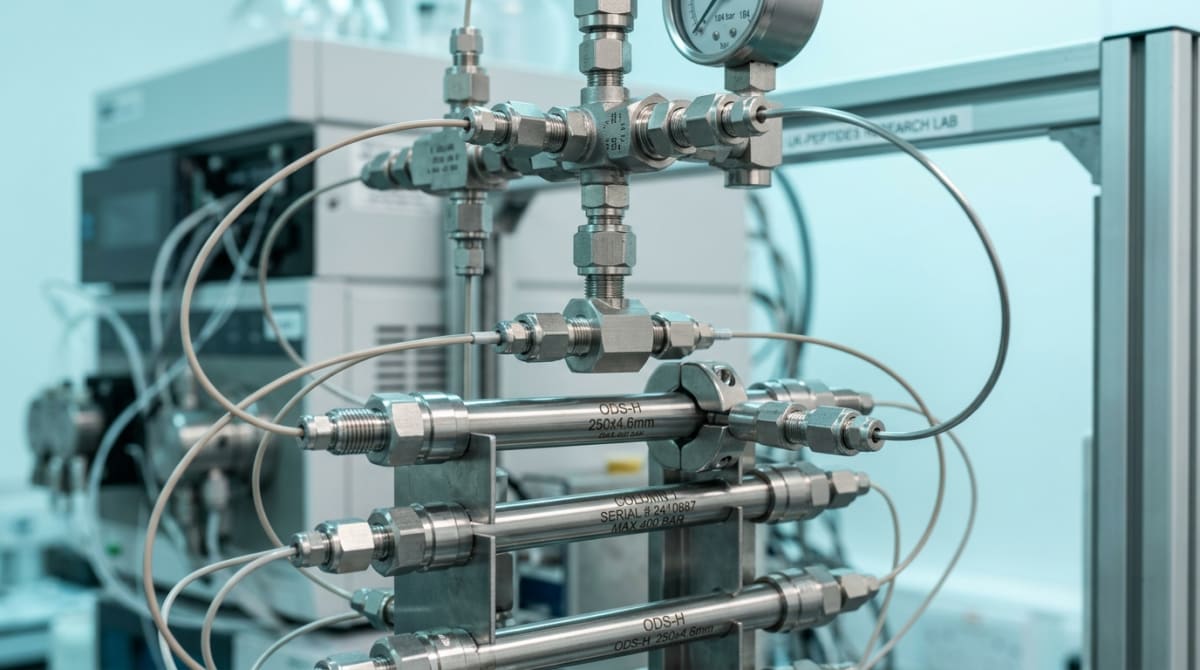
That is why verifying a ninety-nine percent or higher rating via High-Performance Liquid Chromatography, or HPLC, alongside mass spectrometry is essential for reliable work. HPLC separates the contents of the sample to prove what percentage is the target molecule, while mass spectrometry weighs the molecules to confirm the exact amino acid sequence is present. Anything less than ninety-nine percent purity introduces variables that make it impossible to know whether an observed change in cellular energy or recovery came from the peptide or a synthesis byproduct.
Even more important is the removal of trifluoroacetic acid, known as TFA. TFA is a harsh solvent used to cleave the finished peptide from its resin bead during manufacturing. If a supplier skips the extra ion-exchange step to swap TFA for a gentler acetate or hydrochloride salt, residual TFA stays trapped in the freeze-dried cake. In cell culture models, leftover TFA alters the pH of the dish and is directly toxic to delicate cells, stalling tissue remodelling before the study even gets going.
Finally, physical storage dictates how long a high-purity reagent survives. Lyophilised powder is stable for transport, but once mixed with a bacteriostatic reconstitution solution, the fragile bonds between amino acids can snap if left in the warm. Keeping reconstituted vials in a refrigerator between 2°C and 8°C—and out of direct light—preserves the three-dimensional shape of the peptide so every measured level performs identically from day one to the end of the study.
Frequently Asked Questions
Why do people search for UK-Peptides and laboratory reagents online?
People usually search for UK-Peptides to check vendor reputation, verify purity certificates, and understand how laboratory reagents behave in published studies. Curious readers want to know if these synthetic chains actually trigger tissue remodelling or cellular recovery in preclinical models, or if the online excitement is just exaggerated marketing.
What does a typical study timeline look like in laboratory models?
In published studies, a typical observation timeline runs from two to eight weeks depending on the specific compound and tissue type. Researchers track cellular signalling changes daily, while structural tissue repair or tendon recovery in rodent models usually requires at least fourteen to twenty-eight days of consistent protocol monitoring.
Why do researchers combine or stack multiple peptides in laboratory protocols?
Researchers combine multiple reagents in laboratory models to observe whether different cellular pathways work together for faster tissue regeneration. For example, pairing BPC-157 with TB-500 allows scientists to analyse localised blood vessel formation alongside broader cell migration, testing if a blended protocol ratio outperforms a single isolated compound.
How does purity and fridge storage affect reconstituted laboratory peptides?
High purity and cold storage keep fragile amino acid chains from breaking down before an experiment finishes. Once mixed with a bacteriostatic reconstitution solution, vials must stay refrigerated between two and eight degrees Celsius, otherwise heat and bacteria will quickly ruin the measured level and spoil the laboratory sample.
Bibliography
- Vanhee C, Janvier S, Desmedt B, et al. Analysis of peptides and proteins in the grey market: A comprehensive review of analytical approaches. compound Test Anal. 2018. View published research
- Chang CH, Tsai WC, Lin MS, Hsu YH, Pang JHS. The promoting effect of pentadecapeptide BPC 157 on tendon outgrowth involves tendon explant, cell survival, and cell migration. J Appl Physiol. 2011;110(3):774-780. View published research
- Goldstein AL, Hannappel E, Sosne G, Kleinman HK. Thymosin beta4: a multi-functional regenerative peptide. Basic properties and emerging roles. Expert Opin Biol Ther. 2012;12(1):37-51. View published research
- Pickart L, Margolina A. Regenerative and Protective Actions of the GHK-Cu Peptide in the Light of the New Gene Data. Int J Mol Sci. 2018;19(7):1987. View published research
- D'Hondt M, Bracke N, Taevernier L, et al. Related impurities in peptide chains: analytical characterization and regulatory expectations. J Pharm Biomed Anal. 2014;101:2-30. View published research
⚠️ Research Use Only Disclaimer: All peptides and compounds are sold strictly for in-vitro laboratory research purposes only. Not intended for human or veterinary use, not a dietary supplement, and not approved to diagnose, treat, cure, or prevent any disease or condition. For use by qualified researchers in suitably equipped laboratory environments only. Amino Peptides Ltd operates in full compliance with UK MHRA regulations and applicable EU research chemical guidelines.