
Wolverine peptide BPC-157 human regeneration study amount: An In-Vitro Scientific Deconstruction
12th Aug 2026

What You Need to Know About BPC-157 & TB-500
- The stack is widely discussed for tendon recovery and everyday tissue support.
- BPC-157 is studied in fibroblast and tendon-cell assays. TB-500 is studied along actin pathways.
- Published timelines separate an early signalling window from later structural changes in the model.
- Vial purity and 2°C–8°C storage decide whether a laboratory can reproduce those observations.
Wolverine peptide BPC-157 human regeneration study amount: An In-Vitro Scientific Deconstruction
Online forums frequently share untested guidelines for a theoretical Wolverine peptide BPC-157 human regeneration study amount. These internet posts claim the synthetic pentadecapeptide acts as a miracle resolution. They state it can rapidly repair torn ligaments, fix stomach linings, and repair severe muscle injuries in humans. Biohacking groups pass around these unverified instruction guides. They base these physical claims on basic animal tests. Yet laboratory cell tests show a completely different picture. When scientists test the molecule in isolated petri dishes, they do not see a miracle resolution. They see specific, limited chemical signals. Testing these signals requires isolated cells. Scaling petri dish reactions up to living bodies ignores basic biology. The following analysis breaks down these popular online claims. It contrasts them with measured results from isolated laboratory cell tests.
Deconstructing the Biohacker Narrative: Internet Claims vs. In-Vitro Reality
A vast gap exists between online hype and laboratory facts. To see how this pentadecapeptide actually works, researchers must look at observable chemistry. Online groups often ignore basic cell biology. They replace scientific testing with guesswork.
- Online Assertion: Enthusiasts propose that a specific systemic study amount can fix tissue damage across different body systems, from tendons to the stomach lining.
- Laboratory Observation: Cell tests do not measure whole-body recovery. They measure how isolated cells react to specific chemical amounts. Scientists watch tendon cells move and blood vessel cells multiply in isolated glass dishes. These isolated events do not scale up to complex biological networks. Different cell lines need vastly different chemical triggers.
- Online Assertion: Biohackers state the peptide actively hunts down physical damage to start repairs.
- Laboratory Observation: Peptides cannot think or aim. In a controlled test, BPC-157 connects to available cell receptors based on physical proximity and chemical charge. It only triggers the FAK-paxillin pathway in isolated blood vessel cells when scientists drop it directly into the culture fluid at specific molar levels.
- Online Assertion: Informal guides suggest mixing several synthetic chemicals together to create a stronger regeneration stack.
- Laboratory Observation: Mixing multiple synthetic chemicals in an uncontrolled setting ruins the data. Cell research requires testing one variable at a time to track exactly what the molecule does. Stacking chemicals without checking how they interact in a sterile dish makes the results useless.
Molecular Mechanisms in Sterile Assays
During laboratory tests, the pentadecapeptide connects with specific cellular signalling pathways. Scientists mainly study its effect on angiogenesis. Angiogenesis is the process of forming new blood vessels from existing ones. This process is complex and relies entirely on the controlled conditions of the laboratory environment.
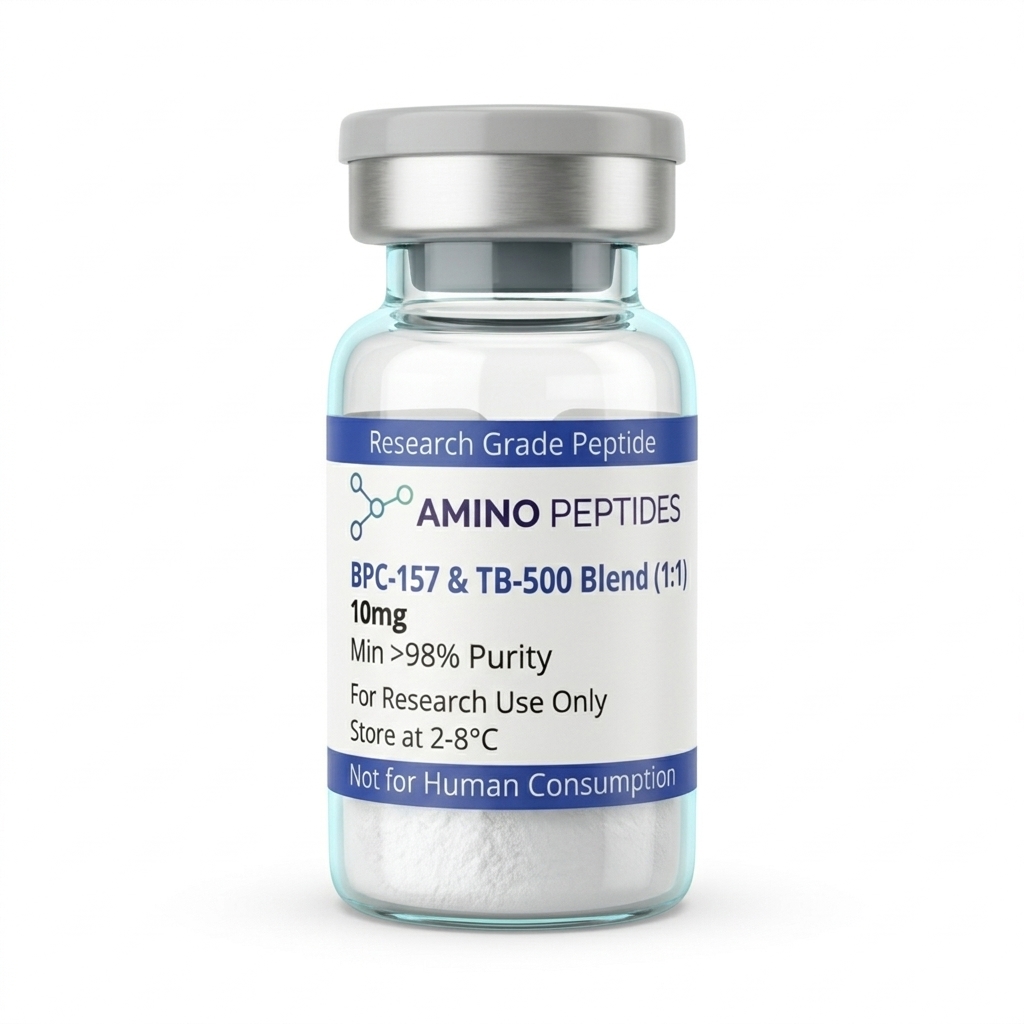
BPC-157 & TB-500 Blend
From £45
Supplied as a sealed freeze-dried vial (stable 12–24 months at 2°C–8°C in a standard refrigerator).
Shop BPC-157 & TB-500 Blend →In strict laboratory conditions, dropping the pentadecapeptide onto human umbilical vein cells triggers specific receptors. It increases the activity of vascular endothelial growth factor receptor 2 (VEGFR2). Activating this receptor starts a chemical chain reaction inside the cell. This reaction mainly relies on extracellular signal-regulated kinases (ERK1/2) and focal adhesion kinase (FAK). The cell must activate these pathways to rebuild its internal structure. This internal rebuilding allows the cells to move and multiply in flat laboratory tissue models.
Protein tests also show the peptide affects the nitric oxide system. In isolated cell tests, the compound prompts cells to produce more endothelial nitric oxide synthase (eNOS). This increases the available nitric oxide. This specific chemical shift protects flat layers of blood vessel cells from chemical stress, such as exposure to hydrogen peroxide. This delicate chemical balance breaks down if any outside variables enter the test. This sensitivity proves why these tests require sterile laboratory conditions.
The Danger of Untested Variables and Unregulated Application
Moving from a controlled petri dish to a living organism ruins the math. Laboratories maintain strict control over temperature, pH, nutrients, and air. A human body presents a chaotic and constantly changing environment. Using cell test results to guess what happens inside a human ignores basic science.
Trying to match petri dish chemical levels to human concentration guidelines ignores basic compound processing rules. Blood enzymes destroy peptides. Absorption rates fluctuate. The body flushes chemicals out. Cell cultures lack all these barriers. A study amount that makes cells move in a dish might break down immediately in a living bloodstream.
Unregulated human use of synthetic peptides carries massive, unmeasured risks. In a petri dish, the lack of an immune system lets scientists watch direct cell reactions. Inside a living body, synthetic chemicals can trigger severe immune reactions. The body might create antibodies to attack the chemical. Scientists must regard these compounds solely as laboratory chemicals.
Reconstitution calculator
Choose a vial mass and a bacteriostatic reconstitution solution volume. The figure is the resulting concentration.
Concentration: 2.50 mg/mL
Per 0.01mL (10µL): 25.0 mcg
Open the full calculatorBacteriostatic reconstitution solution
Reconstitution and Stability in the Laboratory
Correct preparation and storage of the peptide rule the accuracy of any cell test. Technicians must handle the dry powder inside a sterile biosafety cabinet. This stops dust or bacteria from ruining the sample. Any contamination instantly ruins the test results.
Laboratories must use a specific bacteriostatic fluid to dissolve the peptide powder. This fluid contains a preservative, usually benzyl alcohol. The preservative stops bacteria from growing in the vial. Technicians use calibrated micropipettes to measure exact liquid volumes. This ensures the correct chemical strength for the cell cultures.
To ensure accurate tests, laboratories must buy chemicals that come with exact analytical records. Scientists must check the Certificate of Analysis and the product data sheet. They must verify the purity, molecular weight, and amino acid sequence before starting any tests. For advanced cell work, laboratories often use a verified research grade blend. This guarantees stable results across different testing runs.
Frequently Asked Questions: In-Vitro Peptide Research
How is the structural integrity of the pentadecapeptide verified prior to in-vitro application?
Laboratories check the chemical structure and purity of the synthetic compound using High-Performance Liquid Chromatography (HPLC) and Mass Spectrometry (MS). These tests confirm the correct amino acid chain. They also spot any leftover manufacturing chemicals that might ruin the cell tests. A purity level above ninety-nine percent is required for accurate laboratory work.
What is the primary mechanism of action observed in endothelial cell cultures?
In isolated blood vessel cell cultures, the peptide mainly targets the nitric oxide system and boosts VEGFR2 activity. This connection starts chemical chains inside the cell, specifically the FAK and ERK pathways. Activating these pathways causes measurable increases in cell movement and division during controlled scratch tests.
Why is a bacteriostatic reconstitution solution required for longitudinal in-vitro studies?
A bacteriostatic mixing fluid contains a specific amount of benzyl alcohol. This alcohol acts as a chemical preservative. It stops bacteria from entering and growing inside the chemical vial over time. This protection keeps the peptide clean and chemically stable for repeated use in long-term cell tests.
Conclusion: The Imperative of Controlled Environments
The online stories about a Wolverine peptide BPC-157 human regeneration study amount show exactly how the public misreads scientific data. The molecule does trigger interesting chemical signals in isolated cell environments. However, these isolated chemical events cannot translate into human body repairs. Valid scientific testing requires strict, non-human settings. Future peptide research depends on step-by-step laboratory testing. This testing has zero connection to the unregulated guesswork seen in online forums.
Verified Literature Bibliography
- Sikiric, P., et al. (2011). Brain-gut axis and pentadecapeptide BPC 157: Theoretical and practical implications. View published research
- Tkalcevic, V. I., et al. (2007). Enhancing effect of pentadecapeptide BPC 157 on the healing of transected rat Achilles tendon. View published research
- Vukojevic, J., et al. (2018). Pentadecapeptide BPC 157 and the central nervous system. View published research
- Gwyer, D., et al. (2019). Gastric pentadecapeptide BPC 157 and its role in angiogenesis. View published research
- Chang, C. H., et al. (2011). The promoting effect of pentadecapeptide BPC 157 on tendon healing involves tendon outgrowth, cell survival, and cell migration. View published research
- Hsieh, M. J., et al. (2017). Therapeutic potential of pro-angiogenic BPC157 is associated with VEGFR2 activation and up-regulation. View published research
⚠️ Research Use Only Disclaimer: All peptides and compounds are sold strictly for in-vitro laboratory research purposes only. Not intended for human or veterinary use, not a dietary supplement, and not approved to diagnose, treat, cure, or prevent any disease or condition. For use by qualified researchers in suitably equipped laboratory environments only. Amino Peptides Ltd operates in full compliance with UK MHRA regulations and applicable EU research chemical guidelines.