
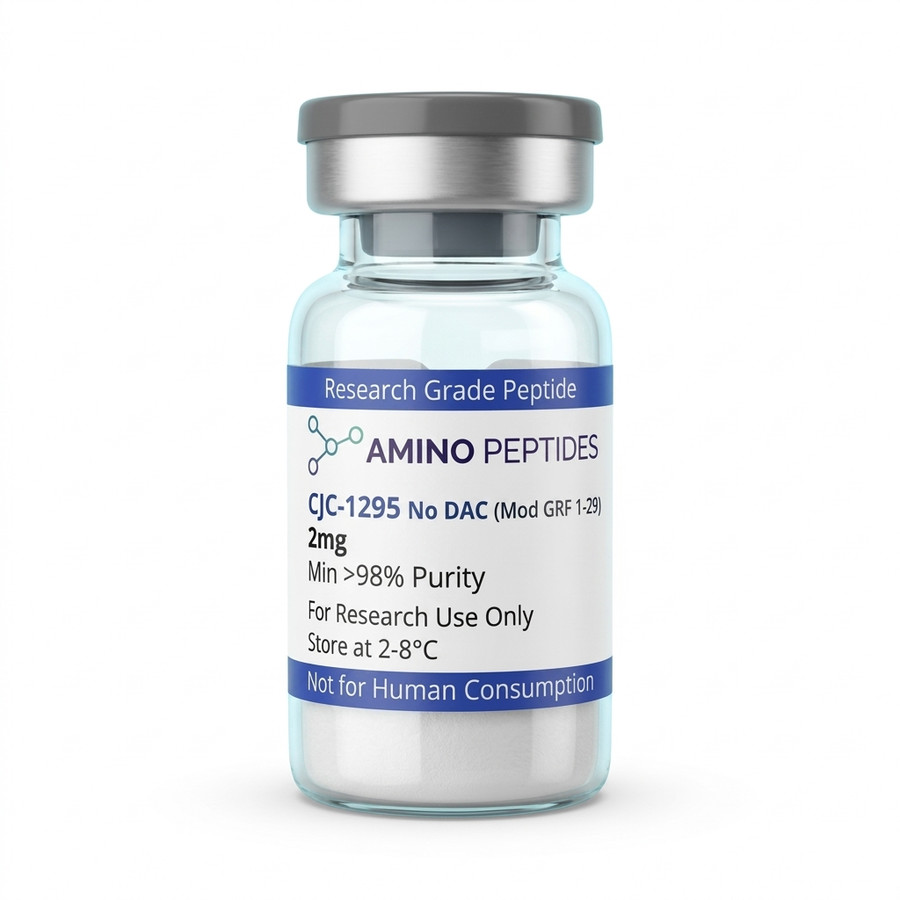
CJC-1295 No DAC, frequently referred to as Modified GRF (1-29), is a synthetic analogue of endogenous growth hormone-releasing hormone (GHRH). In cellular models, this tetrasubstituted peptide demonstrates enhanced resistance to enzymatic cleavage compared to its natural counterpart. As a premium research chemical, UK laboratories utilise this compound to investigate receptor-ligand interactions and intracellular signalling cascades. The structural modifications introduced during advanced peptide synthesis significantly improve its molecular stability, allowing researchers to observe prolonged receptor activation in vitro. When preparing laboratory stocks, precise reconstitution protocols must be followed to maintain the structural integrity of the lyophilised solid. By binding to GHRH receptors on target cells, it triggers the cAMP-dependent pathway, which is a primary focus in contemporary biochemical studies. For deeper insights into structural variations, researchers often explore the Cjc 1295 With Dac Vs No Dac Understanding Half Life Differences to optimise experimental timelines. Further structural data and related analogue properties can be reviewed on PubChem.
Public search data clusters around B2C queries when discussing this peptide. Current literature uses these search phrases to index laboratory cell-repair models, not consumer protocols. Research trends summarise those papers as observations in isolated cell cultures. Amino Peptides supplies this compound only as a lyophilised laboratory reagent strictly for laboratory research.
- Selective binding to the growth hormone secretagogue receptor (GHS-R1a) in isolated somatotroph cell models.
- Interaction with anterior pituitary receptor complexes to evaluate binding affinity and receptor internalisation.
- Modulation of G-protein coupled receptor (GPCR) conformations in cell-free membrane preparations.
- Evaluation of ligand-receptor dissociation rates compared to endogenous GHRH analogues.
- Activation of the adenylyl cyclase pathway, leading to elevated intracellular cyclic AMP (cAMP) levels in laboratory cell cultures.
- Stimulation of protein kinase A (PKA) cascades, measured through phosphorylation studies in controlled environments.
- Induction of calcium ion influx via voltage-gated calcium channels in isolated cellular frameworks.
- Assessment of proteolytic cleavage resistance in cell-free stability experiments.
Technical Specifications
Variant Breakdown
- 2mg Vial: Ideal for preliminary in-vitro assays requiring small-scale stock solutions and immediate cellular application.
- 5mg Vial: Suited for medium-throughput screening and extended receptor binding studies, offering a balanced quantity for multiple experimental runs.
- 10mg Vial: Designed for comprehensive, longitudinal cellular models and extensive biochemical profiling where consistent batch continuity is essential.
Quality Assurance
- HPLC Analysis: High-performance liquid chromatography is utilised to confirm a purity level exceeding 99%, ensuring the absence of truncated sequences.
- Mass Spectrometry: Molecular weight is precisely verified using mass spectrometry, confirming the exact tetrasubstituted structural identity.
- Lyophilised Form: The compound is supplied as a stable, lyophilised solid to preserve molecular integrity during transit and long-term storage.
- Laboratory Characterisation: Each batch undergoes rigorous endotoxin testing and solubility profiling to guarantee suitability for sensitive in-vitro environments.
Research Mechanism
- Receptor Binding: The peptide selectively binds to the GHRH receptor (GHRHR), a G-protein coupled receptor located on the surface of specific target cells.
- Signal Transduction: Upon binding, it induces a conformational change that activates the stimulatory G-protein (Gs), leading to the upregulation of adenylate cyclase.
- cAMP Elevation: Adenylate cyclase catalyses the conversion of ATP to cyclic AMP (cAMP), significantly raising intracellular secondary messenger levels.
- Kinase Activation: Elevated cAMP activates Protein Kinase A (PKA), which subsequently phosphorylates downstream target proteins and transcription factors.
- Enzymatic Resistance: The substitution of four specific amino acids prevents rapid degradation by dipeptidyl peptidase-4 (DPP-4), extending the duration of receptor activation in culture.
Reconstitution & Storage Data
| Vial Strength | Solvent Added | Resulting Concentration |
| 2mg | 1 mL Bacteriostatic Reconstitution Solution | 2.00 mg/mL |
| 2mg | 2 mL Bacteriostatic Reconstitution Solution | 1.00 mg/mL |
| 5mg | 1 mL Bacteriostatic Reconstitution Solution | 5.00 mg/mL |
| 5mg | 2 mL Bacteriostatic Reconstitution Solution | 2.50 mg/mL |
| 10mg | 1 mL Bacteriostatic Reconstitution Solution | 10.00 mg/mL |
| 10mg | 2 mL Bacteriostatic Reconstitution Solution | 5.00 mg/mL |
- Lyophilised (Powder): Store in a standard refrigerator (2-8°C) for up to 3 months. For long-term preservation, freeze at -20°C.
- Reconstituted (Liquid): Store at 2-8°C (Refrigerated).
Scientific References
Endocrinology: "Structure-activity relationships of growth hormone-releasing factor analogues" View Study
Molecular Endocrinology: "Signal transduction mechanisms of the growth hormone-releasing hormone receptor" View Study
Journal of Peptide Research: "In vitro stability and enzymatic degradation of GHRH analogues" View Study
Biochemical Journal: "Dipeptidyl peptidase IV cleavage of growth hormone-releasing hormone" View Study
Peptides: "Conformational analysis and receptor binding of modified GRF peptides" View Study