
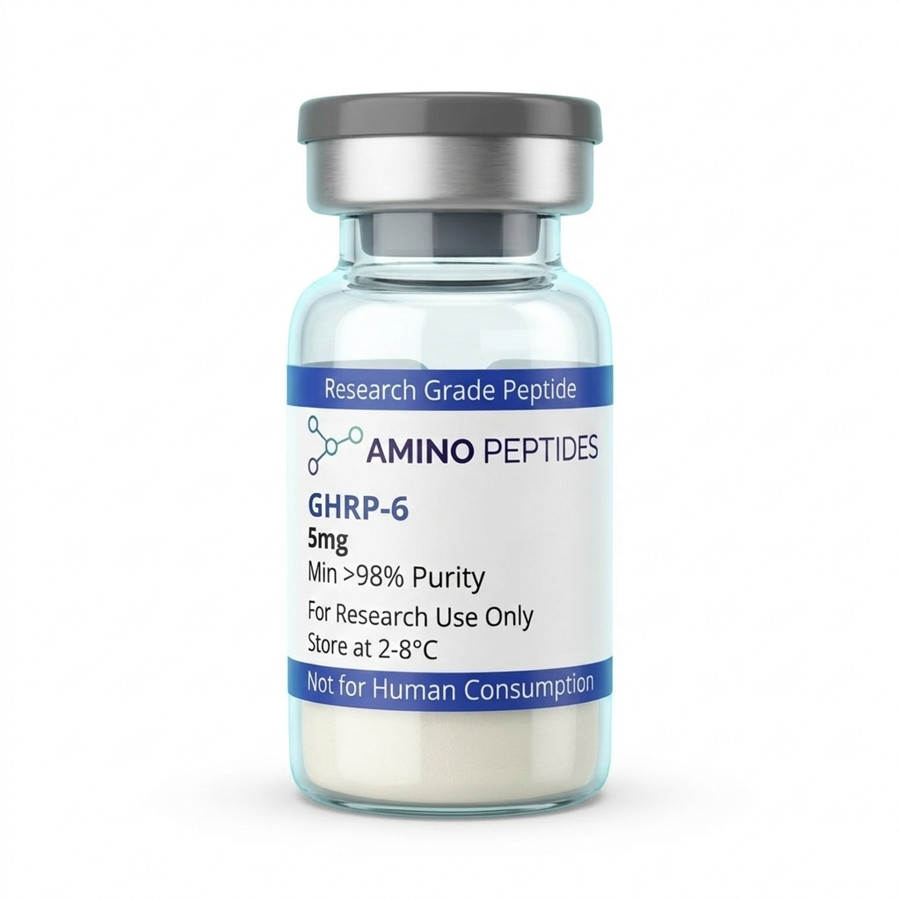
GHRP-6 (Growth Hormone-Releasing Peptide 6) is a synthetic hexapeptide designed to study the activation of the ghrelin receptor (GHS-R1a) in cellular models. As a premium research chemical, UK laboratories utilise this compound to investigate intracellular signalling pathways, including calcium ion mobilisation and the activation of protein kinase C. During in-vitro studies, scientists rely on precise reconstitution protocols to ensure long-term molecular stability. The advanced peptide synthesis of GHRP-6 yields a highly purified lyophilised solid, allowing for accurate laboratory evaluation-dependent assays. By binding to specific cellular receptors, GHRP-6 triggers a cascade that mimics endogenous ghrelin, making it a valuable tool for advancing the somatotropic frontier. Further structural and chemical data can be found on PubChem.
Public search data clusters around phrases like "muscle growth" and "healing" when indexing GHRP-6. Current literature uses these search terms to categorize isolated cellular responses and receptor binding affinities in controlled environments. Research trends focus strictly on these molecular interactions rather than consumer applications. Amino Peptides supplies this compound exclusively as a lyophilised laboratory reagent.
- Growth hormone secretagogue receptor 1a (GHS-R1a) serves as the primary binding site in isolated cellular models.
- CD36 scavenger receptors are identified as secondary targets in macrophage cell lines during controlled lab experiments.
- Melanocortin receptors exhibit competitive binding profiles when exposed to GHRP-6 in cell-free systems.
- Activation of GHS-R1a initiates a phospholipase C (PLC) signalling cascade, leading to intracellular calcium mobilization in isolated somatotrophs.
- Protein kinase C (PKC) phosphorylation pathways are upregulated following prolonged exposure in molecular-stability studies.
- Transcription factor translocation, specifically involving cAMP response element-binding protein (CREB), is observed in targeted tissue cultures.
Technical Specifications
Variant Breakdown
- 5mg Vial: Provides a standard quantity of lyophilised peptide, ideal for preliminary binding assays and short-term cellular experiments.
- 10mg Vial: Offers a larger yield for extensive laboratory screening, allowing for multiple dilutions and long-term stability testing.
Quality Assurance
- HPLC Analysis: High-performance liquid chromatography ensures a purity level exceeding 99%, confirming the absence of synthesis by-products.
- Mass Spectrometry: Verifies the exact molecular weight (873.0 g/mol) and structural integrity of the synthesised hexapeptide.
- Lyophilisation: Processed into a stable, freeze-dried solid to maximise shelf life and preserve molecular structure before reconstitution.
- Endotoxin Testing: Rigorously screened to ensure endotoxin levels remain below 0.5 EU/mg, preventing cellular toxicity in sensitive assays.
Research Mechanism
- Binds selectively to the GHS-R1a receptor on the surface of pituitary somatotroph cells in vitro.
- Triggers an influx of intracellular calcium ions, which acts as a secondary messenger in the signalling cascade.
- Activates the phospholipase C (PLC) and protein kinase C (PKC) pathways to stimulate cellular responses.
- Demonstrates competitive binding dynamics, allowing researchers to map ghrelin receptor interactions.
- Promotes the transcription of specific genes associated with somatotropic activity during controlled cellular assays.
Reconstitution & Storage Data
| Vial Strength | Solvent Added | Resulting Concentration |
| 5mg | 1 mL Bacteriostatic Reconstitution Solution | 5.00 mg/mL |
| 5mg | 2 mL Bacteriostatic Reconstitution Solution | 2.50 mg/mL |
| 10mg | 1 mL Bacteriostatic Reconstitution Solution | 10.00 mg/mL |
| 10mg | 2 mL Bacteriostatic Reconstitution Solution | 5.00 mg/mL |
- Lyophilised (Powder): Store in a standard refrigerator (2-8°C) for up to 3 months. For long-term preservation, freeze at -20°C.
- Reconstituted (Liquid): Store at 2-8°C (Refrigerated).
Scientific References
Endocrinology: "Growth hormone-releasing peptide-6 (GHRP-6) stimulates phosphatidylinositol turnover and calcium mobilisation in vitro" View Study
Journal of Neuroendocrinology: "Mechanism of action of growth hormone-releasing peptide-6 on pituitary cells" View Study
Molecular Endocrinology: "In vitro characterization of GHRP-6 binding to the growth hormone secretagogue receptor" View Study
Peptides: "Ghrelin and GHRP-6: receptor binding and signal transduction pathways in cellular models" View Study