
Analysing the Role of NAD+ in In-Vitro Cellular Metabolism and Energy Pathways
6th Oct 2026

What You Need to Know About NAD+
- NAD+ is nicotinamide adenine dinucleotide, a dinucleotide cofactor rather than a peptide.
- It is searched because it feeds redox reactions that cellular-energy assays actually measure.
- MOTS-c and 5-Amino-1MQ are the stocked partners when a laboratory wants a peptide and an NNMT inhibitor beside it.
- The cofactor still has to be 99%+ HPLC-verified and kept at 2°C–8°C if the redox readout is going to be repeatable.
Nicotinamide adenine dinucleotide, commonly known as NAD+, is a core molecule found in all living cells. In laboratory settings, it serves as a primary subject for researchers studying how cells generate and manage energy. Rather than looking at whole organisms, scientists isolate cells in petri dishes to map exactly how this chemical moves energy from one place to another.
To understand the mechanics of NAD+, it helps to picture a fleet of microscopic delivery trucks. Inside a cell, chemical reactions constantly break down nutrients. This breaking process releases high-energy electrons. NAD+ acts as the empty truck. It pulls up to the chemical reaction, loads the electrons into its cargo bed, and chemically changes its structure to become NADH. The full truck then drives to the mitochondria, the power plant of the cell, to drop off the electrons.
Once the electrons are unloaded, NADH turns back into the empty NAD+ truck, ready to repeat the cycle. This continuous loop is what keeps cellular respiration running in laboratory models. Without this transport system, isolated cells quickly lose their ability to produce ATP, the main energy currency required for basic cellular survival.
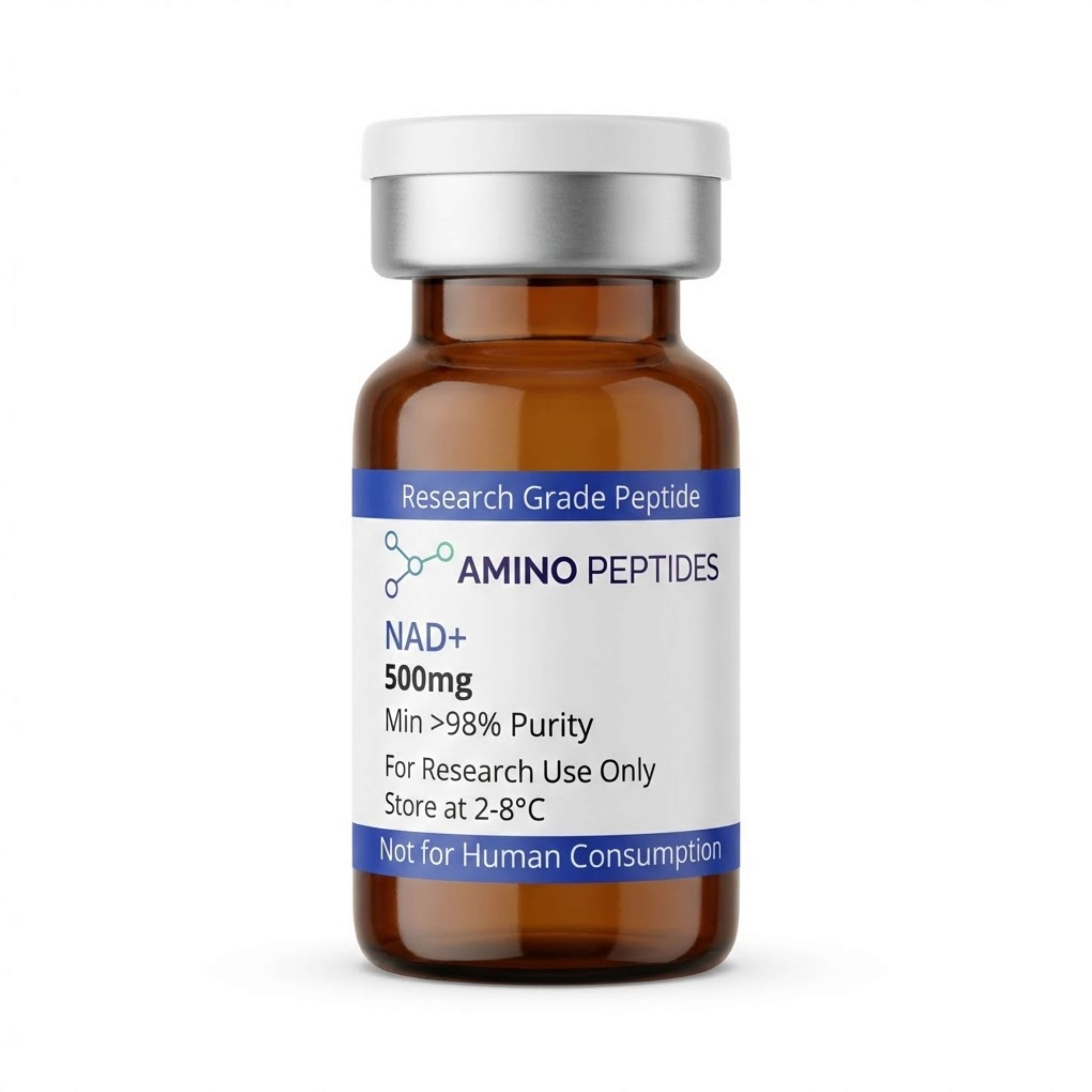
NAD+
From £45
Supplied as a sealed freeze-dried vial (stable 12–24 months at 2°C–8°C in a standard refrigerator).
Shop NAD+ →Researchers analysing its exact molecular weight and purity often refer to the Product Specification Sheet before beginning cellular assays. Knowing the precise chemical properties is critical because NAD+ does more than just carry electrons. It also acts as a chemical switch for other important proteins within the isolated cell.
In the cytoplasm of the cell, the first stage of energy production is glycolysis. Here, enzymes split glucose molecules. This splitting action releases a small amount of energy and high-energy electrons. NAD+ waits right at this step to capture those electrons. Inside the mitochondria, a secondary process called the Krebs cycle strips even more electrons from the broken-down glucose fragments. This stage requires a massive influx of NAD+ to capture the sheer volume of electrons being released.
The final destination for the loaded NADH trucks is the inner membrane of the mitochondria. Here, a series of protein complexes strip the electrons away from NADH. The energy from these electrons is used to pump protons across the membrane, creating a chemical pressure that ultimately spins a microscopic turbine to generate ATP. This entire chain relies entirely on the constant recycling of NAD+.
Beyond energy transport, two primary groups of proteins rely on NAD+ to function: sirtuins and PARPs. In cell culture studies, sirtuins act as cellular regulators. They read the ratio of empty trucks (NAD+) to full trucks (NADH). If the cell has a high amount of empty NAD+, sirtuins activate pathways that instruct the cell to conserve energy and repair internal damage.
PARPs are enzymes that repair broken DNA strands. When researchers expose isolated cells to ultraviolet light or chemical stress, DNA damage occurs. The PARP enzymes rush to the site of the damage, but they require a steady supply of NAD+ to fuel the repair process. During severe cellular stress, rapid PARP activity can drain the cell's NAD+ reserves entirely, leading to cellular failure.
Reconstitution calculator
Choose a vial mass and a bacteriostatic reconstitution solution volume. The figure is the resulting concentration.
Concentration: 2.50 mg/mL
Per 0.01mL (10µL): 25.0 mcg
Open the full calculatorBacteriostatic reconstitution solutionMeasuring the balance of NAD+ and NADH is a standard technique in metabolic research. By extracting the contents of cultured cells and running them through a spectrometer, scientists can calculate the exact ratio. A high ratio indicates a cell in a state of high metabolic demand, while a low ratio often points to cellular dysfunction or metabolic stalling.
When sourcing research-grade NAD+ for laboratory culture studies, purity dictates the accuracy of these spectrometer readings. Contaminants in the sample can absorb light at similar wavelengths, skewing the data and leading to false conclusions about cellular metabolic rates. To quantify these processes accurately, laboratory technicians often use fluorometric assays. They introduce a chemical probe into the cell culture that emits light when it reacts with NADH, allowing them to calculate exactly how much NAD+ is actively participating in the electron transport chain.
It is crucial to separate what happens in a controlled laboratory environment from whole-body biology. A cell culture in a sterile incubator is an isolated system. When researchers observe that adding NAD+ to a petri dish increases sirtuin activity, they are documenting a direct chemical reaction. This does not mean the same compound will survive digestion, cross biological barriers, or reach the cells of a living organism.
The scientific literature is filled with studies characterising how NAD+ levels decline as isolated cells age and divide. As a cell replicates over time, its internal machinery becomes less efficient at recycling NADH back into NAD+. The empty delivery trucks become scarce, and the entire energy transport system slows down. This cellular ageing model allows researchers to test various compounds in-vitro to observe chemical interactions. However, the data remains strictly confined to the laboratory. The mechanisms observed in these isolated environments provide a baseline understanding of cellular chemistry, not a model for whole-body outcomes.
Scientific In-Vitro FAQs
How is NAD+ stability maintained during in-vitro cellular assays?
NAD+ is highly sensitive to environmental degradation. In the laboratory, it must be dissolved using a precise bacteriostatic reconstitution solution and stored at ultra-low temperatures, typically -20 degrees Celsius or lower. Exposure to room temperature or ambient light causes the molecule to rapidly break down, which invalidates cellular assay results.
What role does the NAD+/NADH ratio play in laboratory cell cultures?
The ratio acts as a primary indicator of cellular metabolic health. Researchers measure this balance to determine how efficiently an isolated cell is converting nutrients into ATP. A disrupted ratio in cell cultures usually indicates mitochondrial stress or a block in the electron transport chain.
Why do researchers study sirtuin activation alongside NAD+ in-vitro?
Sirtuins are enzymes that depend entirely on NAD+ to function. In laboratory models, scientists monitor sirtuin activity to understand how cells respond to metabolic stress and initiate internal repair mechanisms. Because sirtuins cannot operate without NAD+, the two are almost always analysed together in cellular biology studies.
- Covarrubias, A. J., Perrone, R., Grozio, A., & Verdin, E. (2021). NAD+ metabolism and its roles in cellular processes during ageing. Nature Reviews Molecular Cell Biology, 22(2), 119-141. View published research
- Cantó, C., Menzies, K. J., & Auwerx, J. (2015). NAD+ Metabolism and the Control of Energy Homeostasis: A Balancing Act between Mitochondria and the Nucleus. Cell Metabolism, 22(1), 31-53. View published research
- Verdin, E. (2015). NAD⁺ in aging, metabolism, and neurodegeneration. Science, 350(6265), 1208-1213. View published research
⚠️ Research Use Only Disclaimer: All peptides and compounds are sold strictly for in-vitro laboratory research purposes only. Not intended for human or veterinary use, not a dietary supplement, and not approved to diagnose, treat, cure, or prevent any disease or condition. For use by qualified researchers in suitably equipped laboratory environments only. Amino Peptides Ltd operates in full compliance with UK MHRA regulations and applicable EU research chemical guidelines.