
AOD 9604 Peptide: Fact vs Fiction Behind the Fat-Loss Trend
4th Nov 2026
What You Need to Know About AOD-9604
- AOD-9604 is the stocked analogue of the C-terminal HGH fragment 176-191, searched for lipolytic signalling.
- In plain English, published models watch how fat cells release stored lipid when this sequence is in the assay.
- Study timelines separate an early signalling window from later changes in lipid handling.
- A 99%+ HPLC-verified, freeze-dried vial kept at 2°C–8°C is the variable a laboratory can hold constant.
How AOD 9604 Targets Lipid Signalling Without Full Growth Hormone Effects
AOD 9604 is a modified sixteen-amino-acid fragment taken from the tail end of the human growth hormone molecule, specifically amino acids 177 to 191 with a tyrosine added at the start. Published studies show this isolated segment triggers fat breakdown and blocks new fat storage in adipose tissue models without altering blood sugar or driving cell growth.
When people ask what is aod 9604 peptide, the simplest way to picture it is a key that has been filed down so it only opens one specific lock. The full growth hormone protein consists of 191 amino acids and binds to receptors all over the body. It influences bone length, organ size, insulin sensitivity, and lipid metabolism all at once. In the late 1990s, biochemistry teams at Monash University noticed that the tiny loop at the very end of the chain handled the fat-burning instructions on its own. By clipping out amino acids 177 through 191 and capping the front with a tyrosine residue to keep the shape stable, researchers created AOD 9604.
In laboratory models of adipose tissue, this shortened chain works in two distinct directions. First, it speeds up lipolysis, which is the chemical process where fat cells break down stored triglycerides into free fatty acids for cellular energy. Second, it slows down lipogenesis, the pathway that turns excess energy back into stored lipid droplets. Because the rest of the growth hormone structure is missing, AOD 9604 cannot latch onto the standard growth hormone receptor to stimulate Insulin-like Growth Factor 1 (IGF-1).
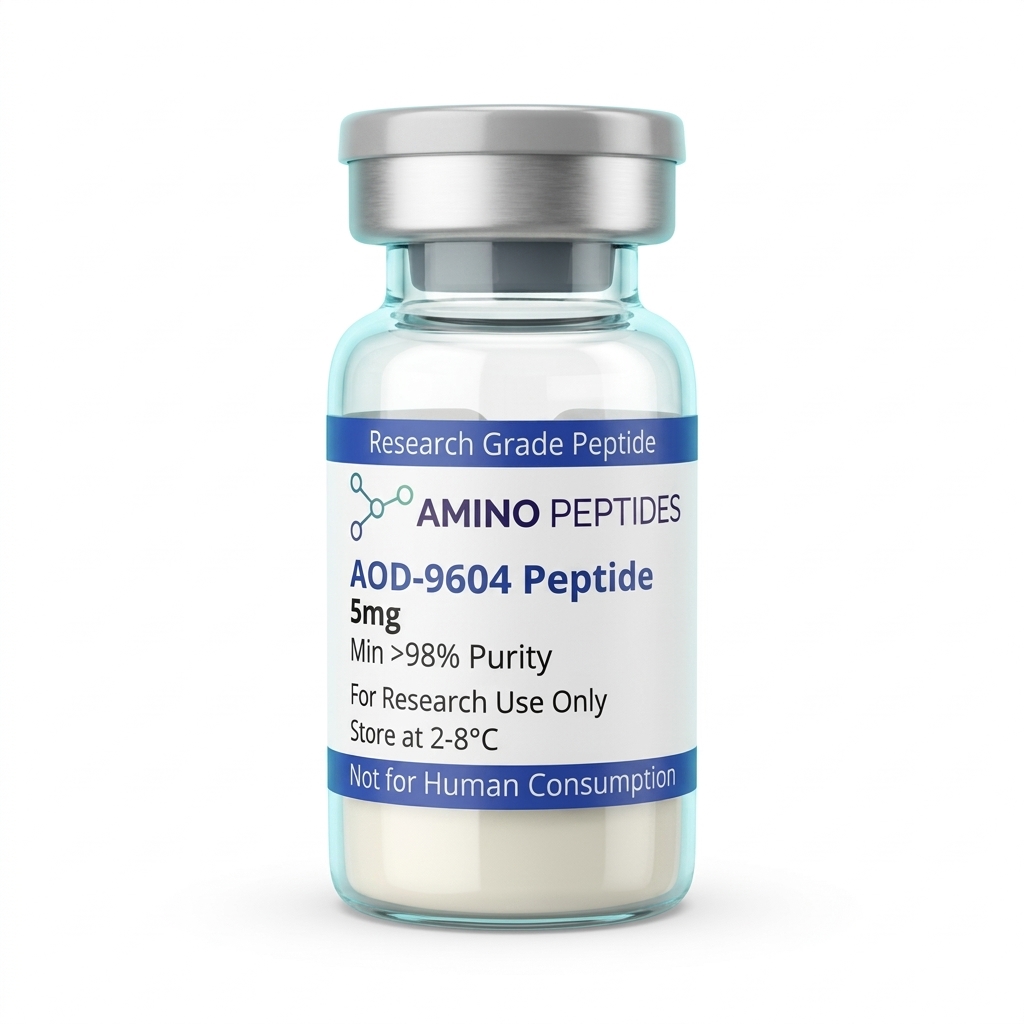
AOD-9604 Peptide
From £22
Supplied as a sealed freeze-dried vial (stable 12–24 months at 2°C–8°C in a standard refrigerator).
Shop AOD-9604 Peptide →Published studies in obese rodent models also highlighted a link to beta-3 adrenergic receptors. These receptors sit on the surface of fat cells and act like tiny thermostats for energy expenditure. In genetically obese mice, AOD 9604 bumped the expression of suppressed beta-3 receptors back toward normal baseline levels. However, when researchers tested the compound in mice that had their beta-3 receptors genetically deleted, the peptide still encouraged fat oxidation and weight reduction, just at a lower rate. This showed investigators that while beta-3 signalling helps amplify the cellular energy response, the fragment also operates through direct lipolytic enzyme activation inside the fat cell itself.
Equally important is what the molecule leaves alone. Full-length growth hormone often causes cells to resist insulin, pushing blood glucose higher. In clamp studies and cell cultures, AOD 9604 showed zero impact on carbohydrate metabolism or insulin receptor signalling. It focuses purely on lipid turnover and cellular energy balance.
What Published Studies Actually Observed Over Days and Weeks
Anyone searching for peptide aod 9604 results or general aod 9604 results online will quickly run into exaggerated fitness forum stories that address the fragment like an overnight eraser for body fat. Looking at actual laboratory notebooks gives a much calmer, step-by-step timeline of how cells and preclinical models respond over days and weeks.
During the first 24 to 72 hours of exposure in isolated adipocyte cultures and rodent models, the changes are purely chemical. There is no instant drop in tissue mass. Instead, lab assays pick up an immediate rise in glycerol and free fatty acid release into the surrounding medium. At the same time, researchers measure a sharp drop in the activity of acetyl-CoA carboxylase, the main enzyme that tells cells to build new fat stores. In calorimetry chambers, obese mice show a measurable climb in fat oxidation rates within the first few days, meaning their cells are burning a higher ratio of lipids for fuel.
Moving into the two-to-four-week window, those early signalling shifts begin to show up as physical changes in preclinical models. In a well-known 14-day study using obese Zucker rats, daily protocol ratios of AOD 9604 cut body weight gain by more than fifty percent compared to control animals, without changing how much food the rats ate. By week four in longer rodent protocols, dissection data confirmed a noticeable drop in Epididymal and retroperitoneal white adipose tissue pads. Noticeably, lean rodents given the exact same study amount showed very little change in total body weight, suggesting the fragment mainly corrects sluggish lipid turnover in tissues carrying excess fat storage rather than stripping mass from lean models.
Reconstitution calculator
Choose a vial mass and a bacteriostatic reconstitution solution volume. The figure is the resulting concentration.
Concentration: 2.50 mg/mL
Per 0.01mL (10µL): 25.0 mcg
Open the full calculatorBacteriostatic reconstitution solutionLonger evaluations running from 12 to 24 weeks brought a surprise twist to the timeline. Early metabolic assays in obese rodents looked very strong, yet larger multi-month evaluations reported mixed outcomes when diet and energy output were not tightly matched. Meanwhile, tissue remodelling researchers discovered a completely separate slow-acting pathway in joint cartilage. Over six to twelve weeks in rabbit models of cartilage wear, direct local protocols of AOD 9604 stimulated chondrocytes to lay down fresh collagen and proteoglycans. This secondary structural recovery took months of steady signalling to appear under a microscope, proving that short-term metabolic shifts and long-term tissue remodelling run on totally different clocks.
Biochemical Comparison: AOD 9604 vs Full-Length hGH and Fragment 176-191
| Property | AOD 9604 (Tyr-hGH 177-191) | hGH Fragment 176-191 | Full-Length hGH (191 AA) |
|---|---|---|---|
| Amino Acid Length | 16 amino acids (N-terminal tyrosine added to 177-191) | 16 amino acids (native sequence 176-191) | 191 amino acids (complete polypeptide) |
| Primary Receptor Binding | Does not bind the classic growth hormone receptor | Does not bind the classic growth hormone receptor | High affinity for the classic growth hormone receptor |
| IGF-1 Signalling Impact | No observed increase in circulating IGF-1 levels in published studies | No observed increase in circulating IGF-1 levels in laboratory models | Strongly stimulates hepatic and local IGF-1 production |
| Carbohydrate Metabolism | Does not impair glucose tolerance or induce insulin resistance in rodent models | Minimal impact on blood glucose homeostasis in short-term assays | Can reduce insulin sensitivity and elevate fasting glucose levels |
| Lipid Metabolism Pathway | Up-regulates beta-3 adrenergic receptors and inhibits lipogenesis | Stimulates lipolysis and suppresses fatty acid synthase activity | Promotes systemic lipolysis alongside broad anabolic tissue growth |
Pairing AOD 9604 With Complementary Peptides in the Lab
In modern laboratory work, researchers rarely look at a single pathway in isolation. Because AOD 9604 operates specifically on lipolysis and chondrocyte matrix production without touching IGF-1 or central nervous system receptors, it pairs cleanly with other compounds designed to study different angles of recovery, focus, or tissue remodelling.
When the research goal involves structural recovery and cartilage or muscle fibre maintenance, investigators frequently compare or combine the fragment with localized growth factors. For instance, scientists studying mechanical strain and cellular repair often choose to buy mgf peptide alongside AOD 9604. Mechano Growth Factor (MGF) is a splice variant of IGF-1 that wakes up dormant satellite cells in muscle tissue after physical stress, whereas AOD 9604 works on lipid energy mobilization and cartilage proteoglycan synthesis. Running them in parallel allows a lab to observe how energy substrate availability from fat stores interacts with localized structural repair signals.
Another common laboratory pairing involves BPC-157 and TB-500. While AOD 9604 encourages chondrocytes to produce extra collagen and matrix proteins over several weeks, BPC-157 supports new blood vessel formation (angiogenesis) and fibroblast migration, and TB-500 regulates actin to help cells move to the site of wear. In preclinical joint and tendon models, combining these three distinct mechanisms lets researchers watch how blood supply, cell migration, and matrix building work together without overlapping on the same receptor.
On the metabolic and cognitive side, labs examining how energy regulation connects to stress and focus often look toward neuropeptides. Pairing metabolic fragments with Semax and Selank gives investigators a way to study peripheral lipid oxidation alongside central Brain-Derived Neurotrophic Factor (BDNF) and GABAergic signalling. Because AOD 9604 does not cross into jittery adrenergic stimulation like caffeine or ephedrine, it does not muddy the calm focus signals observed with Selank or the mental stamina markers tracked with Semax.
Finally, some metabolic labs contrast AOD 9604 with CJC-1295 and Ipamorelin. Those two peptides tell the pituitary gland to release a full pulse of natural growth hormone, which raises IGF-1 across the whole organism. Comparing a full secretagogue stack against the isolated AOD 9604 tail fragment helps researchers separate which cellular outcomes come from whole-body growth hormone pulses and which come strictly from the 177-191 lipid-signalling loop.
Figure 1: AOD 9604 Peptide: Fact vs Fiction Behind the Fat-Loss Trend
Why HPLC Verification and Cold Storage Define AOD 9604 Quality
When browsing aod 9604 peptide reviews or comparing aod 9604 peptide cost across different suppliers, the biggest hidden variable is almost always what sits inside the vial alongside the peptide itself. AOD 9604 is a 16-amino-acid chain that includes two cysteine residues at positions 182 and 189. During synthesis, those two cysteines must link together to form a precise disulphide bridge, folding the peptide into a tiny loop. If the manufacturing process is rushed or poorly controlled, that loop fails to close properly, or the chains link up with neighbours to form clumpy dimers that have zero biological activity.
This structural sensitivity explains why genuine 99%+ purity verified by High-Performance Liquid Chromatography (HPLC) and Mass Spectrometry matters so much. Bargain vials that drive down the aod 9604 peptide cost often skip secondary purification steps. As a result, a budget lyophilised powder might only contain seventy or eighty percent intact cyclic AOD 9604, with the rest made up of broken amino acid sequences and synthesis leftovers. When a lab uses low-grade material, any weak or confusing readout is a failure of the vial, not a failure of the peptide's biology.
Another major quality divider is Trifluoroacetic Acid (TFA) removal. TFA is a harsh solvent used to cleave peptides off their resin beads during solid-phase synthesis. If a manufacturer does not swap out the TFA salt for a cleaner acetate or hydrochloride counter-ion through ion-exchange chromatography, residual TFA stays trapped in the freeze-dried cake. In cell cultures, leftover TFA drops the pH of the medium, stresses cell membranes, and causes erratic false readings in metabolic and cartilage assays.
Once a verified 99%+ pure, TFA-screened vial arrives at the lab, keeping that disulphide loop intact comes down to cold storage and gentle handling. In its dry lyophilised state, the vial belongs in a refrigerator at 2°C to 8°C (or frozen at -20°C for long-term archiving) away from bright light. When preparing the peptide for an assay with a bacteriostatic reconstitution solution, the liquid should be trickled slowly down the inside glass wall rather than blasted directly onto the powder cake. Never shake the vial; gentle swirling prevents shear stress from snapping the delicate disulphide bridge, though AOD 9604 sometimes requires an extra few minutes of subject rolling to dissolve fully into a clear solution.
Frequently Asked Questions
Why are so many people searching for AOD 9604 peptide results?
People search for AOD 9604 because it is a modified fragment of growth hormone studied for its role in fat metabolism. Unlike full growth hormone, published studies observed that this specific C-terminal chain targets lipid breakdown in laboratory models without altering blood sugar levels or triggering unwanted tissue growth.
What timeline did published studies observe for AOD 9604 results?
Published studies typically tracked metabolic changes over a twelve-week to twenty-four-week timeline in laboratory models. Early shifts in fat oxidation signalling appeared within the first fourteen days, while measurable reductions in adipose tissue mass required consistent protocol ratios over several months before researchers could properly analyse the final outcomes.
Why do researchers combine or stack AOD 9604 with other peptides?
Researchers often pair AOD 9604 with other compounds in preclinical models to analyse how different cellular pathways interact during tissue remodelling. For instance, scientists might compare its isolated lipid-mobilising signalling alongside peptides that support cartilage recovery or metabolic regulation to characterise broader physiological responses without overlapping receptor fatigue.
How do purity and fridge storage affect AOD 9604 in the lab?
High purity and strict cold storage are essential to prevent the delicate amino acid chain from degrading before testing. Once mixed with a bacteriostatic reconstitution solution, the liquid peptide must stay refrigerated between two and eight degrees Celsius so the measured level remains stable and reliable for laboratory analysis.
Bibliography
- Ng FM, Sun J, Sharma L, Libinaka R, Jiang WJ, Gianello R. Metabolic studies of a synthetic lipolytic domain (AOD9604) of human growth hormone. Horm Res. 2000;53(6):274-278. View published research
- Heffernan MA, Thorburn AW, Fam B, Summers R, Conway-Campbell B, Waters MJ, Ng FM. Increase of fat oxidation and weight loss in obese mice caused by chronic administration of human growth hormone or a modified C-terminal fragment. Int J Obes Relat Metab Disord. 2001;25(10):1442-1449. View published research
- Heffernan M, Summers RJ, Thorburn A, Ogru E, Gianello R, Jiang WJ, Ng FM. The effects of human GH and its lipolytic fragment (AOD9604) on lipid metabolism following chronic administration in obese mice and beta(3)-AR knock-out mice. Endocrinology. 2001;142(12):5182-5189. View published research
- Stier H, Vos E, Kenley D. Safety and tolerability of the hexadecapeptide AOD9604 in humans. J Endocrinol Metab. 2013;3(1-2):7-15. View published research
⚠️ Research Use Only Disclaimer: All peptides and compounds are sold strictly for in-vitro laboratory research purposes only. Not intended for human or veterinary use, not a dietary supplement, and not approved to diagnose, treat, cure, or prevent any disease or condition. For use by qualified researchers in suitably equipped laboratory environments only. Amino Peptides Ltd operates in full compliance with UK MHRA regulations and applicable EU research chemical guidelines.