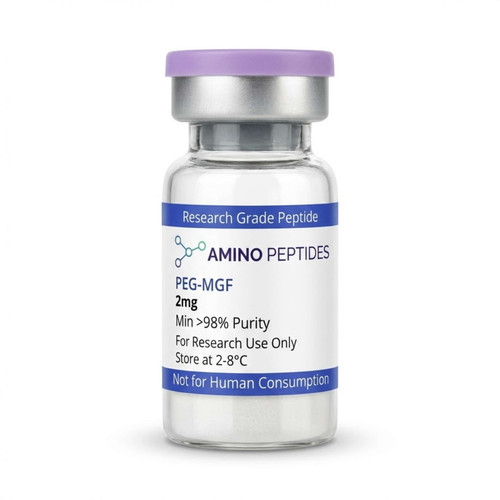


Mechano Growth Factor (MGF) is a splice variant of Insulin-like Growth Factor 1 (IGF-1), primarily expressed in skeletal muscle tissue following mechanical stress. In cellular models, MGF initiates a distinct signalling cascade that promotes the activation and proliferation of satellite cells, which are crucial for muscular repair and cellular hypertrophy. During rigorous peptide synthesis, the structural integrity of MGF is carefully preserved to ensure optimal receptor binding in vitro. When researchers evaluate this compound, maintaining high molecular stability is paramount, requiring precise reconstitution protocols to prevent premature degradation in aqueous environments. As a premium research chemical, UK laboratories utilise MGF to study cellular proliferation pathways independent of mature IGF-1 receptor activation. Further structural data and registry information can be reviewed on PubChem.
Public search data clusters around terms like therapy and muscle growth when referencing Mechano Growth Factor. Current literature summarises these papers as observations in isolated cell cultures, rather than consumer protocols. Amino Peptides supplies this compound only as a lyophilised laboratory reagent. Strictly for laboratory research.
- Binds to uncharacterised mechanosensitive membrane receptors distinct from the IGF-1R (Insulin-like Growth Factor 1 Receptor) in isolated skeletal myoblast lineages.
- Interacts with extracellular matrix (ECM) components to modulate focal adhesion kinase (FAK) signalling in cell-free environments.
- Engages transiently with membrane-bound integrin complexes to initiate downstream kinase cascades in cultured progenitor cells.
- Activates the MAPK/ERK (Mitogen-Activated Protein Kinase) signalling cascade, promoting transcriptional activity related to cellular proliferation in lab models.
- Upregulates the expression of basic helix-loop-helix (bHLH) transcription factors, such as MyoD, in isolated mononuclear cell cultures.
- Inhibits apoptosis pathways by modulating Bax/Bcl-2 ratios during induced mechanical stress in controlled cellular experiments.
- Stimulates the migration and division of satellite cell analogues without triggering terminal differentiation protocols in the laboratory.
Technical Specifications
Variant Breakdown
- 2mg Vial: Provided as a lyophilised solid, this standard quantity is designed for precise laboratory stock preparation, allowing researchers to scale their in-vitro assays effectively without excessive waste.
Quality Assurance
- HPLC Verification: High-performance liquid chromatography ensures the peptide achieves a purity level exceeding 99%, eliminating unwanted synthesis by-products.
- Mass Spectrometry: Molecular weight and structural identity are rigorously confirmed via mass spectrometry to guarantee sequence accuracy.
- Lyophilised Form: The peptide is freeze-dried under strict atmospheric controls to maximise shelf life and preserve structural conformation prior to reconstitution.
- Laboratory Characterisation: Comprehensive analytical testing is performed on every batch to ensure consistent performance across diverse cellular assays.
Research Mechanism
- Satellite Cell Activation: MGF stimulates the proliferation of mononucleated myoblasts (satellite cells) by upregulating specific cyclin-dependent kinases, driving the cells from the G0 resting phase into the active cell cycle.
- Receptor Interaction: Unlike systemic IGF-1, MGF interacts with an independent, yet-to-be-fully-characterised receptor on the cellular membrane, initiating targeted intracellular signalling.
- Signalling Cascade: The peptide activates the MEK-ERK pathway, which is essential for cellular transcription and the subsequent translation of proteins required for structural repair.
- Gene Expression: Exposure to MGF in vitro leads to the transient expression of specific transcription factors that regulate muscle cell differentiation and local tissue adaptation.
Reconstitution & Storage Data
| Vial Strength | Solvent Added | Resulting Concentration |
- Lyophilised (Powder): Store in a standard refrigerator (2-8°C) for up to 3 months. For long-term preservation, freeze at -20°C.
- Reconstituted (Liquid): Store at 2-8°C (Refrigerated).
Scientific References
Journal of Cellular Physiology: "Mechano growth factor (MGF) and its role in skeletal muscle repair" View Study
FASEB Journal: "Expression of mechano growth factor in skeletal muscle" View Study
Muscle & Nerve: "MGF promotes satellite cell proliferation in vitro" View Study
Endocrine Reviews: "Differential splicing of the IGF-1 gene and its implications" View Study
Cell Signalling: "Signalling pathways activated by Mechano Growth Factor" View Study