
CJC-1295 and DAC: Unpacking Albumin Binding Kinetics
27th Aug 2026

What You Need to Know About CJC-1295
- Researchers frequently compare CJC-1295 with the affinity complex against Modified GRF (1-29) because both share the same four amino acid substitutions but show vastly different clearance timelines.
- The added maleimidopropionic acid linker forms a strong covalent bond with free thiol groups on circulating serum albumin.
- By riding along on large albumin proteins, the peptide avoids rapid breakdown by the DPP-4 enzyme and bypasses fast kidney filtration.
- Published studies in laboratory models observed that this albumin-binding mechanism extends the active presence of the molecule from roughly thirty minutes to nearly one week.
How Albumin Hitchhiking Transforms CJC-1295 Recovery and Sleep Signals
CJC-1295 with DAC uses a specialized chemical linker to attach directly to serum albumin in the bloodstream, extending its active window from mere minutes to over a week. This prolonged presence supports steady growth hormone and IGF-1 signalling that published studies link to deeper slow-wave sleep, faster tissue repair, and improved skin elasticity.
To understand why researchers care about CJC-1295 and DAC: Unpacking Albumin Binding Kinetics, it helps to look at how quickly natural hormones disappear. Native growth hormone-releasing hormone, or GHRH, consists of forty-four amino acids, though only the first twenty-nine are needed to trigger pituitary receptors. Left unmodified, enzymes in the blood called dipeptidyl peptidase-4 chop up those twenty-nine amino acids in less than ten minutes. Chemists first swapped out four specific amino acids at positions two, eight, fifteen, and twenty-seven to block enzyme cleavage, pushing the active window to roughly thirty minutes.
The real leap in longevity comes from adding the Affinity Complex, commonly known as DAC. This addition attaches a lysine spacer and a reactive chemical group called 3-maleimidopropionic acid to the tail end of the peptide chain. Blood plasma is packed with serum albumin, a large carrier protein that circulates for nearly three weeks before the body recycles it. Out of thirty-five cysteine amino acids on an albumin protein, thirty-four are locked in structural bridges, leaving just one free thiol group at position thirty-four.
The maleimide ring on the DAC tail seeks out that single free thiol group and forms a permanent covalent bond. Once hitched to albumin, the peptide is too bulky for the kidneys to filter out and shielded from blood enzymes. Instead of vanishing in half an hour, the albumin-bound complex circulates steadily, releasing consistent signals to pituitary cells that govern overnight cellular recovery and collagen synthesis.
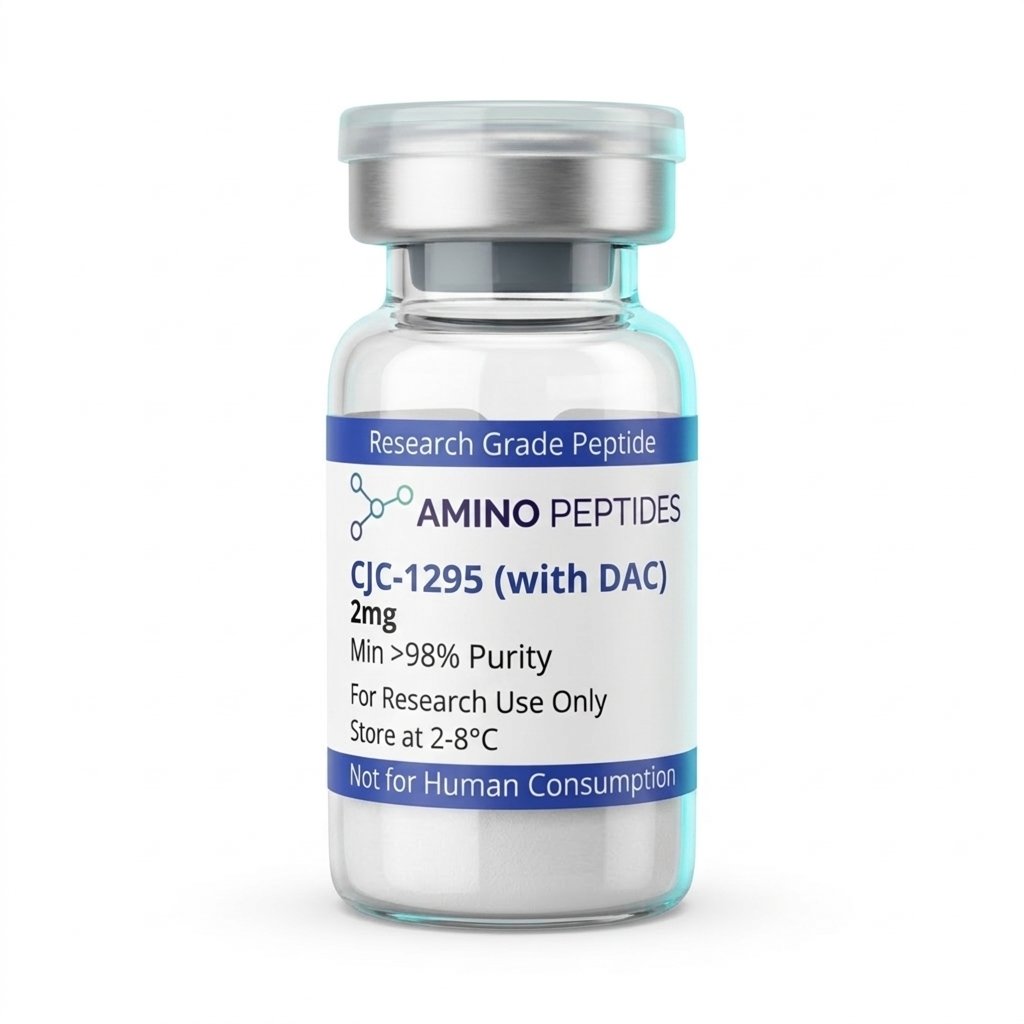
CJC-1295
From £22
Supplied as a sealed freeze-dried vial (stable 12–24 months at 2°C–8°C in a standard refrigerator).
Shop CJC-1295 →What Published Studies Observe Across Early and Late Timelines
When comparing cjc 1295 no DAC against the DAC-conjugated version, the most striking difference in laboratory models is the timeline of receptor activation. Because the covalent bond between the maleimide linker and Cys-34 on serum albumin forms within minutes of contact, the kinetic profile shifts immediately from a brief spike to a sustained plateau. Published studies tracking plasma concentrations show an estimated half-life between 5.8 and 8.1 days following a single measured level.
During the first twenty-four to forty-eight hours in preclinical models, early signalling changes take centre stage. Pituitary somatotrophs respond to the continuous GHRH receptor occupancy by amplifying the size of their natural secretory pulses without flattening the body's circadian rhythm. Instead of forcing a constant, unnatural flood of hormone, the albumin-anchored peptide acts like a volume dial on the pulses that already occur during deep sleep cycles. Researchers monitoring early timelines frequently note rapid shifts in nitrogen retention, heightened cyclic AMP activity inside target cells, and measurable increases in slow-wave sleep architecture within the first week.
Structural and systemic outcomes require longer observation windows because downstream proteins take time to accumulate. Between day seven and day fourteen, circulating Insulin-like Growth Factor 1 (IGF-1) levels climb steadily, often remaining elevated above baseline for up to two weeks after a single protocol ratio. Across four-to-eight-week study timelines, this sustained IGF-1 elevation drives slower biological processes like fibroblast proliferation, collagen matrix remodelling, and lean tissue recovery. While short-acting analogues clear out before morning, the slow turnover of serum albumin ensures that amino acid transport and cellular repair signals stay active around the clock, bridging the gap between acute receptor firing and visible structural regeneration.
Structural and Kinetic Comparison of GHRH Analogues in Laboratory Models
| Feature | Native GHRH (1-29) | Modified GRF (1-29) (No Affinity Complex) | CJC-1295 with Affinity Complex |
|---|---|---|---|
| Amino Acid Sequence | Unmodified 29-amino-acid core | Tetrasubstituted 29-amino-acid core (positions 2, 8, 15, 27) | Tetrasubstituted 29-amino-acid core plus C-terminal lysine and maleimide linker |
| Albumin Binding Ability | None observed | None observed | Covalent attachment to cysteine-34 on serum albumin |
| DPP-4 Enzyme Resistance | Low (rapidly cleaved at position 2) | High (D-alanine substitution blocks cleavage) | Very high (both D-alanine substitution and steric shielding by albumin) |
| Observed Half-Life in Models | Approximately 5 to 10 minutes | Approximately 30 minutes | Approximately 6 to 8 days |
| Signalling Pattern | Brief, immediate receptor activation | Short, distinct pulse of receptor signalling | Sustained basal elevation with preserved natural pulsatility |
Pairing Extended and Pulsatile Peptides in Laboratory Stacks
In endocrinology research, pairing peptides that target two separate receptor families often produces a stronger response than raising the concentration of a single compound. CJC-1295 with DAC belongs to the GHRH analogue family, which binds to G-protein-coupled receptors on the pituitary gland to stimulate cyclic AMP production. However, the pituitary is also regulated by somatostatin, an inhibitory hormone that acts like a brake pedal. If somatostatin levels are high when a GHRH signal arrives, the resulting pulse remains muted.
This biological brake is why laboratory protocols frequently combine GHRH analogues with growth hormone secretagogues that mimic ghrelin, such as Ipamorelin, GHRP-2, or GHRP-6. Ghrelin mimetics bind to a completely different receptor—the GHS-R1a receptor—which operates through the phospholipase C signalling pathway and actively suppresses somatostatin release. When a DAC-bound peptide provides a steady, week-long baseline of GHRH receptor readiness, introducing a selective ghrelin mimetic like Ipamorelin removes the somatostatin brake and triggers a clean, amplified pulse.
Ipamorelin is often favoured in these dual-pathway stacks because published studies show it does not significantly elevate cortisol, prolactin, or aldosterone at standard study amounts, unlike older secretagogues such as GHRP-6 or Hexarelin. Meanwhile, researchers who want strict hour-by-hour control over pulse timing sometimes opt for Modified GRF (1-29)—the DAC-free version—alongside Ipamorelin to create sharp, thirty-minute spikes that return to baseline quickly. Choosing between the DAC and non-DAC versions in a stack comes down to the experimental goal: the albumin-binding DAC variant builds a continuous multi-day foundation for tissue remodelling and IGF-1 elevation, whereas the non-DAC variant isolates brief, targeted secretory bursts without long-term plasma carry-over.

Figure: CJC-1295 and DAC: Unpacking Albumin Binding Kinetics
Reconstitution calculator
Choose a vial mass and a bacteriostatic reconstitution solution volume. The figure is the resulting concentration.
Concentration: 2.50 mg/mL
Per 0.01mL (10µL): 25.0 mcg
Open the full calculatorBacteriostatic reconstitution solutionWhy Analytical Purity and Cold Storage Protect the Maleimide Linker
The chemistry that makes albumin binding possible also makes synthesis and purification far more demanding than standard short-chain peptides. Attaching the lysine linker and the 3-maleimidopropionic acid group to a twenty-nine-amino-acid backbone requires exact stoichiometric control during solid-phase synthesis. If a batch is poorly purified, truncated peptide fragments or unattached maleimide groups can remain in the vial, competing for albumin binding sites or degrading the active sequence before it ever reaches a receptor.
Verifying a minimum purity of 99% via High-Performance Liquid Chromatography (HPLC) and confirming the exact molecular mass through Mass Spectrometry (MS) protects experimental consistency. Equally important is the removal of trifluoroacetic acid (TFA), a harsh solvent used to cleave peptides from their synthesis resin. Excess TFA left behind in low-grade lyophilisates lowers the pH of the solution upon reconstitution and accelerates hydrolysis of the delicate maleimide ring. Choosing batches that undergo proper counter-ion exchange ensures the reactive DAC tail stays intact and ready to form its covalent thioether bond with Cys-34.
Proper storage is the final safeguard for preserving reactive maleimide kinetics. In its freeze-dried powder state, the vial should be kept away from light at -20°C to halt thermal breakdown. Once mixed with a sterile bacteriostatic reconstitution solution, the liquid must be stored immediately in a standard refrigerator between 2°C and 8°C. Gently swirling the vial down the glass wall rather than shaking it prevents shear stress on the thirty-amino-acid chain. Because water slowly hydrolyses the maleimide ring over time, keeping the reconstituted solution cold at 2°C to 8°C preserves the full binding capacity of the peptide across the entire study timeline.
Frequently Asked Questions
Why do researchers search for CJC-1295 and DAC albumin binding kinetics?
Researchers investigate this topic because the affinity anchor fundamentally changes how long the peptide remains active in laboratory models. By latching onto serum albumin, the compound avoids rapid enzymatic breakdown. This allows scientists to analyse sustained growth hormone signalling and tissue remodelling without needing constant protocol interventions.
What does a typical study timeline look like for CJC-1295 with the affinity anchor?
In published studies, a single measured level of the anchored peptide remains detectable in the bloodstream for roughly six to eight days. Preclinical models show that insulin-like growth factor levels stay elevated for up to two weeks, allowing researchers to observe extended cellular repair and recovery phases.
Why is CJC-1295 often combined with other peptides in laboratory models?
Scientists frequently pair CJC-1295 with ghrelin mimetics like Ipamorelin to study dual-pathway receptor signalling in preclinical models. While CJC-1295 amplifies the baseline growth hormone wave, the secondary peptide triggers a sharp release pulse, helping researchers characterise how complementary pathways optimise cellular regeneration.
How should CJC-1295 be stored to maintain purity in the lab?
Lyophilised CJC-1295 powder must be kept in a freezer at minus 20 degrees Celsius to prevent degradation before analysis. Once mixed with a bacteriostatic reconstitution solution, the liquid sample should be stored in a standard laboratory fridge between 2 and 8 degrees Celsius and shielded from light.
Bibliography
- Teichman SL, Neale A, Lawrence B, Gagnon C, Castaigne JP, Frohman LA. Prolonged stimulation of growth hormone (GH) and insulin-like growth factor I secretion by CJC-1295, a long-acting analog of GH-releasing hormone, in healthy adults. J Clin Endocrinol Metab. 2006 Mar;91(3):799-805. View published research
- Jetté L, Léger R, Thibaudeau K, Benquet C, Robitaille M, Pellerin I, Paradis V, van Wyk P, Pham K, Bridon DP. Human growth hormone-releasing factor (hGRF)1-29-albumin bioconjugates activate the GRF receptor on the anterior pituitary in rats: identification of CJC-1295 as a long-lasting GRF analog. Endocrinology. 2005 Jul;146(7):3052-8. View published research
- Alba M, Fintini D, Sagazio A, Lawrence B, Castaigne JP, Frohman LA, Salvatori R. Once-daily administration of CJC-1295, a long-acting growth hormone-releasing hormone (GHRH) analog, normalizes growth in the GHRH knockout mouse. Am J Physiol Endocrinol Metab. 2006 Dec;291(6):E1290-4. View published research
- Ionescu M, Frohman LA. Pulsatile secretion of growth hormone (GH) persists during continuous stimulation by CJC-1295, a long-acting GH-releasing hormone analog. J Clin Endocrinol Metab. 2006 Dec;91(12):4792-7. View published research
- Kratz F. Albumin as a carrier for exogenous compounds in biological systems: a review of cysteine-34 covalent binding kinetics. J Control Release. 2008 Dec 18;132(3):171-83. View published research
See our UK peptide research guides & COA briefings first in Google Search.
Add Amino Peptides UK as a Preferred Source on Google⚠️ Research Use Only Disclaimer: All peptides and compounds are sold strictly for in-vitro laboratory research purposes only. Not intended for human or veterinary use, not a dietary supplement, and not approved to diagnose, treat, cure, or prevent any disease or condition. For use by qualified researchers in suitably equipped laboratory environments only. Amino Peptides Ltd operates in full compliance with UK MHRA regulations and applicable EU research chemical guidelines.