
Epitalon: The Telomerase Activator and Its Impact on Biological Aging
28th Aug 2026

What You Need to Know About Epitalon
- Researchers investigate Epitalon because it acts as a synthetic version of epithalamin, a natural polypeptide extract sourced from the pineal gland.
- It works in the laboratory by encouraging the production of telomerase, an enzyme that helps maintain the protective caps at the ends of chromosomes.
- Published studies in animal and cell models have observed extended cellular division limits and normalised melatonin production in ageing subjects.
- Scientists also analyse its role in gene expression, noting that its small four-amino-acid structure allows it to interact directly with DNA strands in vitro.
How Epitalon Signals Telomerase to Protect Ageing Cells
Epitalon is a synthetic four-amino-acid peptide studied for its ability to switch on telomerase and support natural melatonin rhythms in ageing laboratory models. By helping cells rebuild the protective caps at the ends of their chromosomes, it directly addresses one of the core drivers of cellular wear and tear.
Every time a normal cell divides, the tiny protective tips on its DNA strands—called telomeres—get a little bit shorter. Think of telomeres like the plastic tips on shoelaces that stop the fabric from fraying. When those tips wear down completely, the cell can no longer divide properly and enters a sluggish state known as senescence, or simply dies off. Published studies show that Epitalon (made from Alanine, Glutamic acid, Aspartic acid, and Glycine) interacts directly with genetic switches inside the cell nucleus to stimulate telomerase, the enzyme responsible for adding fresh length back onto worn telomeres.
Beyond chromosome maintenance, preclinical models also track Epitalon for its influence on the pineal gland. As organisms get older, night-time melatonin output naturally drops, disrupting sleep-wake cycles and antioxidant defences. In aged animal models, introducing measured levels of this tetrapeptide helped restore circadian signalling and normalised nocturnal hormone output without forcing an artificial spike during daylight hours. Researchers exploring peptide hormones for pineal and neuroendocrine pathways frequently focus on Epitalon because its tiny molecular size lets it pass through cell membranes and nuclear pores with ease, supporting both DNA stability and healthier daily biological rhythms.
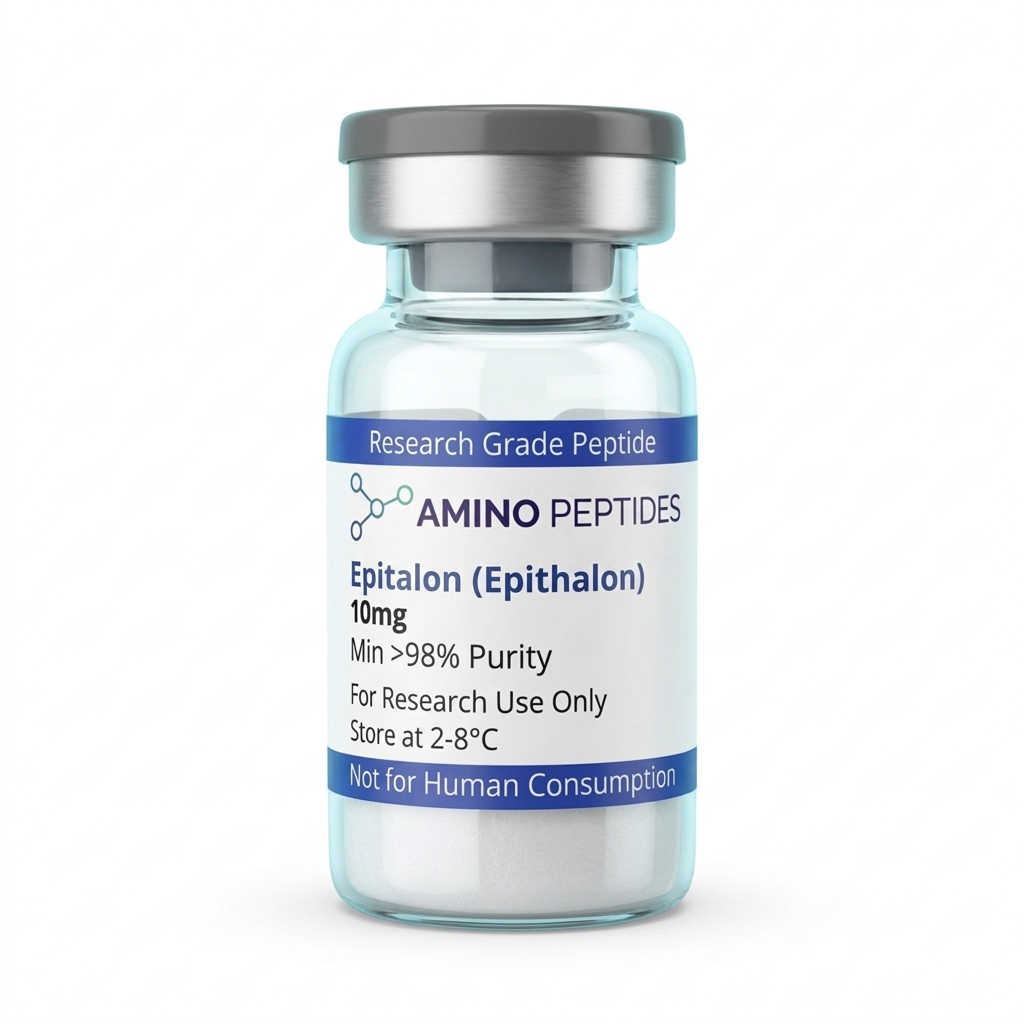
Epitalon
From £19
Supplied as a sealed freeze-dried vial (stable 12–24 months at 2°C–8°C in a standard refrigerator).
Shop Epitalon →What Published Studies Observe From Early Signalling to Long-Term Markers
When examining Epitalon in controlled laboratory settings, the observed outcomes split clearly into two phases: rapid biochemical signalling and slower structural tissue remodelling. Because the molecule is only four amino acids long, it enters cells and begins interacting with DNA regulatory regions within hours of exposure.
During the first three to ten days of a typical laboratory protocol, researchers mainly observe shifts in gene expression and circadian markers. In aged primate and rodent models, night-time melatonin release and cortisol rhythms begin to stabilise within the first week. At the same time, antioxidant enzymes like superoxide dismutase show higher activity, helping clear out daily metabolic waste inside the cells. Fibroblast cultures exposed to Epitalon also display measurable jumps in telomerase RNA activity during this initial window, proving that the genetic switch has been flipped early on.
However, actual telomere lengthening and broader cellular recovery take much longer to show up on laboratory tests. Cells need to go through multiple division cycles before new telomere length becomes easy to measure. In published studies tracking human somatic cell cultures, clear increases in telomere length—alongside the ability of cells to keep dividing well past their normal Hayflick limit—were typically recorded after several weeks of periodic exposure. In long-term rodent longevity studies, researchers often used short ten-to-twenty-day cycles repeated every few months, observing sustained tissue vitality, healthier retinal structure, and improved immune cell counts over six to twelve months of tracking.
Biochemical Comparison: Epitalon vs Related Research Compounds
| Property | Epitalon (AEDG) | Epithalamin | Pinealon (EDR) |
|---|---|---|---|
| Origin and Structure | Synthetic tetrapeptide (four amino acids) | Bovine pineal gland polypeptide extract | Synthetic tripeptide (three amino acids) |
| Amino Acid Sequence | Alanine-Glutamic Acid-Aspartic Acid-Glycine | Complex mixture of multiple peptide fractions | Glutamic Acid-Aspartic Acid-Arginine |
| Primary Laboratory Focus | Telomerase activation and pineal melatonin signalling | Endocrine regulation and lifespan observation in rodents | Central nervous system protection and oxidative stress |
| Cellular Target | Telomeric DNA, chromatin, and pinealocytes | Broad neuroendocrine and immune tissues | Neuronal cells and cerebral cortex models |
| Key Observed Effect in Models | Elongation of telomeres in somatic cells in vitro | Normalisation of circadian hormone rhythms in aged animals | Reduction of reactive oxygen species in neural cultures |
Pairing Epitalon With Pineal, Thymic, and Anabolic Research Peptides
In longevity and cellular regeneration research, scientists rarely look at telomere maintenance in isolation. Because biological ageing affects the immune system, energy production, and tissue repair all at once, laboratory protocols frequently pair Epitalon with complementary bioregulators that target neighbouring pathways.
The most common pairing in published Russian bioregulator literature is Epitalon alongside Thymalin or Thymosin Alpha-1. While Epitalon works on the pineal gland and telomerase activity, thymic peptides focus on the thymus gland, where T-cells mature. Ageing laboratory models often show shrinkage in both glands simultaneously; studying pineal and thymic peptides together allows investigators to observe how restored circadian signalling interacts with renewed immune cell output. Another frequent combination involves GHK-Cu or BPC-157, where Epitalon provides the deep nuclear signal for cell division capacity while the structural peptides support collagen synthesis and localized tissue remodelling.
Researchers investigating muscle maintenance and cellular growth alongside longevity pathways also look at how telomerase activation pairs with growth-factor signalling. For example, investigators who buy igf lr3 for cell proliferation assays sometimes examine whether keeping telomeres intact with Epitalon allows satellite cells to respond more cleanly to anabolic signals over repeated generations. Similarly, pairing Epitalon with mitochondrial peptides like MOTS-c or SS-31 lets laboratory teams study both nuclear DNA protection and cellular energy output at the same time, covering two major hallmarks of ageing in a single experimental design.

Figure: Epitalon: The Telomerase Activator and Its Impact on Biological Aging
Reconstitution calculator
Choose a vial mass and a bacteriostatic reconstitution solution volume. The figure is the resulting concentration.
Concentration: 2.50 mg/mL
Per 0.01mL (10µL): 25.0 mcg
Open the full calculatorBacteriostatic reconstitution solutionWhy 99%+ HPLC Purity and Cold Storage Matter for Tetrapeptides
Even though Epitalon is a short, four-amino-acid chain (Ala-Glu-Asp-Gly), the quality of the raw lyophilised powder determines whether a laboratory assay produces clean data or confusing background noise. Short peptides are synthesised step-by-step using solid-phase chemistry, and rushed manufacturing can leave behind incomplete three-amino-acid fragments or excess trifluoroacetic acid (TFA) salts.
When a batch is verified at 99%+ purity via High-Performance Liquid Chromatography (HPLC) and Mass Spectrometry (MS), you know that the measured level in the vial is actually intact Epitalon rather than leftover synthesis byproducts. Removing excess TFA is especially important for cell culture work; high acid-salt residue alters the pH of the medium and stresses delicate fibroblast lines, which can ruin a long-term telomere study before it even gets started. High-purity vials arrive as a crisp, uniform freeze-dried cake that dissolves cleanly upon contact with a sterile liquid.
Proper storage is just as straightforward. In its dry, lyophilised state, Epitalon is quite stable, but keeping the sealed vials in a standard refrigerator between 2°C and 8°C—or a freezer for long-term storage—protects the peptide bonds from heat and moisture. Once mixed with a bacteriostatic reconstitution solution, the liquid must stay refrigerated at 2°C to 8°C and away from bright light. Gentle swirling, rather than hard shaking, dissolves the powder in seconds while keeping the delicate tetrapeptide structure completely intact for accurate laboratory testing.
Frequently Asked Questions
Why is Epitalon so widely searched in longevity research?
Epitalon is widely searched because published studies suggest this short peptide can activate telomerase, the enzyme that maintains protective caps on chromosomes. In laboratory models, researchers observe how this signalling pathway might support cellular regeneration, normalise melatonin rhythms, and slow markers associated with biological ageing.
What timeline do published studies follow when observing Epitalon?
Published studies typically observe Epitalon over short, cyclical intervals rather than continuous exposure. In preclinical models, scientists often analyse a protocol ratio lasting ten to twenty days, followed by a rest period of several months, to characterise long-term changes in telomere length and cellular recovery.
Can Epitalon be combined with other peptides in laboratory research?
Yes, researchers frequently pair Epitalon with other bioregulator peptides like Thymalin in laboratory models to study combined effects on cellular longevity. By examining these pairings together, scientists can analyse how pineal and immune signalling pathways interact during tissue remodelling and age-related recovery processes.
How should Epitalon purity and storage be handled in a laboratory?
Laboratory-grade Epitalon should always exceed ninety-eight percent purity, verified by third-party chromatography testing. Unmixed freeze-dried powder remains stable in a freezer, while a vial mixed with bacteriostatic reconstitution solution must stay in a dark refrigerator at four degrees Celsius to prevent degradation during study timelines.
Bibliography
- Khavinson VK, Bondarev IE, Butyugov AA. Epithalon peptide induces telomerase activity and telomere elongation in human somatic cells. Bull Exp Biol Med. 2003;135(6):590-592. View published research
- Anisimov VN, Khavinson VK. Peptide bioregulation of aging: results and prospects. Biogerontology. 2010;11(2):139-149. View published research
- Korkushko OV, Khavinson VK, Shatilo VB, Magdich LV. Effect of peptide preparation epithalamin on circadian rhythm of epiphyseal melatonin-producing function in elderly people. Bull Exp Biol Med. 2004;137(4):389-391. View published research
- Araj SK, Brzezik J, Mazurowska K, Szopa A. Overview of Epitalon—Highly Bioactive Pineal Tetrapeptide with Promising Properties. Int J Mol Sci. 2025;26(6):2691. View published research
⚠️ Research Use Only Disclaimer: All peptides and compounds are sold strictly for in-vitro laboratory research purposes only. Not intended for human or veterinary use, not a dietary supplement, and not approved to diagnose, treat, cure, or prevent any disease or condition. For use by qualified researchers in suitably equipped laboratory environments only. Amino Peptides Ltd operates in full compliance with UK MHRA regulations and applicable EU research chemical guidelines.