
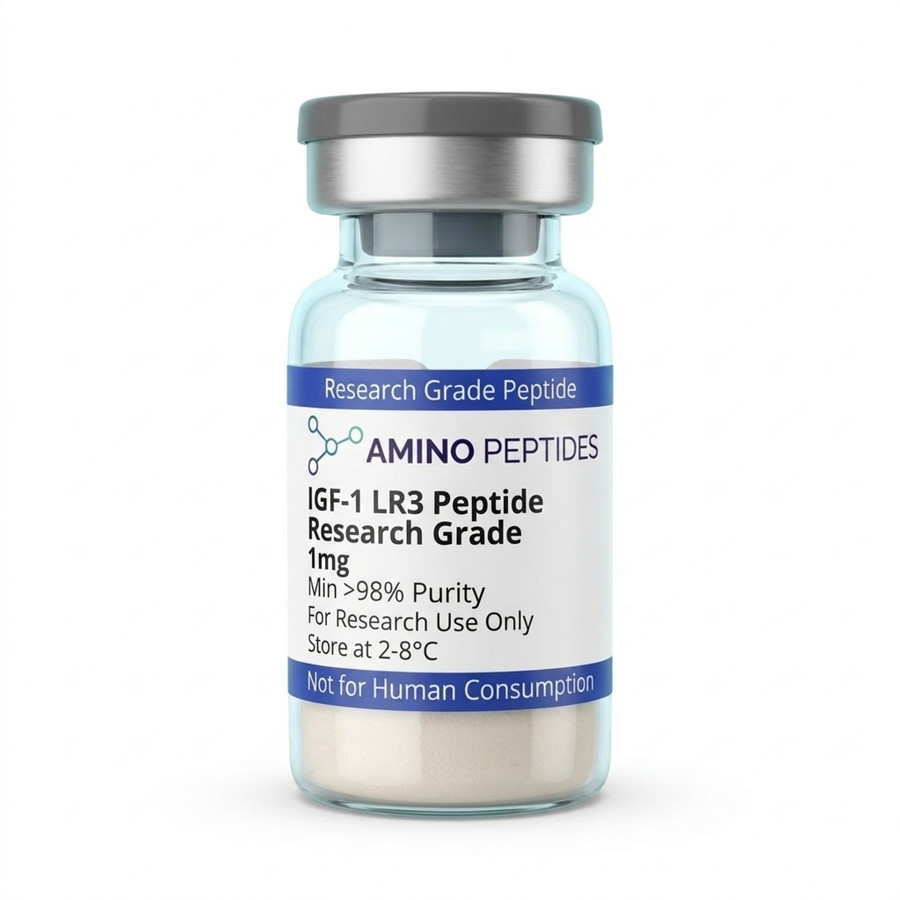
Insulin-like Growth Factor-1 Long Arg3 (IGF-1 LR3) is an 83-amino acid analogue of human IGF-1, engineered specifically for enhanced potency and prolonged cellular interactions in vitro. Through advanced peptide synthesis techniques, this modified variant incorporates an arginine substitution at position three and a 13-amino acid N-terminal extension. These structural modifications significantly reduce its affinity for IGF-binding proteins, allowing for sustained receptor activation. As a premium research chemical, UK laboratories utilise this peptide extensively for cellular proliferation assays, where it demonstrates exceptional molecular stability during extended incubation periods. Researchers must employ precise reconstitution protocols using Bacteriostatic Reconstitution Solution to maintain the structural integrity of the lyophilised peptide. By activating the PI3K/AKT and MAPK signalling cascades, this reagent drives critical cellular processes, including protein synthesis and cellular differentiation. For further insights into related growth factor pathways, researchers can explore literature on advancing the somatotropic frontier. Additional biochemical characterisation is documented extensively within PubMed databases.
Public search data frequently uses terms like "benefits" and "dosage" when exploring IGF-1 LR3. Current literature and research trends index these phrases to describe cellular proliferation and tissue repair in isolated laboratory models. These published studies focus entirely on microscopic cell cultures rather than bodily outcomes. Amino Peptides supplies this compound strictly as a lyophilised laboratory reagent.
- High-affinity binding to the Type 1 Insulin-like Growth Factor Receptor (IGF-1R), a receptor tyrosine kinase, initiating trans-autophosphorylation in cell-free systems.
- Negligible affinity for Insulin-like Growth Factor Binding Proteins (IGFBPs), preventing sequestration and prolonging receptor interaction in controlled molecular environments.
- Interaction with the insulin receptor (IR) at significantly lower affinities, mapped during competitive binding experiments in isolated cellular membranes.
- Modulation of integrin receptor complexes via cross-talk mechanisms observed in extracellular matrix adhesion models.
- Activation of the PI3K/AKT signalling cascade, promoting downstream phosphorylation of mTOR and driving protein synthesis in isolated myoblast cultures.
- Stimulation of the Ras/Raf/MEK/ERK pathway, initiating transcription factor translocation and cellular proliferation in laboratory models.
- Inhibition of FOXO transcription factors via AKT-mediated phosphorylation, preventing apoptosis and enhancing cell survival in nutrient-deprived cell cultures.
- Upregulation of cyclin D1 expression, facilitating G1 to S phase cell cycle progression during controlled cytological experiments.
Technical Specifications
Variant Breakdown
- 1mg Vial: Provides a highly concentrated lyophilised powder, ideal for precise laboratory stock preparation and multiple in-vitro assays.
Quality Assurance
- HPLC Verification: High-performance liquid chromatography ensures a purity level exceeding 99 percent, confirming the absence of synthesis by-products.
- Mass Spectrometry: Advanced mass analysis confirms the exact molecular weight and structural sequence of the synthesised peptide.
- Lyophilised Stability: Processed into a stable lyophilised solid to preserve molecular integrity during transport and long-term laboratory storage.
- Endotoxin Testing: Rigorous laboratory characterisation guarantees endotoxin limits remain below 0.5 EU/mg for optimal cell culture viability.
Research Mechanism
- Receptor Binding: Binds to the type 1 IGF receptor (IGF-1R) on the cellular membrane with high affinity, initiating a cascade of intracellular signals.
- Decreased Binding Protein Affinity: The structural modifications prevent binding to IGF-binding proteins (IGFBPs), vastly increasing the availability of the free, active peptide in culture media.
- PI3K/AKT Activation: Stimulates the phosphoinositide 3-kinase (PI3K) pathway, which upregulates AKT phosphorylation to promote cellular survival and inhibit apoptosis.
- MAPK Pathway Induction: Activates the mitogen-activated protein kinase (MAPK) cascade, driving cellular proliferation and differentiation in various tissue models.
- Metabolic Regulation: Enhances amino acid uptake and stimulates protein synthesis in cultured myoblasts and other target cell lines.
Reconstitution & Storage Data
| Vial Strength | Solvent Added | Resulting Concentration |
| 1mg | 1 mL Bacteriostatic Reconstitution Solution | 1.00 mg/mL |
| 1mg | 2 mL Bacteriostatic Reconstitution Solution | 0.50 mg/mL |
- Lyophilised (Powder): Store in a standard refrigerator (2-8°C) for up to 3 months. For long-term preservation, freeze at -20°C.
- Reconstituted (Liquid): Store at 2-8°C (Refrigerated).
Scientific References
Journal of Endocrinology: "Biological activities of IGF-1 and its analogues in cultured mammalian cells" View Study
Endocrinology: "The role of IGF-1 LR3 in stimulating myoblast proliferation and differentiation" View Study
Growth Hormone & IGF Research: "Structural modifications of IGF-1 and their impact on IGFBP affinity" View Study
Molecular and Cellular Endocrinology: "Activation of PI3K and MAPK pathways by IGF-1 analogues in vitro" View Study