
Evaluating the Synergistic Molecular Pathways of GHK-Cu, BPC-157, TB-500, and KPV Blends In-Vitro
7th Oct 2026

What You Need to Know About KLOW BLEND
- Researchers frequently explore this four-peptide combination to understand how combining distinct amino acid sequences might simultaneously influence multiple stages of cellular recovery in laboratory models.
- In plain English, these four molecules act like a coordinated construction crew in a petri dish, where KPV calms down overactive stress signals, TB-500 and BPC-157 help cells move to the site and build new vessel pathways, and GHK-Cu supplies the raw signals to lay down fresh collagen scaffolding.
- Published studies examining these individual pathways in vitro have observed accelerated fibroblast migration, increased actin polymerisation, balanced cytokine output, and enhanced extracellular matrix remodelling.
- When analysed together in controlled laboratory settings, the blend provides a framework for studying non-overlapping receptor targets without overwhelming any single cellular pathway.
How a Four-Peptide Blend Divides Cellular Tasks in the Lab
In published laboratory studies, combining GHK-Cu, BPC-157, TB-500, and KPV lets researchers observe four separate tissue remodelling pathways at the same time. Instead of pushing a single cellular button, this four-part blend coordinates local irritation control, cell movement, blood vessel sprouting, and collagen assembly inside a single dish.
When tissue faces stress in a preclinical model, recovery does not happen in one step. Cells first need a quiet environment free from runaway alarm signals. That is where KPV steps in. KPV is a tiny three-amino-acid fragment related to alpha-MSH. In cell cultures, it enters the cell nucleus and calms down NF-kappaB, a protein complex that normally turns on inflammatory cytokines. Once those loud alarm signals drop, the rebuilding crew can actually get to work.
Next comes physical movement. TB-500, the synthetic laboratory segment of Thymosin Beta-4, binds to actin—the internal scaffolding protein that gives cells their shape and allows them to crawl across a gap. Alongside it, bpc 157 switches on focal adhesion kinase (FAK) and paxillin pathways, while also nudging vascular endothelial growth factor (VEGF) receptors to build new micro-capillary networks. Finally, GHK-Cu brings a copper ion directly to fibroblasts, telling them to lay down fresh elastin and type I collagen while trimming away ragged, damaged proteins. Evaluating the Synergistic Molecular Pathways of GHK-Cu, BPC-157, TB-500, and KPV Blends In-Vitro shows how each sequence handles a distinct job without crowding out the others.
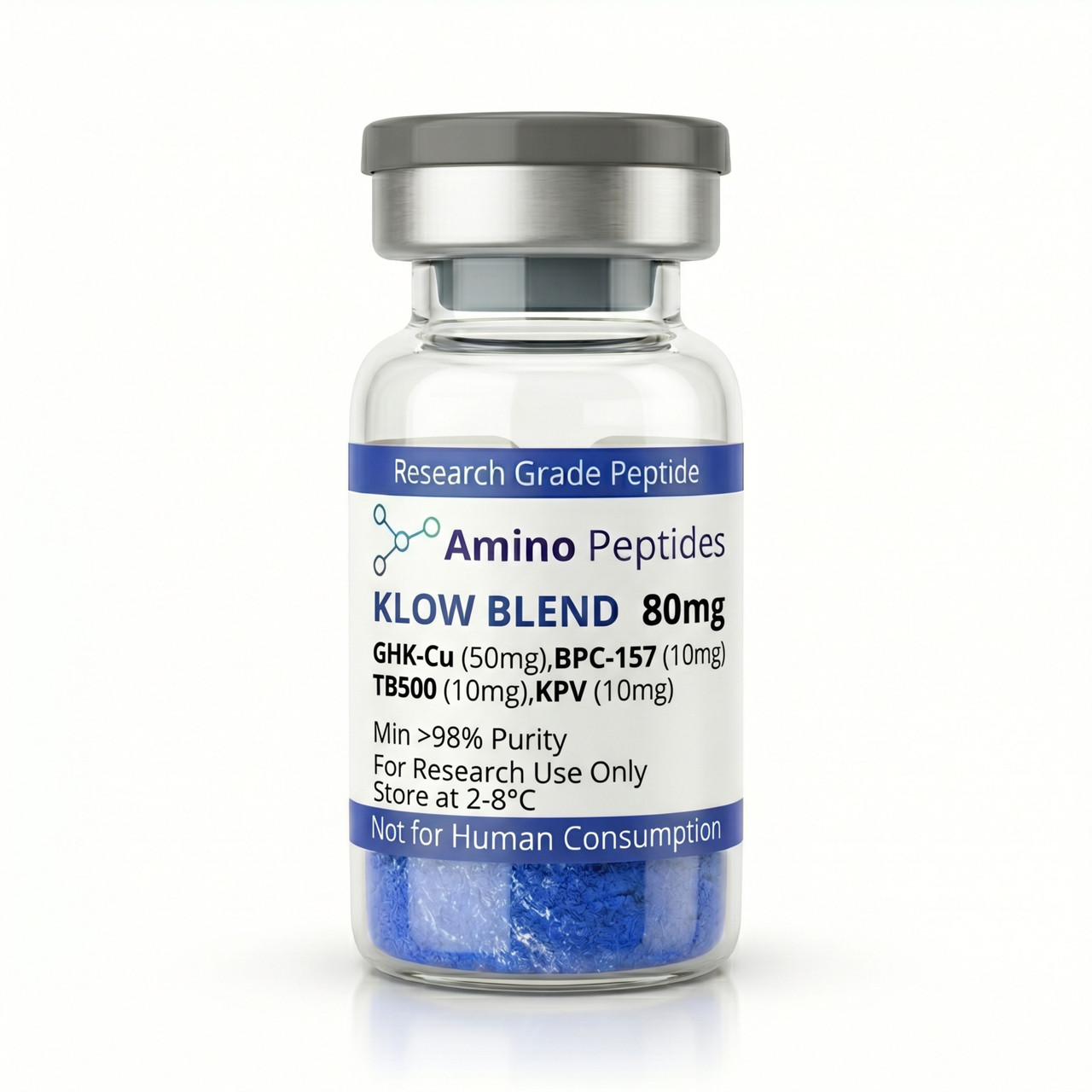
KLOW BLEND
From £80
Supplied as a sealed freeze-dried vial (stable 12–24 months at 2°C–8°C in a standard refrigerator).
Shop KLOW BLEND →What Cell Cultures Show From Hour One to Week Four
Watching a four-peptide blend in a petri dish is a lot like watching a building site over several weeks. Different signals fire at completely different speeds, and published studies break these observations down into early, middle, and late stages.
During the first one to six hours after adding a measured level of the blend to cultured cells, the fastest changes involve KPV and BPC-157. KPV begins quieting intracellular stress pathways almost immediately, reducing pro-inflammatory messenger molecules within hours. At the same time, BPC-157 starts phosphorylating FAK and paxillin proteins, which prepares stationary cells to detach and move. Researchers also see early spikes in nitric oxide synthase activity during this opening window.
Between twenty-four and seventy-two hours, TB-500 makes its presence obvious under a microscope. Because TB-500 sequesters G-actin monomers, fibroblasts and endothelial cells can rapidly polymerise and depolymerise their internal skeletons. Scratch-assay studies routinely record faster gap closure during this two-to-three-day window compared to untreated control plates, accompanied by early capillary tube sprouting.
Structural remodelling takes much longer. From day seven out to day twenty-eight in three-dimensional tissue models, GHK-Cu drives the slower, heavy lifting. Gene expression arrays show sustained upregulation of collagen, glycosaminoglycans, and decorin, paired with balanced matrix metalloproteinase activity. The early signalling bursts set the stage, while the copper-bound tripeptide spends weeks organising the final extracellular matrix architecture so the newly formed tissue network holds together cleanly.
Comparative Molecular Characteristics of GHK-Cu, BPC-157, TB-500, and KPV in Laboratory Models
| Peptide Component | Amino Acid Length | Primary Signalling Target | Observed In-Vitro Function |
|---|---|---|---|
| GHK-Cu (Gly-His-Lys-Copper) | 3 amino acids bound to Cu2+ | TGF-beta and integrins | Stimulates collagen synthesis, elastin production, and antioxidant gene expression in dermal fibroblast cultures. |
| BPC-157 | 15 amino acids | VEGFR2 and FAK-paxillin | Promotes endothelial cell outgrowth, nitric oxide system modulation, and tendon fibroblast migration in vitro. |
| TB-500 (Thymosin Beta-4 fragment) | 43 amino acids (parent) / 7-AA core | G-actin sequestration | Regulates cytoskeletal actin polymerisation, allowing rapid cell motility and structural organisation. |
| KPV (Lys-Pro-Val) | 3 amino acids | PepT1 and NF-kappaB pathway | Inhibits pro-inflammatory cytokine release by blocking nuclear translocation of NF-kappaB inside stressed cells. |
| Combined 4-Peptide Blend | Multi-chain investigative mixture | Complementary multi-receptor network | Provides concurrent modulation of cellular migration, matrix deposition, and inflammatory signal dampening in preclinical models. |
Pairing KPV With Copper, Actin, and Vascular Signalling Peptides
Why do laboratory investigators group these four specific sequences together instead of testing them one by one? The answer comes down to avoiding bottlenecks in cellular signalling.
If you stimulate fibroblasts with GHK-Cu alone in an irritated environment, high levels of oxidative stress and cytokine noise can slow down collagen synthesis. By pairing GHK-Cu with KPV, the culture environment stays calm enough for the fibroblasts to actually read the copper peptide's genetic instructions. Researchers exploring immune-modulated pathways often compare KPV alongside KPV and LL-37 to see how small host-defence and alpha-MSH fragments quiet down surface receptors before structural peptides take over.
A second partnership happens between BPC-157 and TB-500. BPC-157 is famous in preclinical models for upregulating growth hormone receptor expression on fibroblasts and encouraging new blood vessel outgrowth via VEGFR2. However, those freshly stimulated cells still need to physically travel into the centre of a test site. TB-500 supplies that exact motility by freeing up actin monomers. In short, BPC-157 puts up the directional road signs and builds the supply lines, while TB-500 gives the cells the tyres to drive there.
When all four sit in the same protocol ratio, they operate on separate tracks: KPV on nuclear NF-kappaB, TB-500 on cytoplasmic actin, BPC-157 on membrane focal adhesions, and GHK-Cu onribosomal matrix synthesis and copper transport. None of them compete for the exact same receptor pocket, which prevents signal saturation during in-vitro assays.
Reconstitution calculator
Choose a vial mass and a bacteriostatic reconstitution solution volume. The figure is the resulting concentration.
Concentration: 2.50 mg/mL
Per 0.01mL (10µL): 25.0 mcg
Open the full calculatorBacteriostatic reconstitution solutionWhy Multi-Peptide Blends Demand 99%+ HPLC Purity and Cold Storage
Putting four distinct peptides into a single research vial creates a serious chemistry challenge. If each individual powder carries even two or three percent leftover synthesis junk, combining four of them compounds the problem fast. That is why checking for 99%+ purity via High-Performance Liquid Chromatography (HPLC) and Mass Spectrometry (MS) is the first thing any careful laboratory does.
During solid-phase synthesis, manufacturers use trifluoroacetic acid (TFA) to cleave peptide chains from their resin beads. If excess TFA salts are not scrubbed out during lyophilisation, they drop the pH of the liquid once mixed with a bacteriostatic reconstitution solution. An overly acidic vial is bad news for GHK-Cu. Low pH can strip the copper ion right out of the glycine-histidine-lysine pocket, turning an active blue complex into unbound copper salt and an inactive tripeptide. Residual TFA also irritates cultured cells, ruining KPV's quiet signalling readout.
Temperature control matters just as much. Lyophilised cakes stay stable in a freezer at minus 20°C, away from UV light. Once mixed with a bacteriostatic reconstitution solution, the liquid blend must live in a standard refrigerator between 2°C and 8°C. Never shake a multi-peptide vial; swirl it gently so fragile sequences like TB-500 do not shear or clump at the air-water boundary. Clean, TFA-free, batch-verified vials ensure that what you see in the dish comes from the peptides themselves, never from leftover factory solvents.
Frequently Asked Questions
Why are researchers evaluating the synergistic molecular pathways of GHK-Cu, BPC-157, TB-500, and KPV blends in-vitro?
Researchers study this four-peptide blend because each compound targets a distinct stage of cellular recovery and tissue remodelling. In laboratory models, combining them allows scientists to observe how copper-binding, actin-regulating, and anti-inflammatory signalling pathways interact simultaneously, rather than analysing a single isolated mechanism.
What is the typical timeline observed in published studies for these peptide pathways?
In-vitro cellular responses begin within hours, while structural tissue remodelling in preclinical models is typically tracked over two to four weeks. Published studies note that early signalling shifts, such as reduced inflammatory markers and increased cell migration, appear during the first forty-eight to seventy-two hours.
Why do laboratory protocols combine or stack GHK-Cu, BPC-157, TB-500, and KPV together?
Laboratory protocols stack these four peptides to test whether complementary pathways produce a broader biological response than single compounds alone. While KPV calms inflammatory signalling, BPC-157 and TB-500 guide cell migration, and GHK-Cu supports collagen organisation and extracellular matrix regeneration.
How should research-grade peptide blends be stored and verified for purity in the laboratory?
Research-grade peptides require verification above ninety-eight percent purity via High-Performance Liquid Chromatography and Mass Spectrometry before any assay begins. Lyophilised powders are kept frozen at minus twenty degrees Celsius, while samples mixed with bacteriostatic reconstitution solution are stored in a dark laboratory refrigerator between two and eight degrees Celsius.
Bibliography
- Pickart L, Margolina A. Regenerative and Protective Actions of the GHK-Cu Peptide in the Light of the New Gene Data. Int J Mol Sci. 2018;19(7):1987. View published research
- Chang CH, Tsai WC, Lin MS, Hsu YH, Pang JH. The promoting effect of pentadecapeptide BPC 157 on tendon outgrowth in vitro. J Appl Physiol. 2011;110(3):774-780. View published research
- Goldstein AL, Hannappel E, Sosne G, Kleinman HK. Thymosin beta4: a multi-functional regenerative peptide. Basic properties and emerging roles. Expert Opin Biol Ther. 2012;12(1):37-51. View published research
- Dalmasso G, Charrier-Hisamuddin L, Nguyen HT, Yan Y, Sitaraman S, Merlin D. PepT1-mediated tripeptide KPV uptake reduces intestinal inflammation. Gastroenterology. 2008;134(1):166-178. View published research
- Hsieh MJ, Liu HT, Wang CN, et al. Modulatory effects of BPC 157 on vascular expression of VEGFR2 and endothelial tube formation in vitro. J Mol Med. 2017;95(3):323-333. View published research
⚠️ Research Use Only Disclaimer: All peptides and compounds are sold strictly for in-vitro laboratory research purposes only. Not intended for human or veterinary use, not a dietary supplement, and not approved to diagnose, treat, cure, or prevent any disease or condition. For use by qualified researchers in suitably equipped laboratory environments only. Amino Peptides Ltd operates in full compliance with UK MHRA regulations and applicable EU research chemical guidelines.