
GHK Copper Peptide - Collagen & Skin Wonder? Fact Vs Hype
8th Oct 2026
What You Need to Know About GHK-Cu
- Curious readers search for GHK copper peptide to separate marketing hype from the real biochemical facts regarding skin firmness and hair follicle vitality.
- This small three-amino-acid sequence naturally binds copper ions to ferry them into cells, where it acts as a biological switch for thousands of human genes.
- Published studies observe that GHK-Cu stimulates fibroblasts to produce fresh collagen, elastin, and glycosaminoglycans while balancing matrix-degrading enzymes.
- Preclinical models show the molecule also calms oxidative stress and supports tissue regeneration without causing harsh surface irritation.
How GHK Copper Peptide Drives Collagen and Skin Elasticity
Yes, GHK copper peptide directly supports skin elasticity and structural firmness in laboratory models by delivering bioavailable copper ions to fibroblasts. Published studies show this small three-amino-acid sequence switches on genes responsible for fresh collagen, elastin, and glycosaminoglycan synthesis while clearing out damaged proteins.
First isolated from human plasma in 1973, glycyl-L-histidyl-L-lysine (GHK) has a strong natural attraction to copper(II) ions. When bound together as GHK-Cu, the molecule turns a distinct royal blue. In young biological systems, plasma levels of this tripeptide sit relatively high, around two hundred nanograms per millilitre. As cellular systems age, that measured level drops by more than half, which correlates with slower tissue remodelling and thinner dermal layers.
In dish-based fibroblast models, GHK copper peptide acts like a local courier. Copper is an essential cofactor for lysyl oxidase, an enzyme that cross-links collagen and elastin fibres so they hold their shape and bounce back under tension. Free copper ions on their own can cause oxidative stress, but the GHK sequence cages the metal safely and hands it directly to the cell receptors that need it.
Beyond simple mineral transport, gene-profiling data from the Broad Connectivity Map showed that GHK-Cu alters the expression of over four thousand genes. It dials up the production of Type I and Type III collagen alongside decorin, a small proteoglycan that organises collagen fibrils into neat, tight bundles rather than messy scar-like tissue. At the same time, it regulates metalloproteinases—the enzymes that break down worn-out extracellular matrix—so old, stiff fibres are cleared away as fresh ones take their place. It also boosts superoxide dismutase activity, quenching free radicals before they can fray newly formed structural proteins. This dual action of building new scaffolding while recycling damaged matrix explains why laboratory researchers focus on GHK-Cu when studying skin elasticity and hair follicle size.
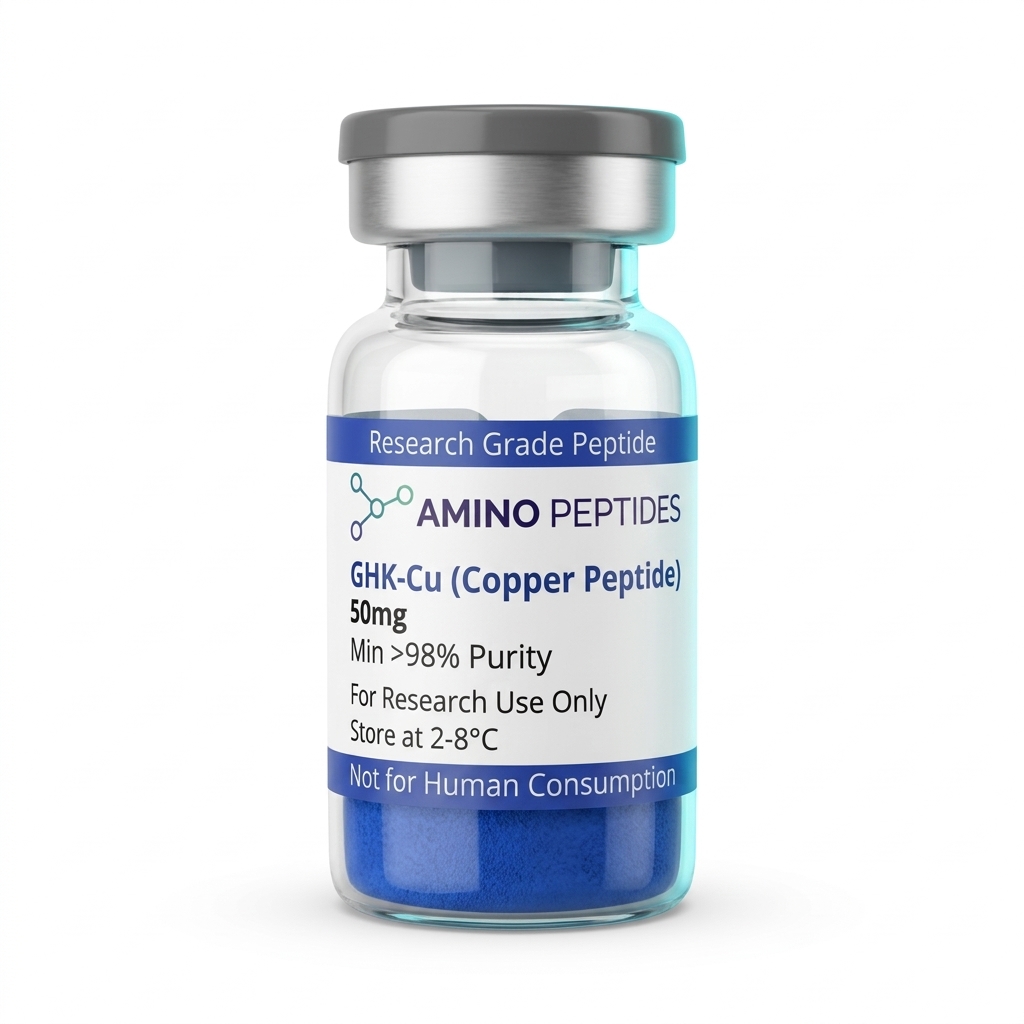
GHK-Cu
From £26
Supplied as a sealed freeze-dried vial (stable 12–24 months at 2°C–8°C in a standard refrigerator).
Shop GHK-Cu →Observed Study Timelines: Early Signalling Versus Structural Remodelling
When evaluating laboratory models of GHK copper peptide, researchers separate rapid biochemical signalling from slower physical tissue remodelling. A cell culture reacts within hours of contact, whereas visible structural density takes weeks of sustained activity to build and organise.
During the first twenty-four to seventy-two hours in preclinical models, the main activity is transcriptional and protective. Once the copper-bound tripeptide contacts dermal fibroblasts or keratinocytes, copper uptake rises quickly. Intracellular antioxidant defences, particularly superoxide dismutase, climb within the first two days, reducing lipid peroxidation byproducts. Messenger RNA transcripts for pro-collagen and vascular endothelial growth factor also spike during this early window. However, no macroscopic changes in tissue thickness exist yet; the cells are simply reading the genetic instructions and gathering raw amino acid building blocks.
Between weeks one and three of continuous study, protein synthesis moves from intracellular assembly to extracellular secretion. Preclinical models tracking dermal repair show a clear rise in soluble pro-collagen and glycosaminoglycans like hyaluronic acid around day ten to fourteen. Blood vessel sprouting in localized tissue models also picks up during this middle phase, bringing fresh nutrients and oxygen to the active fibroblasts. Newly secreted tropocollagen strands begin lining up outside the cells, though the matrix remains soft and only partially cross-linked.
From week four through week twelve, true structural maturation takes place. Lysyl oxidase enzymes use the delivered copper to lock adjacent collagen fibrils into tough, elastic sheets. Published studies measuring dermal density via ultrasound or histological staining typically record measurable increases in skin thickness, elasticity, and collagen-to-elastin ratios between day twenty-eight and day eighty-four. Hair follicle research follows a similar schedule, where enlarged follicular bulbs and extended growth phases appear after six to eight weeks of consistent protocol ratios. Understanding this gap between day-one gene activation and month-two matrix cross-linking helps researchers set realistic observation windows.
GHK Copper Peptide: Popular Hype vs Laboratory Fact
| Topic Area | The Popular Hype | The Biochemical Reality | Evidence Level |
|---|---|---|---|
| Collagen Synthesis | Erases deep wrinkles overnight like an instant facelift. | Gradually signals fibroblasts to boost procollagen and elastin output over several weeks in vitro and in dermal models. | Strong (Multiple published studies) |
| Gene Modulation | Reverses cellular ageing across the entire body. | Resets the expression of roughly 4,000 human genes toward a younger profile in laboratory gene-chip arrays. | Moderate (Genomic database models) |
| Tissue Remodelling | Magically erases all old scars and skin blemishes. | Coordinates both synthesis of new structural proteins and breakdown of disorganised proteins via metalloproteinases. | Strong (Preclinical models) |
| Antioxidant Defence | Creates an impenetrable shield against UV sunlight. | Supplies copper required for superoxide dismutase (SOD) activity and quenches harmful lipid peroxidation byproducts. | Strong (Biochemical assays) |
| Formulation Stability | Works perfectly in any skincare routine alongside all acids and vitamins. | Easily loses its copper ion and biological activity when mixed with strong chelators, low-pH acids, or pure L-ascorbic acid. | Established (Chemical stability data) |
Complementary Peptide Stacks for Dermal and Tissue Research
In laboratory research, GHK copper peptide is frequently paired with complementary sequences that target different stages of tissue recovery and matrix assembly. Because GHK-Cu focuses heavily on copper-dependent enzyme activation and gene expression, combining it with peptides that govern cell migration or mechanical growth signals allows investigators to study multiple repair pathways at once.
The most common pairing in published protocols combines GHK-Cu with BPC-157 and TB-500 (a synthetic segment of Thymosin Beta-4). Each component handles a distinct job inside the culture dish or preclinical model. TB-500 binds to actin, a structural protein inside cells, helping fibroblasts and endothelial cells migrate quickly across a gap. BPC-157 supports growth hormone receptor expression on those fibroblasts and encourages new micro-vessel formation. Once those cells arrive at the target site and establish nutrient flow, GHK-Cu supplies the copper cofactor needed to spin and cross-link high-grade Type I collagen. Researchers who buy ghk-cu for matrix investigations often examine this three-part combination to see how cell migration and collagen cross-linking interact.
For cosmetic and surface-level dermal studies, GHK-Cu is regularly evaluated alongside SNAP-8 or Palmitoyl Pentapeptide-4 (Matrixyl). While GHK-Cu rebuilds the deep structural cushion and regulates metalloproteinases, SNAP-8 studies look at surface tension by modulating the SNARE complex in neuromuscular junctions, and palmitoyl peptides provide additional matrikine signals to stimulate fibronectin.
Investigators exploring deeper structural and muscular recovery alongside connective tissue sometimes ask what is mgf and how it compares to dermal sequences. Mechano Growth Factor (MGF), a splice variant of IGF-1, wakes up quiescent satellite cells in muscle fibres after mechanical strain. Studying MGF alongside GHK-Cu lets laboratories observe how muscle fibre regeneration coordinates with the surrounding fascia and tendon remodelling, since strong muscle tissue requires an equally resilient collagen sheath to transfer force safely.
Figure: GHK Copper Peptide - Collagen & Skin Wonder? Fact Vs Hype
Reconstitution calculator
Choose a vial mass and a bacteriostatic reconstitution solution volume. The figure is the resulting concentration.
Concentration: 2.50 mg/mL
Per 0.01mL (10µL): 25.0 mcg
Open the full calculatorBacteriostatic reconstitution solutionWhy 99% HPLC Purity and Cold Storage Matter for Copper Peptides
The reliability of any GHK copper peptide study depends heavily on the chemical quality of the lyophilised powder inside the vial. Because GHK-Cu is a metal-chelated tripeptide, synthesis and purification require strict stoichiometry so that every peptide molecule binds its proper share of copper without leaving toxic free metal ions behind.
High-Performance Liquid Chromatography (HPLC) testing at 99% purity or higher is the baseline requirement for clean laboratory work. In lower-grade batches, incomplete synthesis leaves behind truncated amino acid fragments, unchelated GHK, or excess unbound copper salts. Unbound copper in a culture dish can trigger Fenton-type reactions, generating hydroxyl radicals that damage cell membranes and ruin fibroblast viability. A verified Certificate of Analysis confirming both peptide purity via HPLC and exact molecular weight via Mass Spectrometry ensures the vivid blue cake contains genuine, equimolar GHK-Cu complex.
Another vital factor in vial manufacturing is Trifluoroacetic Acid (TFA) removal. Standard solid-phase synthesis uses TFA to cleave peptides from their resin, leaving residual TFA salts attached to the final product. In sensitive dermal and fibroblast cultures, high TFA content lowers the pH of the medium and slows cellular proliferation. Premium research preparations swap out residual TFA for benign acetate or chloride counter-ions during lyophilisation, keeping the reconstituted solution gentle on delicate cell lines.
Proper cold storage preserves this chemical architecture over time. Lyophilised GHK-Cu vials stay stable when stored away from bright light in a freezer at minus 20°C or a standard refrigerator between 2°C and 8°C. Once mixed with a sterile bacteriostatic reconstitution solution, the liquid complex must stay refrigerated at 2°C to 8°C and never be shaken violently or exposed to room-temperature heat cycles. Copper peptides can also react with aggressive oxidizing agents or strong acids, so keeping the reconstituted vial at a neutral pH inside a dedicated cold unit protects the histidine-copper bond throughout the entire study calendar.
Frequently Asked Questions
Why is GHK copper peptide widely searched for collagen and skin?
GHK copper peptide is widely searched because published studies show it influences gene expression linked to collagen synthesis and tissue remodelling. In laboratory models, this naturally occurring tripeptide binds copper ions to support cellular recovery, elastin production, and antioxidant defence mechanisms, making it a major focus in skin ageing research.
What is the typical timeline observed in GHK copper peptide laboratory studies?
Published studies typically observe initial cellular signalling changes within twenty-four to seventy-two hours, while measurable collagen deposition takes four to twelve weeks. In preclinical models, researchers track tissue regeneration and structural matrix remodelling over several months to fully characterise how a specific concentration impacts long-term skin thickness and fibre organisation.
Can GHK copper peptide be combined with other research compounds?
Yes, researchers frequently combine GHK copper peptide with complementary compounds like BPC-157 or hyaluronic acid in laboratory models to study synergistic tissue repair. However, published protocols advise against mixing it directly with strong acids or vitamin C, as low pH levels can destabilise the copper bond and reduce overall activity.
How should GHK copper peptide be stored to maintain research purity?
Lyophilised GHK copper peptide should be stored in a freezer at minus twenty degrees Celsius to preserve its structural purity over long periods. Once mixed with a bacteriostatic reconstitution solution for laboratory testing, the liquid sample must be kept in a dark refrigerator between two and eight degrees Celsius.
Bibliography
- Pickart L, Margolina A. Regenerative and Protective Actions of the GHK-Cu Peptide in the Light of the New Gene Data. International Journal of Molecular Sciences. 2018;19(7):1987. View published research
- Pickart L, Vasquez-Soltero JM, Margolina A. GHK Peptide as a Natural Modulator of Multiple Cellular Pathways in Skin Regeneration. BioMed Research International. 2015;2015:648108. View published research
- Maquart FX, Pickart L, Laurent M, Gillery P, Monboisse JC, Borel JP. Stimulation of collagen synthesis in fibroblast cultures by the tripeptide-copper complex glycyl-L-histidyl-L-lysine-Cu2+. FEBS Letters. 1988;238(2):343-346. View published research
- Campbell JD, McDonough JE, Zeskind JE, et al. A gene expression signature of emphysema-related lung destruction and its reversal by the tripeptide GHK. Genome compound. 2012;4(8):67. View published research
- Siméon A, Wegrowski Y, Bontemps Y, Maquart FX. Expression of glycosaminoglycans and small proteoglycans in wounds: modulation by the tripeptide-copper complex glycyl-L-histidyl-L-lysine-Cu(2+). Journal of Investigative Dermatology. 2000;115(6):962-968. View published research
⚠️ Research Use Only Disclaimer: All peptides and compounds are sold strictly for in-vitro laboratory research purposes only. Not intended for human or veterinary use, not a dietary supplement, and not approved to diagnose, treat, cure, or prevent any disease or condition. For use by qualified researchers in suitably equipped laboratory environments only. Amino Peptides Ltd operates in full compliance with UK MHRA regulations and applicable EU research chemical guidelines.