
The Laboratory Evidence for GHK Copper Peptide
16th Sep 2026
What You Need to Know About GHK-Cu
- Curious readers frequently search for the laboratory evidence for GHK copper peptide to understand how a tiny protein fragment interacts with structural proteins like collagen and elastin.
- The molecule acts as a carrier that picks up copper ions and delivers them to specific cellular receptors to trigger internal signalling cascades.
- Published studies observe that this copper-peptide complex can shift gene expression patterns in cultured fibroblasts toward tissue repair and away from cellular breakdown.
- Preclinical models show that natural levels of this tripeptide decline with age, which prompts researchers to study its role in cellular regeneration and antioxidant defence.
How GHK-Cu Directs Cellular Repair and Skin Elasticity in the Dish
The laboratory evidence for GHK copper peptide shows that this tiny three-amino-acid sequence acts like a natural courier for ionic copper, delivering it straight to tired cells to switch on collagen production and tissue remodelling. In isolated cell cultures, it resets thousands of genes toward a younger, more elastic state while clearing away damaged structural proteins.
First isolated from human plasma in 1973 by Dr Loren Pickart, glycyl-L-histidyl-L-lysine (GHK) has a strong natural attraction to copper(II) ions. When bound together as GHK-Cu, the molecule takes on a deep blue hue and gains the ability to ferry copper across outer cell membranes without triggering oxidative damage. Copper is an essential cofactor for lysyl oxidase, an enzyme that weaves loose collagen and elastin strands into a tight, springy mesh.
Gene-expression profiling using Broad Institute Connectivity Map data revealed that GHK-Cu shifts the activity of over four thousand human genes in laboratory models. Specifically, it turns up the volume on genes that build fresh type I and type III collagen, elastin, and glycosaminoglycans like dermatan sulphate. At the same time, it regulates matrix metalloproteinases (MMPs) and their natural inhibitors (TIMPs). This dual action breaks down disorganised, scarred fibres while laying down smooth, freshly organised scaffolding.
Published studies also show that the complex boosts superoxide dismutase (SOD) activity, neutralising free radicals generated during tissue stress. When researchers buy ghk-cu for fibroblast assays, they are looking to observe this exact balance of old-matrix clearance and fresh structural synthesis.
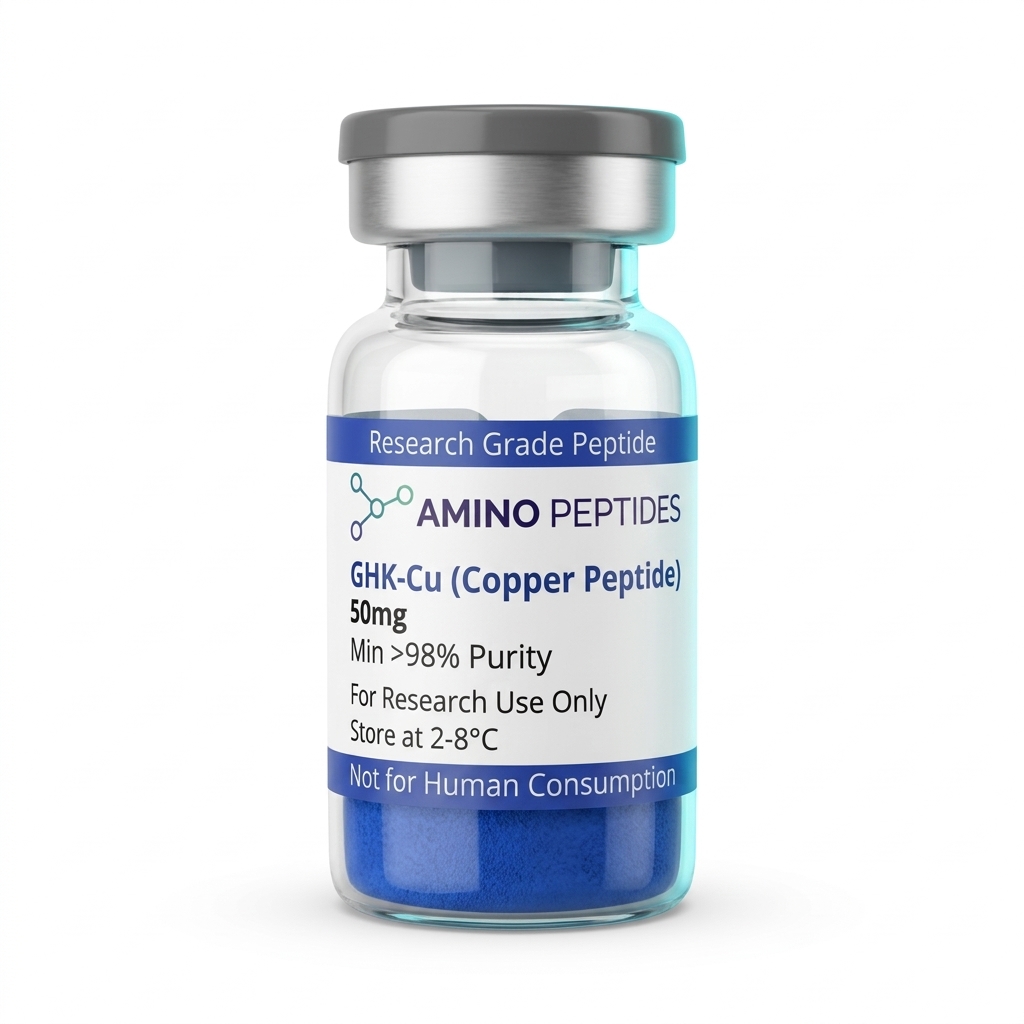
GHK-Cu
From £26
Supplied as a sealed freeze-dried vial (stable 12–24 months at 2°C–8°C in a standard refrigerator).
Shop GHK-Cu →What Published Studies Track From Day One to Week Four
Because cellular remodelling happens in distinct phases, researchers track very different markers depending on how long a study runs. Early observations focus on rapid chemical signalling, while later checkpoints measure physical changes in tissue thickness and tensile strength.
Within the first twenty-four to seventy-two hours of introducing a measured level of GHK-Cu to fibroblast cultures, scientists observe an immediate jump in messenger RNA (mRNA) transcripts. Signalling pathways tied to transforming growth factor-beta (TGF-beta) and basic fibroblast growth factor (bFGF) quieten excessive inflammatory noise and call local repair cells to the area. During this initial window, nothing looks physically different under a standard microscope, yet intracellular copper transport and antioxidant enzyme output are already running at high speed.
By days seven through fourteen, preclinical models begin to show measurable protein accumulation. Fibroblasts secrete pro-collagen into the surrounding extracellular space, and newly formed capillary buds start bringing oxygen and nutrients to the remodelling zone. Studies examining hair follicle dermal papilla cells during this middle phase note prolonged growth cycles and thicker root sheaths.
Between weeks three and four, structural maturation takes centre stage. Cross-linking enzymes tighten the new collagen network, increasing skin elasticity and firmness in dermal equivalents. Researchers measuring glycosaminoglycan density at the twenty-eight-day mark consistently report denser, better-hydrated extracellular matrices compared to untreated control plates. Keeping the study amount steady across these four weeks allows investigators to chart the full arc from silent gene activation to visible structural recovery.
Laboratory Profile: Free GHK vs. GHK-Cu Complex and Related Peptides
| Compound | Copper Binding Affinity | Primary Laboratory Observation | Typical Study Model |
|---|---|---|---|
| GHK-Cu (Copper-bound) | High (forms a stable 1:1 complex) | Stimulates collagen synthesis, glycosaminoglycan production, and antioxidant gene expression | Cultured dermal fibroblasts and preclinical skin models |
| GHK (Copper-free) | High potential, but unbound in solution | Displays weaker signalling activity until it scavenges trace copper from the surrounding medium | In vitro cell culture assays and biochemical binding studies |
| Palmitoyl Tripeptide-1 (Pal-GHK) | Low (modified with a fatty acid chain) | Engineered to cross lipid barriers more easily while supporting matrix protein synthesis | Topical permeation assays and reconstructed epidermis models |
| AHK-Cu (Alanine-Histidine-Lysine) | Moderate to High | Observed to support dermal papilla cell proliferation and vascular endothelial signalling | In vitro follicle cultures and endothelial cell lines |
| Free Copper Ions (Cu2+ alone) | Not applicable (unbound metal ion) | Can cause oxidative stress at higher concentrations without a peptide carrier to regulate delivery | Standard biochemical toxicity and oxidative assay controls |
Complementary Peptides That Pair With GHK-Cu in Lab Models
While GHK-Cu handles copper delivery and collagen gene activation exceptionally well on its own, laboratory investigators frequently combine it with other short-chain sequences to study multi-pathway tissue remodelling. Because different peptides target separate cellular receptors, pairing them in a single protocol ratio allows researchers to watch complementary repair mechanisms run side by side.
The most widely studied combination pairs GHK-Cu with BPC-157 and TB-500 (a synthetic fragment of Thymosin Beta-4). In preclinical models, each member of this trio performs a distinct job. BPC-157 focuses on endothelial nitric oxide signalling and growth hormone receptor expression on fibroblasts, speeding up blood vessel sprouting and tendon outgrowth. TB-500 binds to actin, the internal scaffolding protein that allows repair cells to physically crawl across a gap in damaged tissue. Once TB-500 moves the cells into position and BPC-157 establishes micro-circulation, GHK-Cu supplies the copper cofactors needed to cross-link the final collagen matrix.
Labs studying this exact three-way interaction often source a pre-formulated glow ghk-cu research blend to keep concentration ratios consistent across repeat trials. Another popular pairing in dermal cosmeceutical research combines GHK-Cu with Snap-8 or Matrixyl (palmitoyl pentapeptide-4). While GHK-Cu rebuilds the deeper dermal sponge and regulates metalloproteinases, palmitoyl peptides stimulate surface fibronectin and hyaluronic acid synthesis. Studying these sequences together helps biochemists map how extracellular matrix assembly responds when both copper-dependent enzymes and matrikine receptors are activated at the same time.
Figure: The Laboratory Evidence for GHK Copper Peptide
Reconstitution calculator
Choose a vial mass and a bacteriostatic reconstitution solution volume. The figure is the resulting concentration.
Concentration: 2.50 mg/mL
Per 0.01mL (10µL): 25.0 mcg
Open the full calculatorBacteriostatic reconstitution solutionWhy Copper Stoichiometry, TFA Removal, and Cold Storage Matter
Reproducing the outcomes seen in published studies depends heavily on the chemical quality of the vial sitting on the lab bench. With GHK-Cu, two specific manufacturing details separate clean reference material from unreliable batches: exact copper stoichiometry and complete trifluoroacetic acid (TFA) removal.
Pure GHK-Cu is formed by chelating raw GHK tripeptide with copper(II) acetate at a strict equimolar ratio, yielding a characteristic deep royal-blue lyophilised cake. If a batch looks pale turquoise or streaky white, it contains unbound peptide or uneven copper distribution. Conversely, excess free copper salts left behind by sloppy synthesis can prove toxic to delicate fibroblast cultures, skewing cell viability readouts before the experiment even begins. Verifying at least 99% purity via High-Performance Liquid Chromatography (HPLC) and Mass Spectrometry confirms that the peptide chain is intact and properly complexed.
Removing residual TFA is equally vital. TFA is a harsh acid used during solid-phase synthesis to cleave peptides from their resin beads. If left attached as a counter-ion, TFA lowers the pH of the solution and damages cell membranes in culture. High-grade GHK-Cu undergoes ion-exchange chromatography to swap toxic TFA for a benign acetate salt.
Once a clean lyophilised vial arrives, thermal protection keeps the sequence stable. Unreconstituted freeze-dried powder stores safely in a freezer at minus 20°C. After mixing with bacteriostatic reconstitution solution, the liquid vial must stay refrigerated between 2°C and 8°C away from bright light, and researchers should avoid repeated freeze-thaw cycles that break the copper bond.
Frequently Asked Questions
Why are so many people searching for the laboratory evidence for GHK copper peptide?
People search for GHK copper peptide because published studies show it influences over four thousand genes linked to tissue remodelling and cellular recovery. Researchers analyse this naturally occurring molecule to understand how copper signalling helps older cells behave like younger ones inside controlled preclinical models.
What is the typical timeline observed in GHK copper peptide laboratory models?
Published studies usually track cellular changes over a timeline of two to twelve weeks depending on the specific laboratory model. Initial gene signalling shifts can appear within forty-eight hours in dish experiments, while structural collagen synthesis and visible tissue regeneration take several weeks to measure.
Why do researchers combine or stack GHK copper peptide with other compounds in studies?
Scientists often combine GHK copper peptide with other signalling chains like BPC-157 or TB-500 to observe how multiple pathways interact during tissue recovery. While GHK delivers essential copper for enzymatic repair, companion peptides may target blood vessel formation, allowing researchers to characterise broader regeneration effects.
How is GHK copper peptide purity verified and stored for laboratory research?
High-grade GHK copper peptide requires at least ninety-nine percent purity verified through High-Performance Liquid Chromatography and Mass Spectrometry testing. Before mixing, the dry blue powder stays stable in a freezer, but once mixed with a bacteriostatic reconstitution solution, it must remain refrigerated at four degrees Celsius.
Bibliography
- Pickart, L., & Margolina, A. (2018). Regenerative and Protective Actions of the GHK-Cu Peptide in the Light of the New Gene Data. International Journal of Molecular Sciences, 19(7), 1987. View published research
- Pickart, L., Vasquez-Soltero, J. M., & Margolina, A. (2015). GHK Peptide as a Natural Modulator of Multiple Cellular Pathways in Skin Regeneration. BioMed Research International, 2015, 648108. View published research
- Maquart, F. X., Pickart, L., Laurent, M., Gillery, P., Monboisse, J. C., & Borel, J. P. (1988). Stimulation of collagen synthesis in fibroblast cultures by the tripeptide-copper complex glycyl-L-histidyl-L-lysine-Cu2+. FEBS Letters, 238(2), 343-346. View published research
- Campbell, J. D., McDonough, J. E., Zeskind, J. E., Hackett, T. L., Pechkovsky, D. V., Brandsma, C. A., ... & Hogg, J. C. (2012). A gene expression signature of emphysema-related lung destruction and its reversal by the tripeptide GHK. Genome compound, 4(8), 67. View published research
- Siméon, A., Wegrowski, Y., Bontemps, Y., & Maquart, F. X. (2000). Expression of glycosaminoglycans and small proteoglycans in wounds: modulation by the tripeptide-copper complex glycyl-L-histidyl-L-lysine-Cu(2+). Journal of Investigative Dermatology, 115(6), 962-968. View published research
⚠️ Research Use Only Disclaimer: All peptides and compounds are sold strictly for in-vitro laboratory research purposes only. Not intended for human or veterinary use, not a dietary supplement, and not approved to diagnose, treat, cure, or prevent any disease or condition. For use by qualified researchers in suitably equipped laboratory environments only. Amino Peptides Ltd operates in full compliance with UK MHRA regulations and applicable EU research chemical guidelines.