
An In-Vitro Analysis of TB-500 on Endothelial Cell Migration and Angiogenic Signalling Pathways
16th Jul 2026

What You Need to Know About TB-500
- Researchers investigate TB-500 in cell cultures to understand how synthetic peptides influence the movement of blood vessel cells and support new capillary formation.
- It works in a dish by binding to a structural protein called G-actin, which allows cells to rapidly reshape their internal scaffolding and crawl across laboratory surfaces.
- Published studies observe that adding this peptide to endothelial cells switches on key biochemical signalling cascades, including the Akt and Notch pathways, to guide vascular sprouting.
- Scientists compare the short seven-amino-acid active fragment against the full-length parent molecule to see how molecular size affects cellular migration speed and tube formation.
How TB-500 Mobilises Endothelial Cells and Drives Recovery Signalling
In laboratory dishes, TB-500 acts like a traffic director for endothelial cells by binding to globular actin and freeing those cells to move across microscopic gaps. This rapid cell migration kicks off angiogenic signalling pathways that lay down fresh capillary networks for tissue recovery.
When researchers conduct an in-vitro analysis of TB-500 on endothelial cell migration and angiogenic signalling pathways, they are looking at a synthetic segment of Thymosin Beta-4. Every cell in a culture dish has an internal skeleton made of protein fibres called actin. Left alone, monomers known as G-actin link together into stiff chains called F-actin. That stiffness keeps cells anchored in place. TB-500 steps in and holds onto G-actin monomers so they do not lock into rigid chains too quickly. With a looser, more flexible internal frame, endothelial cells can stretch out, grip the surface of the culture plate, and crawl toward empty space.
That physical movement is only half the story. As these lining cells shift position, they trigger internal chemical messages that encourage new blood vessel sprouts to form, a process scientists call angiogenesis. In published studies using human umbilical vein endothelial cells, adding measured levels of TB-500 boosts the release of vascular endothelial growth factor and activates enzyme systems like Akt and endothelial nitric oxide synthase. You can think of it like opening extra lanes on a motorway so oxygen and nutrients can reach a construction site faster.
People reading about tissue remodelling often wonder why a short peptide fragment receives as much laboratory attention as the full-length parent protein. The answer comes down to size and reach. Because TB-500 centres on the active actin-binding region, specifically the short amino acid sequence Ac-SDKP and the central LKKTETQ motif, it diffuses through dense collagen gels and extracellular matrices with very little resistance. Preclinical models show that this easy movement lets the peptide coordinate cell migration evenly across a scratch assay rather than bunching up at the edges. By keeping the cell cytoskeleton supple and turning on pro-angiogenic switches at the same time, TB-500 gives laboratory investigators a clear view of how structural recovery starts at the microscopic level.
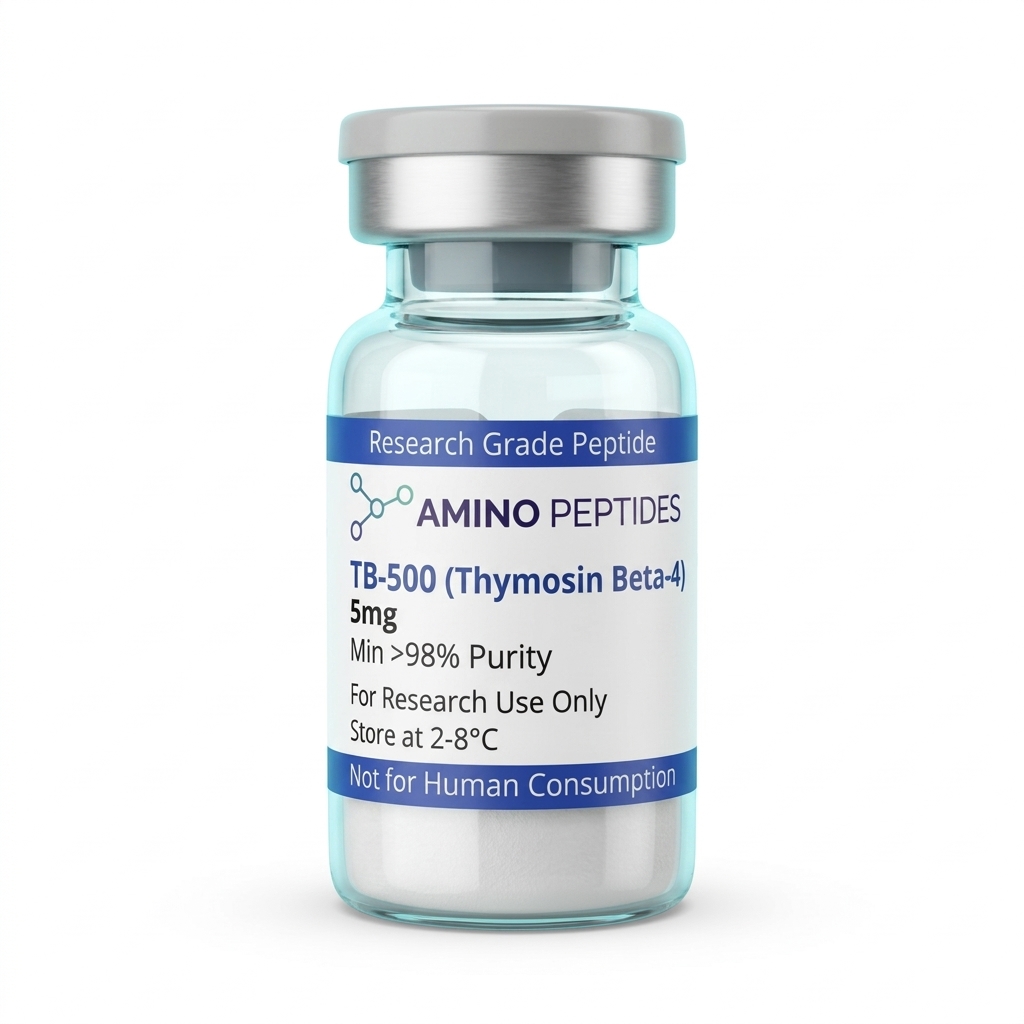
TB-500
From £29
Supplied as a sealed freeze-dried vial (stable 12–24 months at 2°C–8°C in a standard refrigerator).
Shop TB-500 →What Cell Culture Clocks Show: Early Signals vs Structural Remodelling
Watching endothelial cells respond to TB-500 in a dish requires two different stopwatches: one set for minutes and hours, and another set for days. Early chemical signalling happens almost as soon as the peptide touches the cell membrane, while visible structural changes take much longer to build.
Within the first fifteen to sixty minutes of introducing a measured level of TB-500 into an endothelial culture, intracellular sensors light up. Western blot tests from published studies show rapid phosphorylation of focal adhesion kinase and Akt proteins during this early window. At this point, looking through a standard microscope shows very little change. The cells still sit in their original clusters. Inside the cytoplasm, however, G-actin pools are already shifting toward the leading edge of each cell, preparing the membrane to push forward into flat projections called lamellipodia.
Between six and hours, wait — let us state that clearly as six and 24 hours — the physical migration becomes easy to measure. In a classic scratch-wound assay, where a technician draws a sterile pipette tip across a flat sheet of endothelial cells to leave a clear gap, cultures exposed to TB-500 close that gap noticeably faster than untreated control wells. Time-lapse cameras capture individual cells detaching from their neighbours, crawling into the open lane, and laying down provisional matrix proteins. Around the 12-hour mark, gene expression profiles also show a clear jump in matrix metalloproteinases, the enzymes that trim away old scaffolding so fresh cells can squeeze through.
Structural organisation arrives between 24 and 72 hours. When endothelial cells are seeded onto a thick layer of basement membrane extract, they do not just wander randomly; they begin linking up end-to-end. By day two or three, preclinical models show these cells folding into hollow, branching tube networks that mimic tiny capillary beds. These later structural outcomes depend entirely on the earlier signalling wave staying active. If the study amount is washed out too early, the half-formed tubes stall and flatten back out. Researchers tracking tissue remodelling use these distinct time windows to separate fast receptor and actin dynamics from the slower, energy-intensive work of building stable vessel walls.
Comparison of Angiogenic Peptides in Laboratory Cell Culture Models
| Peptide Compound | Amino Acid Length | Primary Cellular Target | Key Signalling Pathway | Observed In-Vitro Outcome |
|---|---|---|---|---|
| TB-500 (Ac-LKKTETQ Fragment) | 7 amino acids | Monomeric G-actin cytoskeleton | Actin polymerisation and focal adhesion turnover | Accelerated endothelial scratch closure and rapid cell motility |
| Thymosin Beta-4 (Full-Length) | 43 amino acids | G-actin, ATP synthase, and ILK-PINCH complex | PI3K/Akt, eNOS, and Notch1-DLL4 cascades | Coordinated capillary tube sprouting and enhanced cell survival |
| Ac-SDKP (N-Terminal Fragment) | 4 amino acids | Endothelial progenitor receptors | TGF-beta modulation and matrix metalloproteinases | Increased microvascular network branching in gel matrices |
| BPC-157 | 15 amino acids | VEGFR2 and focal adhesion kinase (FAK) | FAK-paxillin and VEGFR2-Akt-eNOS pathways | Up-regulated receptor expression and blood vessel outgrowth |
| GHK-Cu | 3 amino acids + Copper(II) | Extracellular matrix metalloproteinases | VEGF, FGF-2, and collagen synthesis signalling | Remodelling of extracellular scaffolding to support new vessels |
Smart Laboratory Pairings: Combining TB-500 With Complementary Peptides
In laboratory models of tissue regeneration, single peptides rarely work in total isolation inside living systems, so investigators frequently test TB-500 alongside complementary sequences to see how different pathways cooperate. Because TB-500 specialises in actin sequestration and endothelial migration, pairing it with peptides that handle extracellular matrix production or local inflammatory signalling lets researchers observe multi-step repair in a single setup.
The most common laboratory pairing combines TB-500 with BPC-157. While TB-500 frees up G-actin so endothelial cells can physically move into a gap, BPC-157 upregulates growth hormone receptor expression on fibroblasts and stimulates the early synthesis of collagen fibres. In combined cell culture experiments, TB-500 acts as the advance crew that brings in the capillary sprouts, and BPC-157 acts as the masonry team that pours the structural mortar around those new vessels. Published studies looking at tendon and vascular explants note that running both pathways together produces denser tube networks and stronger matrix alignment than either compound achieves on its own.
Researchers also look at how cellular migration behaves when oxidative stress or microbial Debris slows down the culture dish. In those scenarios, teams often examine immunomodulatory sequences such as KPV and LL-37 alongside angiogenic peptides. KPV helps calm excessive nuclear factor kappa B signalling in surrounding cells, keeping inflammatory cytokines from stalling endothelial movement, while LL-37 participates in both host defence and secondary angiogenic signalling through formyl peptide receptors. Studying these sequences in parallel shows how calming a noisy cellular environment lets TB-500 drive clean, uninterrupted migration.
Even dermal and surface remodelling studies borrow from this multi-target logic. While TB-500 supports the deeper microvascular bed in full-thickness skin models, surface-focused investigations might separately evaluate a snap 8 peptide to study SNARE complex modulation in neuro-cutaneous assays, or GHK-Cu to track glycosaminoglycan and elastin synthesis. Keeping each peptide's job distinct helps laboratory teams design clean protocol ratios where actin mobilisation, matrix deposition, and calm signalling work together without crowding the same receptor.

Figure: An In-Vitro Analysis of TB-500 on Endothelial Cell Migration and Angiogenic Signalling Pathways
Reconstitution calculator
Choose a vial mass and a bacteriostatic reconstitution solution volume. The figure is the resulting concentration.
Concentration: 2.50 mg/mL
Per 0.01mL (10µL): 25.0 mcg
Open the full calculatorBacteriostatic reconstitution solutionWhy 99%+ Purity and Cold Storage Decide Your Assay Outcomes
An endothelial migration assay is only as reliable as the material inside the vial, because cultured lining cells are famously sensitive to chemical leftovers from synthesis. When a laboratory team sets up an in-vitro analysis of TB-500 on endothelial cell migration and angiogenic signalling pathways, a batch that falls short of 99%+ purity by High-Performance Liquid Chromatography can easily skew the results before the first time-lapse photo is even taken.
During solid-phase synthesis, amino acids are linked together step by step. Without strict purification, truncated peptide fragments and residual trifluoroacetic acid, known as TFA, remain trapped in the freeze-dried powder. TFA is a strong acid used to cleave peptides from their resin beads. If excess TFA stays in the vial, dissolving the powder changes the pH of the cell culture medium and damages fragile endothelial membranes. What looks like a failed migration test is often just cellular irritation caused by acidic salt impurities rather than any property of TB-500 itself. Verified batches undergo ion-exchange steps to strip out excess TFA and confirm a clean 99%+ HPLC peak, ensuring the observed actin and angiogenic activity comes strictly from the intact 43-amino-acid sequence or its targeted active fragment.
Storage habits in the laboratory matter just as much as factory purification. Lyophilised TB-500 powder is stable during transit, but once it arrives, keeping the sealed vials in a refrigerator between 2°C and 8°C protects the peptide bonds from slow heat breakdown. Once a technician adds a sterile bacteriostatic reconstitution solution to dissolve the cake, the liquid peptide must stay refrigerated at 2°C to 8°C and away from bright UV light. Repeated freeze-thaw cycles can shear the peptide or cause microscopic clumping, which lowers the actual concentration reaching the culture wells.
When adding the liquid to the vial, letting the bacteriostatic reconstitution solution trickle gently down the inside glass wall rather than squirting it straight onto the powder prevents foaming and surface denaturation. Rolling the vial between the palms instead of shaking it keeps the peptide folded properly so every scratch assay and tube-formation test delivers clean, repeatable numbers.
Frequently Asked Questions
Why do researchers look up an in-vitro analysis of TB-500 on endothelial cell migration and angiogenic signalling pathways?
Researchers search for this specific analysis to understand how the synthetic peptide fragment interacts with actin proteins to promote new blood vessel formation in laboratory models. Published studies examine these cellular signalling mechanisms to characterise how endothelial cells move, organise, and support tissue remodelling inside controlled petri dish environments.
What is the typical timeline observed in laboratory studies for TB-500 endothelial cell migration?
In published studies, endothelial cell migration typically begins within four to six hours after introducing a specific concentration of TB-500 to the culture dish. Complete capillary-like tube formation and measurable angiogenic signalling milestones are normally analysed by researchers across a twenty-four to forty-eight hour observation window.
Can TB-500 be combined with other peptides like BPC-157 in laboratory models?
Yes, researchers frequently pair TB-500 with BPC-157 in preclinical models to analyse complementary cellular pathways during tissue regeneration experiments. While TB-500 primarily influences actin regulation and endothelial migration, BPC-157 targets distinct growth factor receptors, allowing scientists to observe combined effects on structural recovery.
How should TB-500 purity be verified and stored for in-vitro laboratory analysis?
Laboratory-grade TB-500 must reach at least ninety-eight percent purity, verified through High-Performance Liquid Chromatography and Mass Spectrometry before any experimental use. Once mixed with a sterile bacteriostatic reconstitution solution, the liquid peptide requires dark refrigerator storage between two and eight degrees Celsius to prevent molecular degradation.
Bibliography
- Malinda KM, Goldstein AL, Kleinman HK. Thymosin beta 4 stimulates directional migration of human umbilical vein endothelial cells. FASEB J. 1997;11(6):474-481. View published research
- Philp D, Huff T, Gho YS, Hannappel E, Kleinman HK. The actin binding site on thymosin beta4 promotes angiogenesis. FASEB J. 2003;17(14):2103-2105. View published research
- Grant DS, Rose W, Yaen C, Goldstein A, Martinez J, Kleinman H. Thymosin beta4 enhances endothelial cell differentiation and angiogenesis. Angiogenesis. 1999;3(2):125-135. View published research
- Smart N, Risebro CA, Melville AA, Moses K, Schwartz RJ, Chien KR, Riley PR. Thymosin beta4 induces adult epicardial progenitor mobilization and neovascularization. Nature. 2007;445(7124):177-182. View published research
- Ho EN, Kwok WH, Lau MY, Lam KK, Wan TS, Wong AS, Leung GN, To KK. Doping control analysis of TB-500, a synthetic version of an active region of thymosin beta4, in equine urine and plasma by liquid chromatography-mass spectrometry. J Chromatogr A. 2012;1265:57-69. View published research
See our UK peptide research guides & COA briefings first in Google Search.
Add Amino Peptides UK as a Preferred Source on Google⚠️ Research Use Only Disclaimer: All peptides and compounds are sold strictly for in-vitro laboratory research purposes only. Not intended for human or veterinary use, not a dietary supplement, and not approved to diagnose, treat, cure, or prevent any disease or condition. For use by qualified researchers in suitably equipped laboratory environments only. Amino Peptides Ltd operates in full compliance with UK MHRA regulations and applicable EU research chemical guidelines.