
GHK-Cu Copper Peptide: Skin Elasticity, Collagen & Hair Follicle Science
31st Aug 2026

What You Need to Know About GHK-Cu
- Researchers study GHK-Cu because natural levels of this tiny copper-binding protein fragment drop sharply as tissues age.
- It works like a biological messenger that delivers copper ions directly to cells and resets the activity of thousands of genes.
- Published studies in laboratory models show it boosts collagen and elastin production to support skin elasticity and structural repair.
- Scientists also analyse how it enlarges hair follicles and extends their active growth phase by improving local blood vessel formation.
Why Everyone Is Talking About GHK-Cu Copper Peptide: Skin Elasticity, Collagen & Hair Follicle Science & How It Works
GHK-Cu is a naturally occurring tripeptide bound to copper that acts like a master switch for cellular repair and tissue remodelling. Published studies show it directly signals fibroblasts to boost collagen, improve skin elasticity, and support robust hair follicle structure.
In simple terms, think of your cells as tiny builders that slow down over time. In youthful tissue, high measured levels of GHK-Cu keep these builders active, organising structural proteins so skin stays firm and resilient. As natural concentrations drop, the scaffolding weakens. When researchers introduce GHK-Cu copper peptide into laboratory models, it binds and delivers elemental copper straight into target cells.
Once inside, it flips hundreds of genetic switches back toward a younger state. It tells dermal cells to ramp up both collagen and elastin production while clearing out damaged, disorganised proteins. For hair follicle science, the mechanism is equally fascinating. Preclinical models show this copper complex widens tiny blood vessels around the root and blocks local signals that cause follicles to shrink, keeping them in their active growth phase for longer.
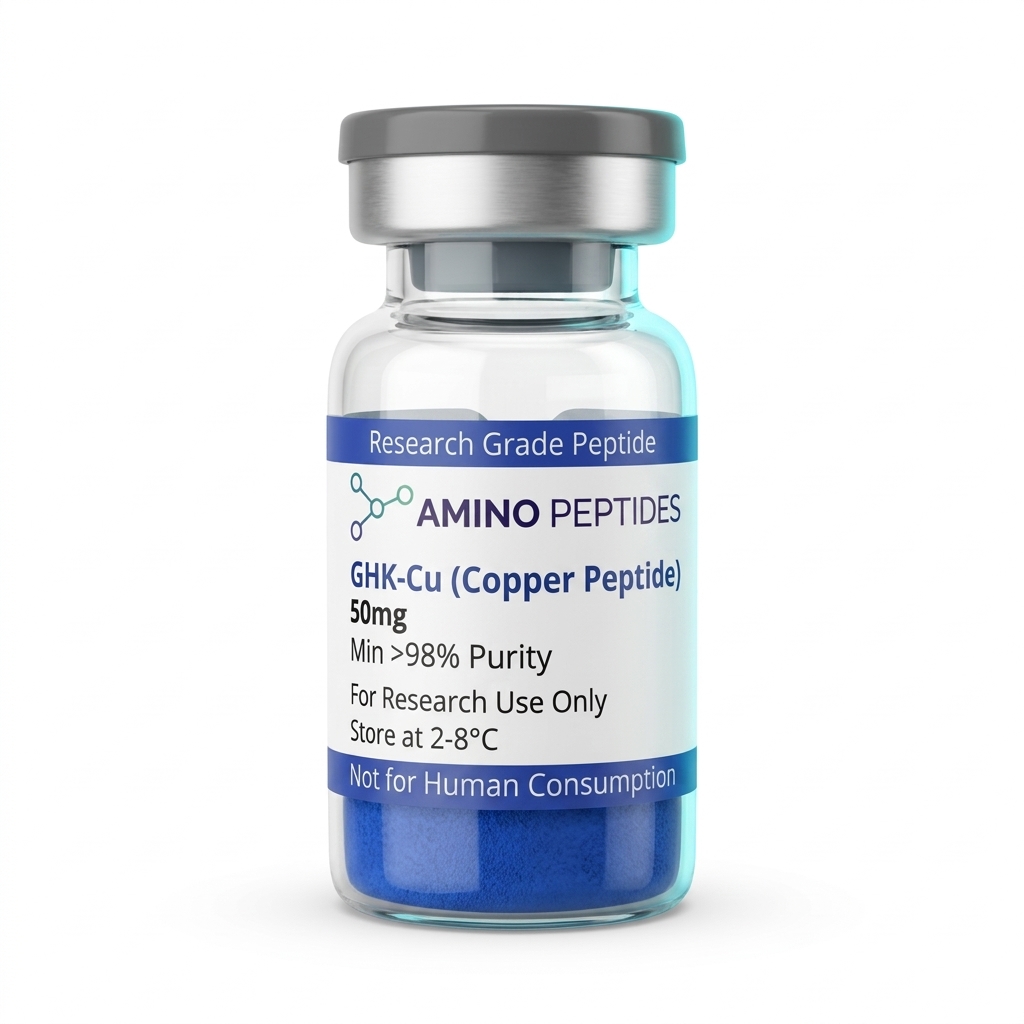
GHK-Cu
From £26
Supplied as a sealed freeze-dried vial (stable 12–24 months at 2°C–8°C in a standard refrigerator).
Shop GHK-Cu →What Published Studies Show on Timelines & Observed Results
In laboratory models, GHK-Cu does not rebuild tissue overnight; instead, it works in two distinct phases: rapid early signalling followed by gradual structural remodelling. Within the first twenty-four to seventy-two hours of exposure, published studies observe an immediate spike in cellular communication. The peptide quickly calms oxidative stress, recruits repair cells to the target area, and switches on the genes responsible for making fresh glycosaminoglycans and growth factors.
However, physical, measurable changes in tissue thickness and strength take weeks of consistent signalling. In dermal laboratory models, noticeable jumps in new collagen synthesis and improved skin elasticity typically appear between weeks three and six. By week eight to twelve, researchers observe denser, better-organised collagen bundles and firmer extracellular matrices.
Hair follicle models follow a similar staggered timeline. Early days show increased blood vessel branching around the dermal papilla, while actual enlargement of the follicle bulb and extended active growth cycles are typically recorded after four to eight weeks of observation. The takeaway from the literature is clear: cellular instructions happen fast, but laying down physical protein bricks requires steady time.
GHK-Cu Copper Peptide compared to related laboratory research peptides
| Peptide | Amino Acid Structure | Primary Research Focus | Key Signalling Pathway | Typical Purity Standard |
|---|---|---|---|---|
| GHK-Cu | Tripeptide (Gly-His-Lys) + Cu2+ | Collagen synthesis, skin elasticity, and hair follicle size | TGF-beta, integrins, and broad gene expression resetting | ≥98% to 99% (HPLC) |
| AHK-Cu | Tripeptide (Ala-His-Lys) + Cu2+ | Dermal papilla cell proliferation and follicle maintenance | VEGF upregulation and dermal fibroblast stimulation | ≥98% (HPLC) |
| Palmitoyl Tripeptide-1 | Fatty-acid linked Gly-His-Lys (No Copper) | Surface matrix protein synthesis in topical laboratory models | Matrikine feedback signalling without metal ion transport | ≥95% to 98% (HPLC) |
| BPC-157 | Pentadecapeptide (15 amino acids) | Tendon, ligament, and gut lining structural recovery | FAK-paxillin pathway and nitric oxide system modulation | ≥99% (HPLC) |
| TB-500 (Thymosin Beta-4 Fragment) | 43-amino acid protein or active fragment | Cellular migration and blood vessel formation | Actin sequestration and endothelial cell mobilisation | ≥98% to 99% (HPLC) |
Popular Synergies: Why Researchers Stack It With Partner Compounds
While GHK-Cu is a powerhouse for dermal and structural research on its own, scientists frequently examine how it behaves alongside complementary peptides. The most popular research pairing combines GHK-Cu with BPC-157 and TB-500, often referred to in laboratory circles as a glow blend peptide stack. Each compound handles a different job in the tissue recovery puzzle, preventing bottlenecks during regeneration.
Here is why they fit together so well. GHK-Cu acts as the architect, telling fibroblasts to produce collagen, elastin, and fresh extracellular matrix proteins. Meanwhile, TB-500 acts like the logistics manager, organising actin so repair cells can migrate smoothly across tissue to reach the exact spot where they are needed. Finally, BPC-157 supports the rapid formation of new micro-vessels, ensuring the entire area gets the nutrient supply required for heavy protein synthesis.
When researchers analyse these three pathways together in preclinical models, they observe far more efficient tissue remodelling than when using a single isolated signal. One compound lays the vascular tracks, the second moves the cellular workers, and the copper complex directs the final structural build.
Reconstitution calculator
Choose a vial mass and a bacteriostatic reconstitution solution volume. The figure is the resulting concentration.
Concentration: 2.50 mg/mL
Per 0.01mL (10µL): 25.0 mcg
Open the full calculatorBacteriostatic reconstitution solutionWhy Purity, TFA Removal & 2°C–8°C Fridge Storage Matter Most
When working with copper-bound peptides, the quality inside the vial determines whether laboratory observations are reliable or ruined. Genuine, high-purity GHK-Cu has a vivid, unmistakable deep blue-violet hue that reflects proper copper chelation. Cheap grey-market vials often contain poorly bound copper salts or leftover synthesis chemicals like trifluoroacetic acid (TFA). High TFA residue is bad news for delicate cell cultures, as it alters pH, causes cellular irritation, and skews collagen signalling data.
Top-tier research suppliers remove excess TFA and verify every batch using independent HPLC and mass spectrometry testing to guarantee purity above 99 percent. Once a pristine lyophilised powder is mixed with a bacteriostatic reconstitution solution, temperature control becomes your top priority.
Amino acid chains can slowly degrade and lose their copper bond if left in warm rooms or exposed to direct light. Reconstituted vials must be stored strictly between 2°C and 8°C in a dedicated refrigerator, never frozen once liquid, as ice crystals shear delicate peptide bonds. Starting with verified purity and maintaining cold storage ensures the molecular structure stays intact from day one.
Research Questions, Answered
Why is GHK-Cu copper peptide researched for skin elasticity and collagen?
Researchers study GHK-Cu because this small copper-binding molecule signals cells to support tissue remodelling and structural recovery. In published studies, it activates fibroblast pathways that generate fresh collagen and elastin fibres. This laboratory activity helps scientists understand how extracellular matrices maintain firmness, thickness, and overall skin elasticity in experimental models.
What is the typical timeline observed in copper peptide hair follicle studies?
In laboratory models examining hair follicle growth, measurable changes in cellular signalling and follicle size typically appear between two and twelve weeks. Published studies observe initial cellular activation within days, while structural tissue regeneration and extended growth phases require several weeks of consistent exposure at a specific study concentration.
Can GHK-Cu be combined with other peptides in laboratory research?
Yes, researchers frequently pair GHK-Cu with other structural peptides like BPC-157 or TB-500 in preclinical models to observe combined tissue recovery. When designing these multi-peptide protocols, scientists carefully analyse how different signalling pathways interact, ensuring the combined protocol ratio optimises cellular repair without causing receptor saturation or chemical instability.
How do purity levels and cold storage affect GHK-Cu stability?
High purity levels above 99 percent and strict cold storage are essential to prevent GHK-Cu from degrading during laboratory testing. Freeze-dried powder remains stable in a freezer, but once mixed with a bacteriostatic reconstitution solution, the liquid must stay refrigerated at four degrees Celsius to preserve its delicate copper bond.
Bibliography
- Pickart L, Vasquez-Soltero JM, Margolina A. GHK Peptide as a Natural Modulator of Multiple Cellular Pathways in Skin Regeneration. BioMed Research International. 2015;2015:648108. View published research
- Pickart L, Margolina A. Regenerative and Protective Actions of the GHK-Cu Peptide in the Light of the New Gene Data. International Journal of Molecular Sciences. 2018;19(7):1987. View published research
- Maquart FX, Pickart L, Laurent M, Gillery P, Monboisse JC, Borel JP. Stimulation of collagen synthesis in fibroblast cultures by the tripeptide-copper complex glycyl-L-histidyl-L-lysine-Cu2+. FEBS Letters. 1988;238(2):343-346. View published research
- Pickart L, Vasquez-Soltero JM, Margolina A. The Human Tripeptide GHK-Cu in Prevention of Oxidative Stress and Degenerative Conditions of Aging: Implications for Cognitive Health. Oxidative compound and Cellular Longevity. 2012;2012:324832. View published research
⚠️ Research Use Only Disclaimer: All peptides and compounds are sold strictly for in-vitro laboratory research purposes only. Not intended for human or veterinary use, not a dietary supplement, and not approved to diagnose, treat, cure, or prevent any disease or condition. For use by qualified researchers in suitably equipped laboratory environments only. Amino Peptides Ltd operates in full compliance with UK MHRA regulations and applicable EU research chemical guidelines.