
Mito Stack Safety and Biology: Deconstructing SS-31, MOTS-c, and NAD+ Claims - Fact vs. Fiction
16th Oct 2026

What You Need to Know About NAD+, MOTS-c & SS-31
- People look this stack up because the compounds touch cellular energy from different directions.
- NAD+ feeds redox reactions. MOTS-c is a mitochondrial peptide. SS-31 is discussed for the inner membrane when it is part of the stack.
- Published work tracks early signalling within hours and later changes in mitochondrial output.
- A 99%+ HPLC-verified, freeze-dried vial kept at 2°C–8°C is the variable a laboratory can actually hold constant.
How SS-31, MOTS-c, and NAD+ Power Cellular Energy
In laboratory models, SS-31, MOTS-c, and NAD+ work at three distinct stages of energy production to help cells generate ATP efficiently and reduce oxidative waste. Rather than forcing temporary stimulation, this combination repairs the inner mitochondrial membrane, improves fuel uptake, and supplies the coenzymes needed to keep cellular batteries running smoothly.
Every cell relies on tiny structures called mitochondria to turn nutrients into usable energy, known as adenosine triphosphate (ATP). As cells age or face heavy metabolic stress, the inner folding of the mitochondria begins to sag. A special phospholipid called cardiolipin holds these folds together, much like mortar between bricks. When cardiolipin oxidises, electrons leak out instead of creating ATP, which slows down cellular recovery and creates damaging free radicals.
Published studies show that SS-31 (also called Elamipretide) binds directly to cardiolipin. By stabilising the physical curve of the inner membrane, SS-31 keeps the electron transport chain tightly packed so electrons flow cleanly again. Meanwhile, NAD+ acts as the main delivery truck that carries those electrons into the system. Without enough NAD+ present in the cell, energy production stalls regardless of how healthy the membrane looks.
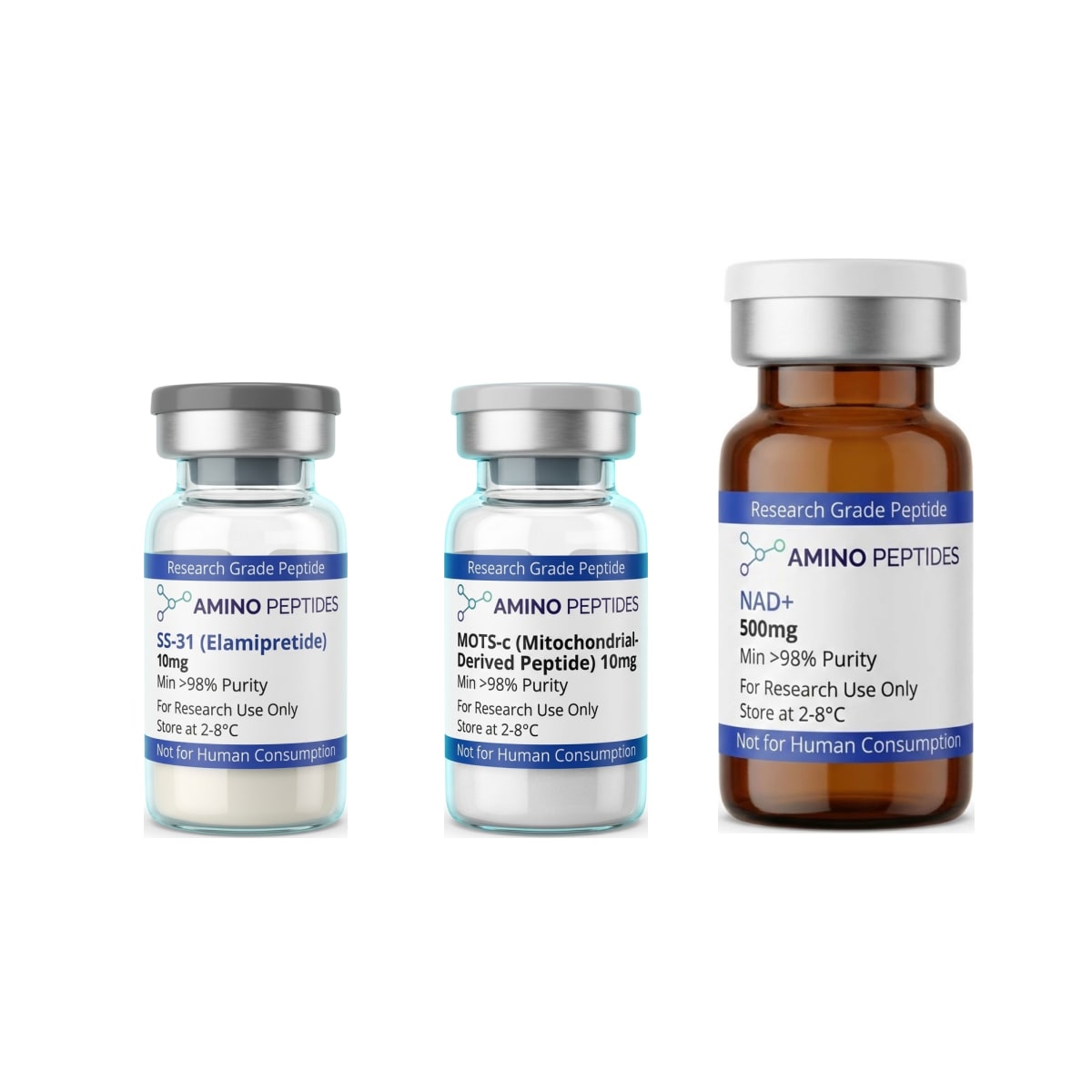
SS-31 & MOTS-c & NAD+
From £116
Supplied as a sealed freeze-dried vial (stable 12–24 months at 2°C–8°C in a standard refrigerator).
Shop SS-31 & MOTS-c & NAD+ →MOTS-c handles the supply side of the equation. Encoded directly by mitochondrial DNA, this 16-amino-acid peptide travels to the cell nucleus during energetic stress and activates the AMPK pathway. In preclinical models, this signal tells the cell to pull in more glucose and fatty acids, ensuring the newly stabilised mitochondria have plenty of raw fuel to burn.
What Published Studies Observe Across Research Timelines
Online discussions often claim that mitochondrial compounds create instant, dramatic physical changes overnight, which misses how cellular biology actually unfolds. In controlled laboratory models, researchers separate the observed outcomes of SS-31, MOTS-c, and NAD+ into rapid biochemical signalling and slower structural tissue remodelling.
During the first 24 to 72 hours of an experiment, the changes are purely chemical and energetic. Published studies demonstrate that SS-31 reaches the inner mitochondrial membrane within minutes of introduction into cell cultures. In aged preclinical models, scientists measure a noticeable drop in reactive oxygen species (ROS) and a rebound in ATP output within the first few hours. When NAD+ is evaluated alongside it, researchers observe an immediate uptick in sirtuin enzyme activity, which helps regulate cellular housekeeping and circadian rhythm genes.
Across days 7 to 14, the signalling effects of MOTS-c become easier to measure. Laboratory models tracking metabolic flexibility show improved insulin sensitivity and steadier glucose clearance during this middle window. Rather than creating new tissue right away, the cells are adjusting how they partition fuel and clear out metabolic byproducts.
True structural recovery takes considerably longer. In published studies running from 4 to 8 weeks, sustained cardiolipin protection and AMPK activation lead to mitochondrial biogenesis—the creation of fresh, healthy mitochondrial networks. At this later stage, researchers examining muscle and cardiac tissue in preclinical models note denser cristae architecture, improved endurance markers, and healthier cellular resilience under stress. Early shifts happen at the microscopic receptor level, while visible tissue remodelling requires weeks of consistent biochemical support.
Reconstitution calculator
Choose a vial mass and a bacteriostatic reconstitution solution volume. The figure is the resulting concentration.
Concentration: 2.50 mg/mL
Per 0.01mL (10µL): 25.0 mcg
Open the full calculatorBacteriostatic reconstitution solutionMito Stack Biology: Comparing SS-31, MOTS-c, and NAD+ in Laboratory Models
| Compound | Molecular Class | Primary Cellular Target | Observed Mechanism in Published Studies | Combined Stack Evidence Status |
|---|---|---|---|---|
| SS-31 (Elamipretide) | Synthetic tetrapeptide (D-Arg-Dmt-Lys-Phe-NH2) | Cardiolipin on the inner mitochondrial membrane | Stabilises membrane curvature and optimises electron transport chain efficiency while limiting reactive oxygen species | Studied individually; unverified in triple combinations |
| MOTS-c | Mitochondrial-derived peptide (16 amino acids) | Folate-methionine cycle and AMPK signalling pathway | Translocates to the cell nucleus under metabolic stress to regulate gene expression and glucose utilisation | Studied individually; unverified in triple combinations |
| NAD+ (Nicotinamide Adenine Dinucleotide) | Dinucleotide coenzyme | Redox reactions, sirtuins (SIRT1-7), and PARP enzymes | Acts as a primary electron carrier during cellular respiration and serves as a substrate for DNA repair enzymes | Studied individually; unverified in triple combinations |
| Triple 'Mito Stack' Protocol | Multi-compound research mixture | Overlapping mitochondrial and nuclear pathways | Hypothesised to address membrane integrity, metabolic signalling, and redox pools at the same time | No published preclinical models have evaluated all three together |
How the Mitochondrial Trio Works Together in the Lab
Trying to fix cellular energy with a single compound often creates a bottleneck in the lab. If a researcher adds high measured levels of NAD+ to aged cells whose inner mitochondrial membranes are still leaky, the extra electron flow can simply increase oxidative stress. That is why investigators frequently evaluate a targeted peptides stack to address hardware, fuel supply, and electron transport at the same time.
In this three-part model, SS-31 acts as the structural carpenter. By securing cardiolipin and sealing the electron transport chain first, it prepares the mitochondrion to handle a higher workload without leaking free radicals. Once that physical structure is stable, introducing NAD+ provides the necessary coenzyme pool to drive Complexes I through IV of the respiratory chain at full capacity.
MOTS-c completes the circuit by preventing fuel starvation. Because stabilised mitochondria running with ample NAD+ consume substrates rapidly, MOTS-c triggers the AICAR-AMPK pathway to bring fresh glucose and fatty acids into the cell. Researchers studying the Mito Prime NAD combination can observe how membrane stabilisation, coenzyme replenishment, and metabolic signalling interact without leaving one step of the cycle behind.
Some laboratory protocols also examine how these mitochondrial agents pair with tissue-specific peptides like BPC-157 or GHK-Cu. While BPC-157 and GHK-Cu signal fibroblasts to lay down new collagen and extracellular matrix, that construction work demands massive amounts of cellular ATP. Supporting the mitochondrial power grid alongside structural peptides gives researchers a clearer look at how energy availability governs the speed of tissue regeneration.
Figure: Mito Stack Safety and Biology: Deconstructing SS-31, MOTS-c, and NAD+ Claims - Fact vs. Fiction
Why Vial Purity and Cold Storage Matter for Mitochondrial Peptides
When evaluating safety and biology in mitochondrial research, many problems blamed on the peptides themselves actually stem from poor chemical synthesis. Because SS-31 and MOTS-c interact with delicate intracellular membranes, any leftover manufacturing solvents in the vial can skew laboratory readouts and damage cell cultures.
During solid-phase peptide synthesis, manufacturers use trifluoroacetic acid (TFA) to cleave amino acid chains from their resin beads. If a supplier skips secondary ion-exchange purification, residual TFA salts remain attached to the lyophilised powder. In preclinical models, excess TFA is toxic to mitochondria; it alters local pH, irritates cellular membranes, and triggers inflammatory signalling that looks the exact opposite of what pure SS-31 or MOTS-c is supposed to do. Always verify that research materials come with third-party High-Performance Liquid Chromatography (HPLC) and Mass Spectrometry certificates confirming 99%+ purity and thorough TFA removal.
Proper storage is equally important for keeping these fragile chains intact. Both MOTS-c and NAD+ are sensitive to heat and light, which can snap peptide bonds or oxidise the nicotinamide ring before an experiment even begins. Unopened lyophilised vials remain stable when kept frozen at -20°C. Once mixed with a sterile bacteriostatic reconstitution solution, the liquid must be stored in a dark refrigerator between 2°C and 8°C and handled gently without shaking. Avoiding freeze-thaw cycles and using verified, high-purity vials ensures that any observed changes in cellular energy come from the actual peptides rather than chemical contaminants.
Frequently Asked Questions
Why are researchers investigating the combination of SS-31, MOTS-c, and NAD+?
Researchers investigate this trio to observe how cellular energy production can be supported from multiple angles simultaneously. Published studies show SS-31 stabilises mitochondrial membranes, MOTS-c regulates metabolic signalling, and NAD+ fuels vital energy transfer processes. Together, these compounds help scientists analyse cellular recovery and age-related decline in preclinical models.
What does the research timeline look like for these mitochondrial compounds?
Published studies demonstrate that cellular responses to these molecules occur across varying timeframes in laboratory models. While SS-31 and NAD+ can influence mitochondrial membrane stability and energy markers within hours, MOTS-c typically requires several weeks of sustained protocol ratios to visibly alter metabolic gene expression and tissue remodelling.
Can SS-31, MOTS-c, and NAD+ be combined in a single research protocol?
Yes, laboratory protocols frequently examine these compounds alongside one another because they target distinct pathways within the mitochondria. However, researchers avoid mixing them in the same vial, as differing pH levels can degrade the fragile peptide structures. Instead, they are prepared separately to preserve stability during experimental observation.
How should these research peptides be stored after reconstitution?
Once mixed with a bacteriostatic reconstitution solution, these compounds must be stored in a standard refrigerator between 2°C and 8°C. Keeping the vials away from light and avoiding freezing ensures the amino acid chains do not break down. Verify that your research materials exceed 99% purity via independent analysis.
Bibliography
- Szeto HH. First-in-class cardiolipin-protective compound as a strategy to restore mitochondrial bioenergetics. Br J Pharmacol. 2014;171(8):2029-2050. View published research
- Lee C, Zeng J, Drew BG, et al. The mitochondrial-derived peptide MOTS-c promotes metabolic homeostasis and reduces obesity and insulin resistance. Cell Metab. 2015;21(3):443-454. View published research
- Kim KH, Son JM, Benayoun BA, Lee C. The Mitochondrial-Encoded Peptide MOTS-c Translocates to the Nucleus to Regulate Nuclear Gene Expression in Response to Metabolic Stress. Cell Metab. 2018;28(3):516-524. View published research
- Covarrubias AJ, Perrone R, Grozio A, Verdin E. NAD+ metabolism and its roles in cellular processes during ageing. Nat Rev Mol Cell Biol. 2021;22(2):119-141. View published research
- Campbell MD, Duan J, Samuelson AT, et al. Improving mitochondrial function with SS-31 reverses age-related redox stress and improves exercise tolerance in aged mice. Free Radic Biol Med. 2019;134:268-281. View published research
⚠️ Research Use Only Disclaimer: All peptides and compounds are sold strictly for in-vitro laboratory research purposes only. Not intended for human or veterinary use, not a dietary supplement, and not approved to diagnose, treat, cure, or prevent any disease or condition. For use by qualified researchers in suitably equipped laboratory environments only. Amino Peptides Ltd operates in full compliance with UK MHRA regulations and applicable EU research chemical guidelines.