
Neuropeptide Research: How ACTH 1-39 Influences Adrenal Response
10th Jul 2026

Adrenocorticotropic hormone (ACTH 1-39) represents a key regulatory neuropeptide synthesised in the anterior pituitary gland. In laboratory models, this 39-amino-acid peptide serves as the primary agonist for the melanocortin 2 receptor (MC2R), initiating a cascade of intracellular events that govern steroidogenesis. Researchers studying endocrine pathways rely on high-purity research peptide reagents to analyse these cellular mechanisms without the confounding variables present in vivo. Understanding the precise biophysical interactions of ACTH 1-39 is fundamental to mapping the complex feedback loops of the hypothalamic-pituitary-adrenal axis in vitro.
Receptor Binding Kinetics and Signal Transduction
The biological activity of ACTH 1-39 is mediated through its highly specific binding to MC2R, a G-protein coupled receptor primarily expressed in adrenocortical cells. Unlike other melanocortin receptors, MC2R requires the presence of the accessory protein MRAP (Melanocortin 2 Receptor Accessory Protein) for stable cell-surface expression and functional ligand binding. Upon binding, ACTH 1-39 stimulates the Gs alpha subunit, activating adenylate cyclase. This activation leads to a rapid increase in intracellular cyclic adenosine monophosphate (cAMP) levels, which serves as the primary secondary messenger propagating the signal.
This rapid accumulation of cAMP recruits protein kinase A (PKA), which subsequently phosphorylates key transcription factors and enzymes. The primary downstream target of this pathway is the steroidogenic acute regulatory (StAR) protein, which facilitates the transfer of cholesterol across the outer mitochondrial membrane to the inner membrane. By studying these kinetics in vitro, researchers can map the temporal dynamics of receptor activation and subsequent desensitisation, providing valuable insights into receptor-ligand interactions.
Steroidogenesis and Chemical Synthesis Pathways
In cell cultures, the introduction of ACTH 1-39 triggers a biphasic response. The acute phase, occurring within minutes, involves the mobilisation of cholesterol and its conversion to pregnenolone within the mitochondria. The chronic phase involves the transcriptional upregulation of steroidogenic enzymes, including cytochrome P450 side-chain cleavage (CYP11A1) and 21-hydroxylase (CYP21A2). By analysing these pathways, laboratory researchers can characterise the rate-limiting steps of steroid synthesis. To maintain experimental integrity, investigators often source materials from a reputable analytical peptide supplier to ensure the absence of truncated peptide fragments that could act as competitive antagonists.
Structural Integrity and Reconstitution Protocols
The stability of ACTH 1-39 in aqueous solutions is highly dependent on pH, temperature, and the choice of solvent. The peptide contains several labile amino acid residues prone to oxidation and deamidation, particularly methionine at position 4 and glycine-asparagine sequences. To preserve the structural integrity of the peptide sequence during long-term assays, researchers must employ precise reconstitution protocols. Using a sterile reconstitution solvent, such as a bacteriostatic reconstitution solution, helps prevent microbial degradation while maintaining a stable pH environment. This is critical when evaluating the peptide's long-term effects on cell viability and receptor downregulation in continuous cell lines.
Precision in peptide reconstitution remains the single most critical factor determining the reproducibility of in-vitro receptor assays.
Comparative Analysis in Neuropeptide Research
When comparing ACTH 1-39 to shorter fragments, such as ACTH 1-24, researchers observe distinct differences in binding affinity and receptor internalisation rates. While ACTH 1-24 retains full steroidogenic potency, the remaining C-terminal sequence of the full-length 1-39 peptide plays a vital role in peptide stability and protection against enzymatic cleavage in vitro. Investigating these structural differences helps researchers understand the evolutionary conservation of neuropeptides and informs the future of peptidomimetics in laboratory settings.
Frequently Asked Questions
Q1: Why does ACTH 1-39 require the MRAP protein for functional activity in vitro?A1: The melanocortin 2 receptor (MC2R) is unique because it cannot achieve functional cell-surface expression or bind ACTH 1-39 without the melanocortin 2 receptor accessory protein (MRAP). MRAP assists in the proper folding, glycosylation, and trafficking of MC2R from the endoplasmic reticulum to the plasma membrane, forming a stable receptor-accessory complex necessary for ligand recognition.
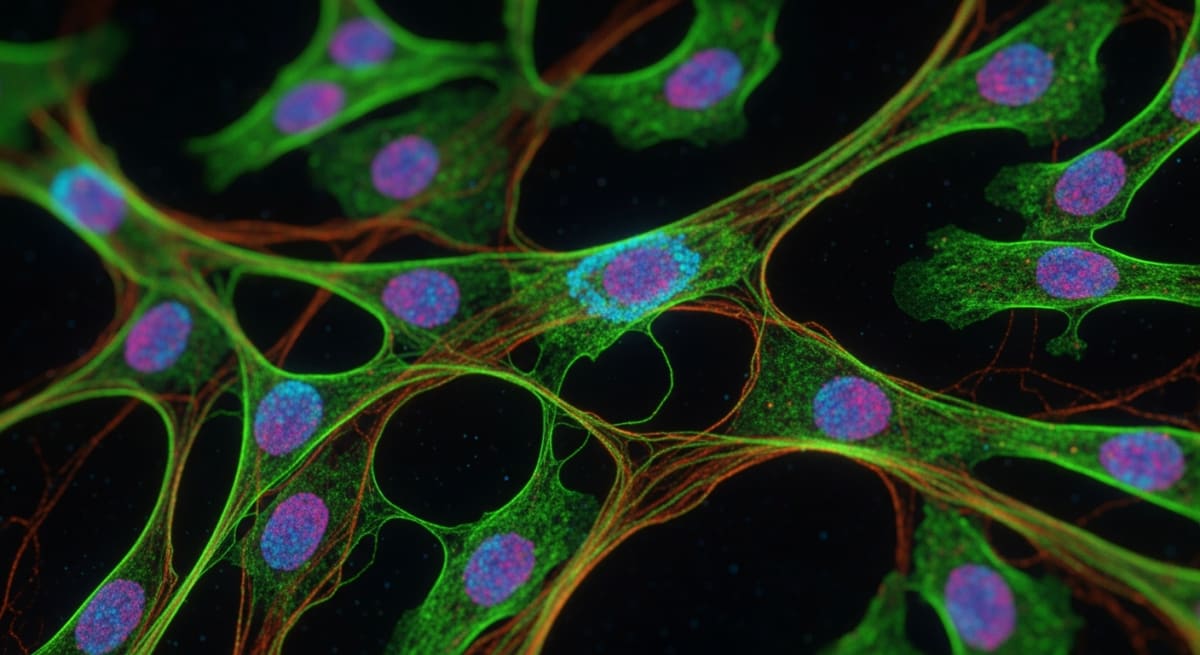
Figure 1: Vibrant fluorescent microscopy showing glowing neon green, magenta, and cyan cellular structures against a dark background.
A2: While the N-terminal 1-24 sequence contains the core binding and activation domains, the C-terminal residues (25-39) provide structural stability and protect the peptide from rapid enzymatic degradation by exopeptidases in cell culture media. This makes the full-length ACTH 1-39 valuable for studying prolonged exposure effects on receptor desensitisation.
Q3: What is the optimal pH range for maintaining ACTH 1-39 stability during in-vitro assays?A3: ACTH 1-39 exhibits optimal stability in slightly acidic to neutral pH ranges (pH 4.0 to 6.5). Exposure to highly alkaline environments accelerates deamidation and oxidation processes, which can alter the peptide's conformation and reduce its binding affinity to MC2R.
References
- Mountjoy, K. G., et al. (1992). The cloning of a family of melanocortin receptors. Science, 257(5074), 1248-1251. View published research
- Metherell, L. A., et al. (2005). Mutations in MRAP, encoding a new single-transmembrane protein, cause familial glucocorticoid deficiency type 2. Nature Genetics, 37(2), 166-170. View published research
- Clark, A. J., et al. (2016). ACTH, MC2R and MRAP. Frontiers in Endocrinology, 7, 101. View published research
- Ruggiero, C., & Lalli, E. (2016). ACTH receptor signaling in adrenocortical development and physiology. Molecular and Cellular Endocrinology, 429, 19-26. View published research
- Cooray, S. N., et al. (2009). The melanocortin 2 receptor accessory protein acts as a divalent homodimer to facilitate receptor expression and ligand binding. Endocrinology, 150(10), 4586-4593. View published research
- Gantz, I., & Fong, T. M. (2003). The melanocortin system. American Journal of Physiology-Endocrinology and Metabolism, 284(3), E468-E474. View published research
- Liang, J., et al. (2021). Structural basis for adrenocorticotropic hormone recognition by the melanocortin-2 receptor. Cell Research, 31(11), 1197-1205. View published research
⚠️ Research Use Only Disclaimer: All peptides and compounds are sold strictly for in-vitro laboratory research purposes only. Not intended for human or veterinary use, not a dietary supplement, and not approved to diagnose, treat, cure, or prevent any disease or condition. For use by qualified researchers in suitably equipped laboratory environments only. Amino Peptides Ltd operates in full compliance with UK MHRA regulations and applicable EU research chemical guidelines.