
PT-141 (Bremelanotide): Evaluating CNS-Mediated Responses in Sexual Dysfunction Models
25th Jun 2026

Current structural analyses of melanocortin receptor agonists prioritise isolated central nervous system (CNS) pathways. Characterised by the sequence Ac-Nle-cyclo(Asp-His-D-Phe-Arg-Trp-Lys)-OH, the synthetic cyclic heptapeptide PT-141 functions as an analogue of endogenous alpha-melanocyte-stimulating hormone (alpha-MSH). Laboratory applications evaluate how this compound interfaces directly with central nervous system receptors during controlled in-vitro assays. By applying the peptide to sectioned brain slices, researchers isolate downstream signalling cascades from systemic interference. Hypothalamic tissue preparations offer a defined environment for measuring neurochemical pathway initiation following specific melanocortin receptor binding.
Verified Research Reagent
PT-141 (Bremelanotide)
HPLC-verified lyophilised compound, UK-domestic supply. Manufactured under controlled conditions for qualified in-vitro laboratory research.
Tracing the structural derivation of this peptide reveals its origins in melanotan II. Chemical modification via selective C-terminal deamination of the terminal amide group yields a free carboxylate metabolite with a unique binding profile. Altering the molecular geometry preserves measurable receptor affinity while shifting secondary metabolic interactions in cellular media. Personnel procuring reagents from platforms advertising options to shop all peptides often examine these structural variations to map changes in receptor selectivity. Isolating medial preoptic area (mPOA) and paraventricular nucleus (PVN) tissue cultures permits precise characterisation of these receptor-ligand interactions. An internal disulfide bond stabilises the configuration against rapid enzymatic degradation, making it suitable for prolonged exposure in microplate assays.
Melanocortin Receptor Binding Profiles
Interactions with the five-member G-protein coupled melanocortin receptor (MCR) family govern the peptide's biochemical activity. Unlike endogenous alpha-MSH, which binds non-selectively across the family, this synthetic analogue demonstrates pronounced affinity for MC3R and MC4R subtypes. Ex-vivo neurological models rely on MC4R activation to initiate central pathways. Ligand binding induces a conformational shift that stimulates the Gs protein, compelling adenylyl cyclase to convert ATP into cyclic adenosine monophosphate (cAMP). Subsequent in-vitro assays verify that accumulating cAMP activates protein kinase A (PKA), which modulates ion channel states and transcription factors including cAMP response element-binding protein (CREB). Applying the peptide to PVN slice preparations frequently results in measurable central nitric oxide release, allowing investigators to track GPCR activation dynamics independent of peripheral variables.
Ex-Vivo Isolated Tissue Mechanisms
Mechanistic distinctions become clear when comparing this peptide against peripheral agents that trigger local cyclic guanosine monophosphate (cGMP) accumulation in smooth muscle cells. Operating exclusively upstream on central nervous system receptors, the melanocortin agonist initiates coordinated neural firing in isolated spinal and brain stem preparations without vascular interference. Sectioned tissues reveal specific melanocortinergic projections extending from the arcuate nucleus into the mPOA and PVN. Modulating dopaminergic pathways through these central receptors prompts localised dopamine release in controlled cellular models. Because cross-talk between melanocortinergic and dopaminergic neurons occurs readily in these assays, researchers must utilise highly selective agonists to restrict off-target receptor activation.
In-Vitro Slice Preparation Observations
Primary data identifying target brain regions originates from functional neural slice models. Mapping c-Fos immunoreactivity confirms targeted neuronal activation across isolated mPOA, PVN, and supraoptic nucleus tissues. Direct application of MC4R antagonists to these PVN cultures rapidly neutralises the biochemical response, validating that the effects depend on specific central receptor populations. Additional cellular cultures show the peptide modulating gonadotropin-releasing hormone (GnRH) secretion, isolated from the broader hypothalamic-pituitary-gonadal (HPG) axis. While this endocrine modulation indicates potential shifts in cellular neuroendocrine baselines, investigators must rigorously control the in-vitro environment to prevent culture-induced stress responses from disrupting melanocortin signalling pathways.
Analytical Methodologies for Evaluating Receptor Activation
Validating peptide efficacy depends on stringent analytical methodologies. High-performance liquid chromatography (HPLC) and mass spectrometry confirm structural sequence and molecular weight prior to running assays. In-vitro receptor binding procedures utilise membrane preparations from cells expressing recombinant human MC3, MC4, and MC5 receptors to calculate the inhibition constant (Ki) and half-maximal effective concentration (EC50). Technicians also measure intracellular calcium dynamics in real time. Because MC4R couples to both Gs and Gq proteins, tracking calcium fluctuations yields comprehensive data regarding the active signalling pathways. Microfluidic platforms and confocal microscopy facilitate continuous monitoring of receptor internalisation and desensitisation, protocols frequently supported by analytical reagents from amino peptides suppliers. These established frameworks produce exact receptor occupancy rates and kinetic profiles.
In-Vitro Frequently Asked Questions
What primary intracellular signalling pathway does this peptide activate in vitro?
Laboratory assays confirm the peptide triggers the Gs-protein-coupled pathway upon binding to the melanocortin 4 receptor (MC4R). This interaction stimulates adenylyl cyclase, raising intracellular cyclic adenosine monophosphate (cAMP) levels and subsequently activating protein kinase A (PKA) to adjust neuronal excitability in isolated cultures.
How does the structural selectivity differ from endogenous alpha-MSH?
While endogenous alpha-MSH acts non-selectively across MC1R, MC3R, MC4R, and MC5R, the synthetic analogue displays marked selectivity for MC3R and MC4R. Restricting MC1R-mediated pathways enables investigators to separate central nervous system responses from peripheral mechanisms during cellular modelling.
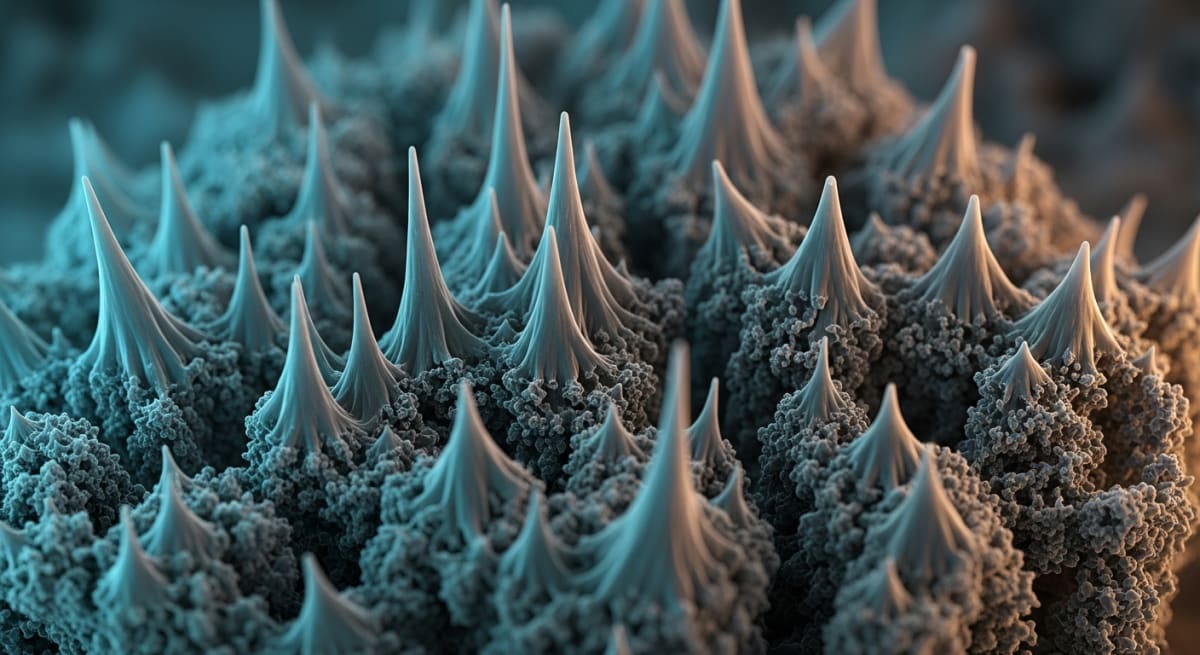
Figure 1: An ultra-high contrast black-and-white scanning electron microscope (SEM) view of a highly detailed, textured peptide crystalline structure.
Which reconstitution solvent preserves peptide stability for laboratory assays?
Extended observation protocols mandate the use of a sterile bacteriostatic solution. Preservative agents within this solvent inhibit microbial growth and maintain molecular conformation, whereas standard sterile water degrades rapidly and serves only immediate, short-term experimental needs.
Bibliography
- Shadiack, A. M., et al. (2007). Melanocortin receptor agonists in male and female sexual dysfunction. Current Topics in Chemistry, 7(11), 1137-1144. View study
- King, S. H., et al. (2005). Bremelanotide, a melanocortin receptor agonist in sexual dysfunction. Current Opinion in Investigational Science, 6(10), 1046-1053. View study
- Pfaus, J. G., et al. (2004). Selective facilitation of sexual solicitation in the female rat by a melanocortin receptor agonist. Proceedings of the National Academy of Sciences, 101(27), 10201-10204. View study
- Diamond, L. E., et al. (2006). Co-administration of low concentrations of bremelanotide and sildenafil neopentyl glycol to rats enhances erectile response. European Journal of Pharmacology, 539(1-2), 129-135. View study
- Hadley, M. E. (2005). Discovery that a melanocortin receptor agonist (MT-II) induces penile erections. Life Sciences, 77(17), 2179-2190. View study
⚠️ Research Use Only Disclaimer: All peptides and compounds are sold strictly for in-vitro laboratory research purposes only. Not intended for human or veterinary use, not a dietary supplement, and not approved to diagnose, treat, cure, or prevent any disease or condition. For use by qualified researchers in suitably equipped laboratory environments only. Amino Peptides Ltd operates in full compliance with UK MHRA regulations and applicable EU research chemical guidelines.