
Semax Examined: Scientific Deconstruction and Safety Profile
5th Nov 2026

What You Need to Know About Semax Peptide
- Researchers investigate Semax to understand how short synthetic peptides can influence cognitive signalling pathways without triggering adrenal hormone activity.
- It works by gently boosting the expression of brain-derived neurotrophic factor (BDNF) and its receptors, which support nerve cell survival and synaptic plasticity.
- Adding the three-amino-acid Pro-Gly-Pro tail helps the molecule resist rapid breakdown by enzymes in laboratory models.
- Published studies in rodent models have observed rapid shifts in gene expression linked to vascular remodelling, immune response, and neural protection after ischaemic stress.
How Semax Supports Focus and Cellular Energy in Lab Models
Semax is a synthetic seven-amino-acid peptide that laboratory researchers study for its ability to elevate brain-derived neurotrophic factor and support neural focus without triggering adrenal hormone release. Built from a small fragment of adrenocorticotropic hormone, it keeps the mental clarity signals while leaving behind the steroid-stimulating action of the full parent chain.
To see how Semax works, it helps to look at its structure. Scientists took the fourth through seventh amino acids of the natural hormone ACTH—specifically Methionine, Glutamate, Histidine, and Phenylalanine—and attached a stable three-part tail made of Proline, Glycine, and Proline. Natural ACTH fragments break down in blood plasma in a matter of seconds because enzymes chew them up. That Pro-Gly-Pro tail acts like a molecular bumper, slowing down enzymatic breakdown so the sequence lasts much longer in preclinical models.
In published studies, the headline observation around Semax is how quickly it nudges the expression of brain-derived neurotrophic factor, commonly called BDNF, along with its matching receptor, TrkB. You can think of BDNF as nourishment for nerve cells. When BDNF levels rise in tissue cultures or animal models, nerve cells form stronger connections, communicate faster across synapses, and handle low-oxygen stress much better. Researchers also observe changes in dopamine and serotonin turnover within specific brain regions linked to attention and memory consolidation.
What makes the safety profile of this sequence so interesting to biochemists is what it leaves alone. Full-length ACTH tells the adrenal glands to pump out cortisol. Because Semax only uses a tiny four-amino-acid slice of that chain, it cannot switch on adrenal steroid receptors. Laboratory models show heightened cellular energy and sharp signalling activity without the jittery cardiovascular spikes or hormonal exhaustion associated with classic stimulants. When investigators source Semax UK reference vials, they are looking specifically at this clean separation between neurotrophic support and endocrine stress.
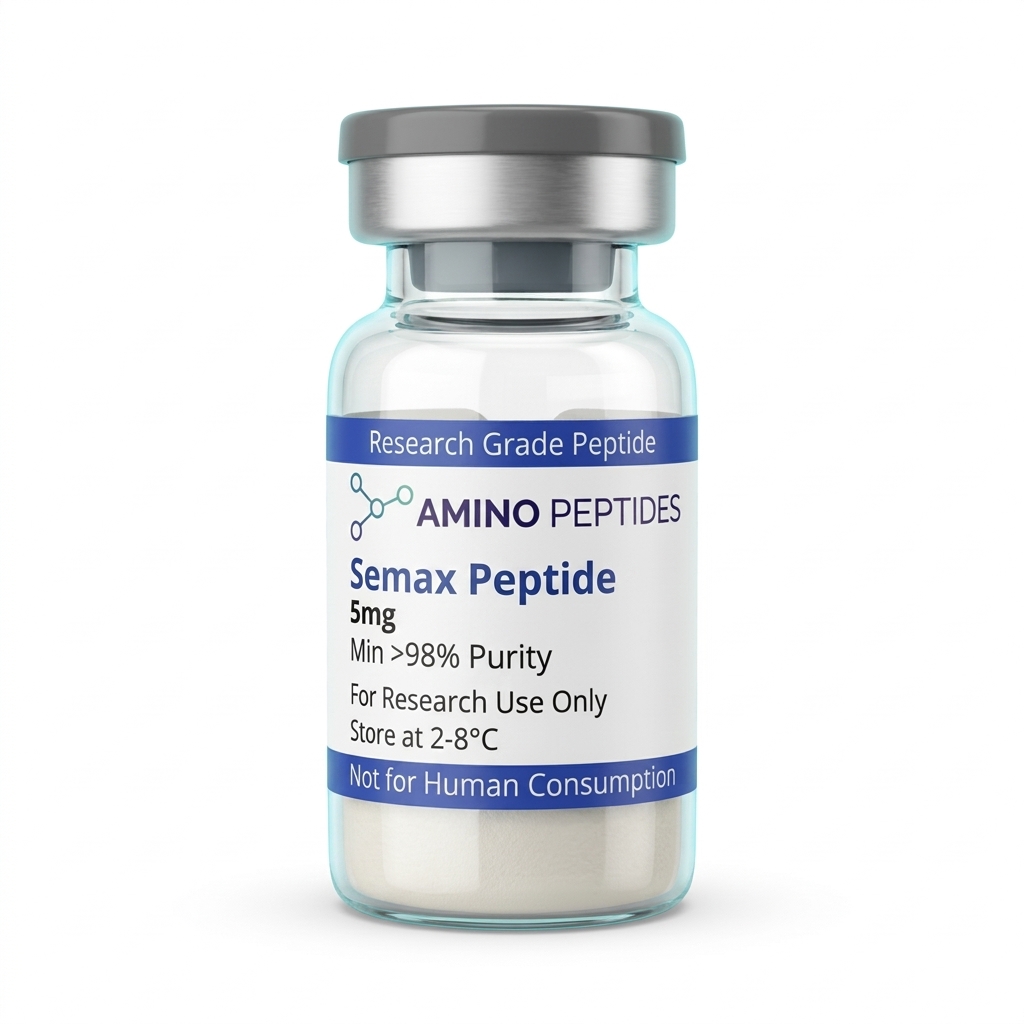
Semax Peptide
From £19
Supplied as a sealed freeze-dried vial (stable 12–24 months at 2°C–8°C in a standard refrigerator).
Shop Semax Peptide →What Published Studies Observe Across Early and Late Phases
When scientists track Semax in laboratory models, they divide their observations into two distinct windows: the rapid chemical signalling that happens in the first few hours, and the slower structural adaptations that build up over days or weeks. Understanding the difference between these two phases explains why study protocols are designed the way they are.
The early phase begins almost immediately after exposure in preclinical setups. Within fifteen to sixty minutes, researchers measure a sharp rise in messenger RNA for BDNF and nerve growth factor inside the hippocampus and frontal cortex of test models. This means the cells are actively reading the genetic instructions to build more support proteins. During this same early window, studies also record shifts in neurotransmitter metabolites, particularly a boost in dopaminergic and serotonergic activity when the model is placed under an attention task. In plain terms, the immediate outcome observed in the lab is faster signal transmission between neurons and better resistance to acute mental fatigue.
The later phase looks quite different. If a study protocol continues over seven to fourteen days, the focus moves from quick chemical messengers to physical tissue remodelling at the microscopic level. Repeated rises in TrkB receptor activity encourage dendritic sprouting—the growth of tiny branches that nerve cells use to talk to their neighbours. Published studies evaluating recovery after reduced blood flow show that this multi-day window is when protective gene expression peaks, helping cells maintain their energy-producing mitochondria and calm down local oxidative stress.
Researchers also keep a close eye on receptor sensitivity during longer timelines. If a biological system receives too high a concentration of any signalling peptide for too long, cells can pull their receptors inside to quiet the noise. Because of this, published laboratory protocols typically favour measured levels spaced over short cycles rather than heavy, continuous saturation. Observing how fast the Pro-Gly-Pro tail clears from tissue helps scientists map out these clean on-and-off recovery windows.
Biochemical Comparison: Semax vs Related Neuropeptides in Preclinical Models
| Peptide | Amino Acid Sequence | Structural Origin | Primary Signalling Focus | Enzyme Resistance Feature |
|---|---|---|---|---|
| Semax | Met-Glu-His-Phe-Pro-Gly-Pro | ACTH(4-7) + Pro-Gly-Pro | BDNF/TrkB expression and neural recovery | C-terminal Pro-Gly-Pro tripeptide |
| Selank | Thr-Lys-Pro-Arg-Pro-Gly-Pro | Tuftsin + Pro-Gly-Pro | GABAergic modulation and enkephalin stability | C-terminal Pro-Gly-Pro tripeptide |
| Native ACTH(4-10) | Met-Glu-His-Phe-Arg-Trp-Gly | Endogenous pituitary fragment | Transient attention and melanocortin receptor binding | None (rapidly degraded by aminopeptidases) |
| N-Acetyl Semax | Ac-Met-Glu-His-Phe-Pro-Gly-Pro | N-terminally modified Semax | Enhanced neurotrophic signalling stability | N-terminal acetylation plus Pro-Gly-Pro tail |
| PGP Tripeptide | Pro-Gly-Pro | Collagen / elastin motif | Cellular membrane stability and vascular support | Intrinsic proline-based resistance to peptidases |
Pairing Semax With Complementary Neuropeptide Sequences
In biochemical research, peptides rarely act in a vacuum. Living neural tissue relies on a constant give-and-take between excitatory focus signals and calming regulatory pathways. Because of this, scientists often evaluate Semax alongside complementary sequences to see how different pathways support one another without overlapping or competing for the same receptors.
The most famous pairing in Russian and European literature is the combination of Semax and Selank. While Semax is built from a fragment of ACTH to drive BDNF expression and mental alertness, Selank is a seven-amino-acid analogue of tuftsin, a natural immune-modulating peptide that shares the exact same Pro-Gly-Pro protective tail. In preclinical models, Selank primarily interacts with the GABAergic system—the brain's main calming brake pedal—and slows the enzymes that break down natural enkephalins. When researchers study both molecules together, they observe a balanced profile: Semax supports sharp attention and synaptic plasticity, while Selank steadies emotional stress responses and keeps inhibitory tone smooth.
Another area of active lab interest is pairing Semax with N-acetylated or amidated variations of itself, or alongside mitochondrial support sequences like SS-31 and NAD+ precursors. Because forming new synaptic connections requires a lot of adenosine triphosphate (ATP), nerve cells working under a BDNF boost burn through cellular energy reserves faster. Combining a neurotrophic signal with a compound that supports mitochondrial membrane stability allows investigators to watch how energy supply meets structural demand during tissue recovery.
Researchers also compare Semax alongside vascular and systemic repair peptides such as BPC-157 in models of neural tissue strain. While Semax works directly on neurotrophin genes and monoamine turnover, BPC-157 is studied for its influence on nitric oxide pathways and blood vessel integrity. Looking at both angles gives investigators a fuller view of how blood flow and nerve growth factors cooperate during recovery.
Figure 1: Semax Examined: Scientific Deconstruction and Safety Profile of the Synthesised Peptide
Reconstitution calculator
Choose a vial mass and a bacteriostatic reconstitution solution volume. The figure is the resulting concentration.
Concentration: 2.50 mg/mL
Per 0.01mL (10µL): 25.0 mcg
Open the full calculatorBacteriostatic reconstitution solutionWhy Vial Purity and Cold Storage Matter for Semax
A seven-amino-acid sequence might look simple on paper, but synthesising Semax cleanly requires serious analytical care. When a laboratory protocol fails to reproduce the results seen in published studies, the culprit is almost always poor vial quality rather than the peptide sequence itself. Checking the analytical paperwork behind a batch is the easiest way to spot the difference between a clean reference standard and a degraded powder.
The first benchmark to look for is High-Performance Liquid Chromatography, or HPLC, verifying a purity level of 99% or higher. During solid-phase synthesis, amino acids are linked together one by one. Sometimes an amino acid fails to attach, leaving behind truncated six-unit chains or bent sequences that mimic Semax closely enough to fool basic tests. High-grade HPLC separates these failed fragments out, while Mass Spectrometry confirms the exact molecular weight of 813.92 Daltons. If a vial sits at 92% purity, that missing 8% isn't empty space—it is a soup of broken peptide fragments and leftover synthesis solvents that can muddy cellular signalling.
Equally important is the removal of trifluoroacetic acid, known as TFA. Manufacturers use TFA to cleave the finished peptide off its resin bead. If the lab skips the final ion-exchange wash, residual TFA stays bound to the peptide as a salt. In delicate neural cell cultures, free TFA is harsh and acidic, causing cellular irritation and skewed pH readouts that have nothing to do with Semax. Clean research batches swap TFA out for a mild acetate counter-ion.
Finally, the methionine residue sitting at the very front of the Semax chain is sensitive to heat and oxygen. If a vial is left in a warm room, that methionine can oxidise into methionine sulfoxide, which drops its biological signalling strength. Lyophilised freeze-dried vials should be kept in a dark refrigerator between 2°C and 8°C, and gently mixed with a bacteriostatic reconstitution solution down the glass wall without shaking.
Frequently Asked Questions
Why is Semax widely searched by researchers?
Semax is widely searched because published studies show it influences brain-derived neurotrophic factor and neural signalling pathways in laboratory models. Scientists analyse this synthetic seven-amino-acid peptide to understand how specific molecular sequences support cellular recovery and resilience under controlled stress conditions without altering baseline hormone stability.
What does the study timeline for Semax look like in laboratory models?
In preclinical models, researchers observe rapid shifts in gene expression within minutes of introducing a measured level of Semax. Published studies note that neurotrophic signalling peaks after a few hours, while structural tissue remodelling observations are typically recorded across study periods lasting from seven to fourteen days.
Do researchers combine Semax with other peptides in laboratory studies?
Yes, researchers frequently pair Semax with related neuropeptides like Selank in laboratory models to observe combined signalling effects. By testing specific protocol ratios, scientists can characterise how different synthetic fragments interact simultaneously with stress-response pathways and cellular recovery mechanisms during complex experimental evaluations.
How should Semax purity and fridge storage be managed for research?
Research-grade Semax requires at least ninety-eight percent purity verified by analytical testing and must be stored in a refrigerator after mixing. Before adding a bacteriostatic reconstitution solution, the dry powder remains stable in a freezer, whereas liquid concentrations degrade quickly if exposed to heat or bright light.
Bibliography
- Dolotov OV, Karpenko EA, Inozemtseva LS, et al. Semax, an analogue of ACTH(4-10) with cognitive effects, regulates BDNF and trkB expression in the rat hippocampus. Brain Research. 2006;1117(1):54-60. View published research
- Medvedeva EV, Dmitrieva VG, Povarova OV, et al. The peptide semax affects the expression of genes related to the immune and vascular systems in rat brain focal ischemia: genome-wide transcriptional analysis. BMC Genomics. 2014;15:228. View published research
- Eremin KO, Kudrin VS, Saransaari P, Oja SS, Grivennikov IA, Myasoedov NF, Rayevsky KS. Semax, an ACTH(4-10)MGH-PGP analogue, activates the rodent dopaminergic and serotonergic brain systems. Neurochemical Research. 2005;30(12):1493-1500. View published research
- Agapova TY, Agniullin YV, Shadrina MI, et al. Neurotrophin gene expression in rat brain under the action of Semax. Neuroscience and Behavioral Physiology. 2008;38(3):259-263. View published research
- Tsai SJ. Semax, an analogue of adrenocorticotropin (4-10), is a potential agent for the study of attention and memory mechanisms. Medical Hypotheses. 2007;68(5):1144-1146. View published research
⚠️ Research Use Only Disclaimer: All peptides and compounds are sold strictly for in-vitro laboratory research purposes only. Not intended for human or veterinary use, not a dietary supplement, and not approved to diagnose, treat, cure, or prevent any disease or condition. For use by qualified researchers in suitably equipped laboratory environments only. Amino Peptides Ltd operates in full compliance with UK MHRA regulations and applicable EU research chemical guidelines.