
The Science of The GHK Peptide: A Laboratory Investigation
11th Sep 2026

What You Need to Know About GHK-Cu
- Curious readers frequently search for this tiny molecule to understand how it naturally declines in the body with age and what its copper-binding ability means in a laboratory setting.
- In plain English, the peptide acts like a microscopic delivery truck that picks up copper ions and drops them off at specific cellular receivers to switch youth-associated genes back on.
- Published studies in cell cultures and preclinical models have observed that this complex supports collagen synthesis, elastin production, and the natural architecture of structural tissues.
- Researchers also investigate its broad influence on the human genome, noting its capacity to reset thousands of cellular signals linked to antioxidant defence and tissue regeneration.
How a Tiny Tripeptide Drives Skin Elasticity and Cellular Recovery
The GHK peptide works by grabbing onto free copper ions and ferrying them directly into cells to switch on repair and skin elasticity genes. In laboratory models, this tiny three-amino-acid chain acts like a biological reset signal that tells ageing fibroblasts to start producing fresh collagen and elastin again.
First isolated from human plasma in 1973 by Dr Loren Pickart, glycyl-L-histidyl-L-lysine (GHK) is a naturally occurring fragment of collagen chains. When tissue experiences wear and tear, enzymes clip these fragments loose. Once free, GHK shows an immediate attraction to copper(II) ions, forming the bright blue complex known as GHK-Cu. Copper is an essential trace metal that enzymes need to cross-link collagen fibres and neutralise damaging free radicals, yet loose copper ions cannot easily cross cell membranes on their own. GHK solves this transport problem cleanly.
When researchers buy ghk-cu for dermal cell culture experiments, they are usually studying two main outcomes: extracellular matrix rebuilding and gene expression shifts. Inside the dermis, fibroblast cells build the scaffolding that gives skin its bounce and firmness. As organisms age, naturally circulating levels of GHK drop sharply—falling by more than half between age twenty and age sixty in published plasma measurements. Without that steady signal, fibroblasts slow down. Introducing a measured level of GHK-Cu back into aged cell cultures wakes those fibroblasts up. They begin secreting type I and type III collagen, elastin, and glycosaminoglycans like chondroitin sulphate.
Just as important is how GHK manages tissue breakdown. Healthy tissue remodelling requires tearing down old, stiff proteins while laying down fresh ones. GHK stimulates metalloproteinases—the cleanup enzymes that clear away scarred or sun-damaged matrix—while simultaneously boosting anti-proteases so the cleanup never goes too far. Broad gene-profiling studies using the Broad Institute Connectivity Map found that GHK influences over four thousand human genes, nudging DNA expression back toward a younger, more energetic pattern and calming inflammatory signalling molecules such as interleukin-6 and TNF-alpha. Rather than pushing a single receptor button, this tripeptide coordinates both structural rebuilding and antioxidant defence at the cellular level.
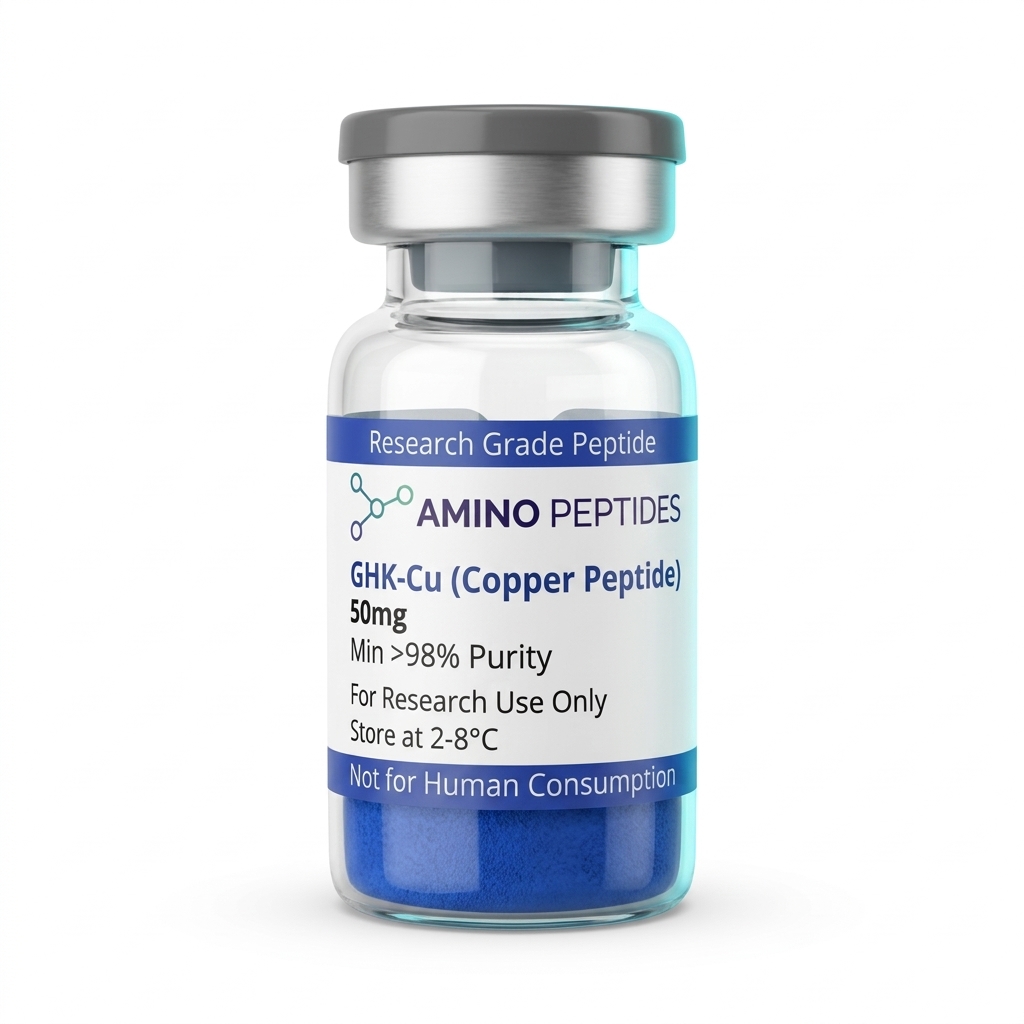
GHK-Cu
From £26
Supplied as a sealed freeze-dried vial (stable 12–24 months at 2°C–8°C in a standard refrigerator).
Shop GHK-Cu →What Published Studies Observe Across Early and Late Timelines
In laboratory models, the biological response to GHK unfolds in two distinct phases: rapid genetic signalling followed by slower, physical tissue remodelling. Because building real structural proteins takes time, published studies separate what happens in the first few hours from what becomes visible after several weeks of continuous observation.
During the first twenty-four to seventy-two hours after a measured level of GHK-Cu meets a cell culture, the changes are almost entirely chemical and genetic. Copper uptake happens within minutes. Over the next several hours, researchers observe a rapid drop in oxidative stress markers as superoxide dismutase (SOD) activity rises. At the same time, inflammatory cytokines quieten down and growth factor genes—especially those linked to transforming growth factor-beta (TGF-beta) and nerve outgrowth—begin transcribing mRNA. At this early stage, nothing looks different under a standard microscope, even though the cell's internal protein factory is already shifting gears.
Between day four and day fourteen, preclinical models begin to show measurable cellular migration and early matrix deposition. Fibroblasts and keratinocytes move faster across scratch-assay plates, and fresh capillary buds start forming to bring oxygen and nutrients to the site of recovery. Collagen synthesis rates climb steadily during this second week, accompanied by a noticeable uptick in decorin, a small proteoglycan that organises collagen fibrils into neat, flexible bundles rather than tangled scars.
True structural changes—such as improved skin elasticity, thicker dermal layers, and denser elastin networks—typically appear between weeks four and twelve in longer laboratory investigations. Histology slides taken at the eight-week and twelve-week marks consistently show tighter collagen weave, increased epidermal thickness, and stronger mechanical resilience compared to untreated control samples. Hair follicle models studied over similar multi-week windows also display enlarged follicle bulbs and an extended active growth phase. Researchers designing an experiment around GHK therefore match their observation window to their goal: forty-eight hours is plenty for tracking antioxidant gene expression, whereas studying visible matrix density and elasticity demands at least a month to three months of steady protocol ratios.
Biochemical Comparison: Naked GHK vs. GHK-Cu Complex in Laboratory Models
| Biochemical Attribute | Unbound GHK Tripeptide | GHK-Cu (Copper-Bound Complex) | Primary Laboratory Observation |
|---|---|---|---|
| Molecular Structure | Three amino acids (glycine, histidine, lysine) without a metal ion | Tripeptide chelated with a single divalent copper(II) ion | The histidine ring acts as a molecular claw that grabs and holds copper tightly. |
| Colour in Solution | Clear and colourless when dissolved in purified water | Distinctive deep royal blue or violet-blue hue | Colour intensity allows researchers to visually confirm metal binding and concentration. |
| Primary Mechanism | Acts as a scavenger looking for free transition metals in fluid | Delivers bioavailable copper directly across cellular membranes | Copper delivery is required to activate lysyl oxidase and superoxide dismutase enzymes. |
| Extracellular Matrix Impact | Minimal direct stimulation until it binds ambient copper | Strong upregulation of collagen, elastin, and glycosaminoglycans | Preclinical models show accelerated structural repair when the copper complex is complete. |
| Gene Signalling Profile | Functions primarily as a breakdown product of larger matrix proteins | Modulates over 4,000 human genes in Broad Institute Connectivity Map studies | Shifts aged cellular gene expression patterns toward a younger, more resilient state. |
Pairing GHK With Complementary Peptides in Research Blends
While GHK-Cu performs plenty of heavy lifting on its own, laboratory investigators frequently pair it with complementary peptides to study how different recovery pathways overlap. Because tissue regeneration involves blood vessel growth, cell migration, inflammation control, and matrix assembly all happening at once, combining peptides that target separate steps can reveal how these signals cooperate.
The most widely studied combination pairs GHK-Cu with BPC-157 and TB-500 (a synthetic segment of Thymosin Beta-4). Researchers looking at multi-pathway recovery often examine the glow ghk-cu blend, which brings all three molecules together in a single vial at a fixed protocol ratio. Each component handles a different job in preclinical models. BPC-157 is a fifteen-amino-acid gastric peptide fragment studied for its ability to speed up tendon and ligament fibroblast outgrowth and encourage nitric oxide signalling along blood vessels. TB-500 focuses on actin—the internal cytoskeleton protein that cells use to crawl across gaps during recovery. When TB-500 frees up actin monomers, cells migrate into the study zone faster; once they arrive, BPC-157 supports local microcirculation and growth hormone receptor sensitivity, and GHK-Cu supplies the copper-driven gene signals needed to lay down organised collagen and elastin.
In dermal and cosmeceutical research, GHK is also frequently evaluated alongside SNAP-8 or Matrixyl-class palmitoyl pentapeptides. While SNAP-8 interacts with the SNARE protein complex to relax mechanical tension in surface models, GHK works deeper in the fibroblast layer to thicken the structural cushion underneath. Another common pairing in longevity-focused cell work combines GHK with Epitalon or NAD+ precursors to watch how extracellular matrix rebuilding interacts with telomere maintenance and mitochondrial energy output. By stacking peptides that do not compete for the same receptor, investigators can observe broader tissue remodelling without needing excessive study amounts of any single compound.

Figure: The Science of The GHK Peptide: A Laboratory Investigation
Reconstitution calculator
Choose a vial mass and a bacteriostatic reconstitution solution volume. The figure is the resulting concentration.
Concentration: 2.50 mg/mL
Per 0.01mL (10µL): 25.0 mcg
Open the full calculatorBacteriostatic reconstitution solutionWhy 99%+ Purity, TFA Removal, and Cold Storage Matter
Getting reliable, repeatable data from GHK-Cu experiments depends heavily on the chemical quality inside the vial. Because GHK is a copper-binding tripeptide, poorly purified batches can suffer from two major problems: incorrect copper chelation ratios and leftover manufacturing acids that irritate delicate cell cultures.
Every batch used in serious laboratory work should carry a verified High-Performance Liquid Chromatography (HPLC) purity rating of 99% or higher, backed by Mass Spectrometry to confirm the exact molecular weight. During solid-phase synthesis, manufacturers routinely use trifluoroacetic acid (TFA) to cleave peptides from their resin beads. If that TFA is not thoroughly stripped away through ion-exchange chromatography, residual fluoride salts remain trapped in the lyophilised powder. In a petri dish or preclinical model, excess TFA alters the pH of the liquid medium and causes cellular stress that has nothing to do with the peptide itself. Clean TFA removal leaves behind a gentle acetate salt or pure copper complex that dissolves smoothly into a clear, deep royal-blue liquid.
Storage and handling are equally straightforward once you know the rules of peptide stability. In its dry, freeze-dried powder form, GHK-Cu is quite stable, provided it stays sealed away from moisture and light in a freezer at minus 20°C or a standard laboratory fridge at 2°C to 8°C. Once mixed with a sterile bacteriostatic reconstitution solution, the liquid peptide must live in the fridge between 2°C and 8°C at all times. Never shake a reconstituted vial; gentle swirling along the glass wall dissolves the blue cake in seconds without shearing the peptide bonds. Avoiding repeated freeze-thaw cycles and keeping the vial out of direct sunlight ensures the copper ion stays tightly bound to the histidine ring from the first study amount to the last drop.
Frequently Asked Questions
Why is the GHK peptide so widely researched in laboratory models?
Researchers study the GHK peptide because it acts as a strong cellular signalling molecule for tissue remodelling and collagen synthesis. In published studies, it binds easily to copper ions and appears to reset older gene expression patterns back to a younger state, making it a primary target for regeneration work.
What is the typical timeline observed in published GHK studies?
In laboratory models, initial cellular signalling and gene expression shifts often appear within twenty-four to forty-eight hours of exposure. Measurable changes in structural proteins, such as increased collagen or elastin density, typically take between two and four weeks of observation depending on the specific study amount and experimental setup.
Can GHK be combined with other peptides in laboratory protocols?
Yes, researchers frequently pair GHK with other investigative compounds like BPC-157 or TB-500 in preclinical models to observe combined effects on tissue recovery. Because these molecules use different cellular signalling pathways, studying them together helps scientists analyse whether a combined protocol ratio optimises structural repair in test environments.
How should research-grade GHK be stored to maintain high purity?
Dry, lyophilised GHK powder should be kept in a freezer at minus twenty degrees Celsius away from light to protect its ninety-nine percent purity. Once mixed with a bacteriostatic reconstitution solution, the liquid must be stored in a standard refrigerator between two and eight degrees Celsius for short-term laboratory testing.
Bibliography
- Pickart L, Margolina A. Regenerative and Protective Actions of the GHK-Cu Peptide in the Light of the New Gene Data. International Journal of Molecular Sciences. 2018;19(7):1987. View published research
- Pickart L, Vasquez-Soltero JM, Margolina A. GHK Peptide as a Natural Modulator of Multiple Cellular Pathways in Skin Regeneration. BioMed Research International. 2015;2015:648108. View published research
- Pickart L, Vasquez-Soltero JM, Margolina A. The Human Tripeptide GHK-Cu in Prevention of Oxidative Stress and Degenerative Conditions of Aging: Implications for Cognitive Health. Oxidative compound and Cellular Longevity. 2012;2012:324832. View published research
- Campbell JD, McDonough JE, Zeskind JE, et al. A gene expression signature of emphysema-related lung destruction and its reversal by the tripeptide GHK. Genome compound. 2012;4(8):67. View published research
- Maquart FX, Pickart L, Laurent M, Gillery P, Monboisse JC, Borel JP. Stimulation of collagen synthesis in fibroblast cultures by the tripeptide-copper complex glycyl-L-histidyl-L-lysine-Cu2+. FEBS Letters. 1988;238(2):343-346. View published research
⚠️ Research Use Only Disclaimer: All peptides and compounds are sold strictly for in-vitro laboratory research purposes only. Not intended for human or veterinary use, not a dietary supplement, and not approved to diagnose, treat, cure, or prevent any disease or condition. For use by qualified researchers in suitably equipped laboratory environments only. Amino Peptides Ltd operates in full compliance with UK MHRA regulations and applicable EU research chemical guidelines.