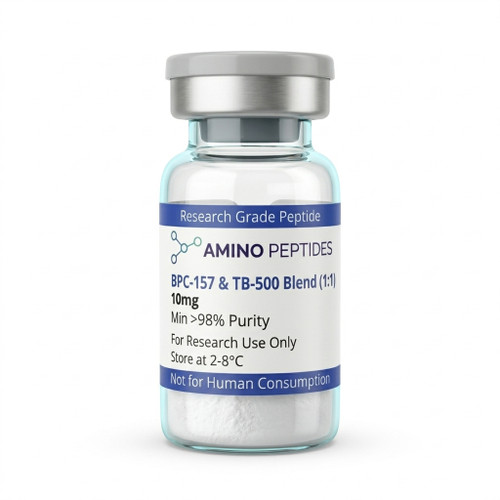


When evaluating research chemicals in the UK, laboratory investigators frequently study the complementary pathways of BPC-157 Peptide and TB-500 (Thymosin Beta-4) in isolated cellular models. In parallel-arm in-vitro assays, these two molecules demonstrate significant biological overlap, particularly concerning endothelial cell migration and angiogenesis. While BPC-157 Peptide is characterised by its ability to upregulate vascular endothelial growth factor (VEGF) expression, TB-500 (Thymosin Beta-4) acts on actin-sequestering mechanisms to facilitate cellular motility. This intersection of Bpc 157 Nitric Oxide Synthase Endothelial Cells Survival and actin dynamics provides a robust framework for investigating tissue remodelling pathways in controlled environments.
In controlled in-vitro environments, assessing the molecular stability and functional overlap of BPC-157 Peptide alongside TB-500 (Thymosin Beta-4) reveals synergistic effects on focal adhesion kinase (FAK) signalling. Although they are supplied as separate vials for independent preparation, co-incubation studies show that their pathways converge on extracellular matrix deposition nodes. BPC-157 Peptide stimulates nitric oxide synthesis, whereas TB-500 (Thymosin Beta-4) promotes actin polymerisation, creating a dual-action cellular response frequently observed in fibroblast assays documented on PubMed. This An In Vitro Analysis Of Tb 500 On Endothelial Cells highlights how their mechanisms run parallel to support cellular survival under oxidative stress.
Advances in peptide synthesis allow for highly purified, separate lyophilised vials of BPC-157 Peptide and TB-500 (Thymosin Beta-4), ensuring that researchers can establish precise, independent reconstitution protocols using Bacteriostatic Reconstitution Solution. When introduced to isolated cell systems in tandem, BPC-157 Peptide and TB-500 (Thymosin Beta-4) demonstrate overlapping influence on cytoskeletal reorganisation and cellular proliferation. By targeting both early growth response protein 1 (EGR-1) and direct actin-binding capacities, this combination allows researchers to thoroughly map the biochemical cascades that govern structural integrity in cell-free assays.
Current literature uses the search phrase "BPC-157 Peptide TB-500 (Thymosin Beta-4) stack" when indexing papers that examined these compounds in laboratory models. Research trends group them together, but the published work records separate cell-culture experiments rather than a combined product. Amino Peptides supplies these compounds only as separate lyophilised laboratory reagents. Strictly for laboratory research.
- BPC-157 Peptide is characterised against nitric oxide synthase (NOS) pathways and vascular endothelial growth factor (VEGF) receptors in isolated endothelial cell models.
- TB-500 (Thymosin Beta-4) demonstrates high-affinity binding to G-actin monomers, sequestering actin to modulate cytoskeletal dynamics in cell-free environments.
- Converging receptor characterisation indicates that both BPC-157 Peptide and TB-500 (Thymosin Beta-4) independently modulate focal adhesion kinase (FAK) phosphorylation cascades during isolated cellular migration experiments.
- Parallel laboratory arms investigate the synergistic upregulation of transforming growth factor beta (TGF-β) receptor expression when both peptides are introduced to isolated fibroblast cultures.
- BPC-157 Peptide upregulates the ERK1/2 signalling cascade, promoting early growth response protein 1 (EGR-1) transcription in isolated cellular models.
- TB-500 (Thymosin Beta-4) mediates intracellular actin polymerization through the competitive inhibition of F-actin assembly, altering cellular motility parameters.
- Investigations into converging cascades reveal that BPC-157 Peptide and TB-500 (Thymosin Beta-4) independently influence matrix metalloproteinase (MMP) secretion profiles in parallel laboratory experiments.
- Molecular stability studies confirm that both lyophilised compounds maintain structural integrity without premature degradation when subjected to standard laboratory reconstitution protocols.
Technical Specifications
Variant Breakdown
- BPC-157 Peptide: Supplied as a 5mg lyophilised research vial, synthesised for independent laboratory preparation and precise experimental aliquoting.
- TB-500 (Thymosin Beta-4): Provided as a separate 5mg lyophilised vial, characterised for parallel-arm in-vitro assays and cellular interaction studies.
Quality Assurance
- HPLC Verification: Each peptide undergoes rigorous high-performance liquid chromatography to confirm analytical purity prior to lyophilisation.
- Mass Spectrometry: The molecular identity of both supplied vials is independently validated through mass spectrometry to ensure sequence accuracy.
- Lyophilised Stability: The peptides are processed into a stable lyophilised powder, optimising long-term molecular stability during laboratory storage.
- Batch Characterisation: Independent laboratory testing confirms the absence of synthesis truncations across all provided research vials.
Research Mechanism
- Endothelial Cell Migration: In human umbilical vein endothelial cell (HUVEC) assays, BPC-157 Peptide upregulates vascular endothelial growth factor (VEGF) expression while TB-500 (Thymosin Beta-4) modulates actin dynamics, converging to accelerate cellular motility.
- Fibroblast Proliferation: Parallel-arm studies in isolated fibroblast cultures demonstrate that BPC-157 Peptide and TB-500 (Thymosin Beta-4) synergistically enhance extracellular matrix deposition through complementary focal adhesion kinase (FAK) activation.
- Nitric Oxide Signalling: When evaluated in isolated cellular models, BPC-157 Peptide stimulates endothelial nitric oxide synthase (eNOS), which operates in parallel with the actin-sequestering properties of TB-500 (Thymosin Beta-4) to support cellular survival under oxidative stress.
- Cytoskeletal Reorganisation: Co-incubation experiments reveal that the regulatory influence of BPC-157 Peptide on early growth response protein 1 (EGR-1) intersects with the direct actin-binding capacity of TB-500 (Thymosin Beta-4), optimising structural integrity in cell-free assays.
Reconstitution & Storage Data
| Vial Strength | Solvent Added | Resulting Concentration |
| 5mg Kit | 1 mL Bacteriostatic Reconstitution Solution | 5.00 mg/mL |
| 5mg Kit | 2 mL Bacteriostatic Reconstitution Solution | 2.50 mg/mL |
- Lyophilised (Powder): Store in a standard refrigerator (2-8°C) for up to 3 months. For long-term preservation, freeze at -20°C.
- Reconstituted (Liquid): Store at 2-8°C (Refrigerated).
Scientific References
Current Pharmaceutical Design: "Brain-gut Axis and Pentadecapeptide BPC 157: Theoretical and Practical Implications" View Study
Trends in Molecular laboratory evaluation: "Thymosin beta4: actin-sequestering protein moonlights to repair injured tissues" View Study
Journal of Pharmacological Sciences: "BPC 157 promotes the angiogenetic capability of endothelial cells" View Study
Journal of Investigative Dermatology: "Thymosin beta 4 promotes dermal laboratory evaluation" View Study