
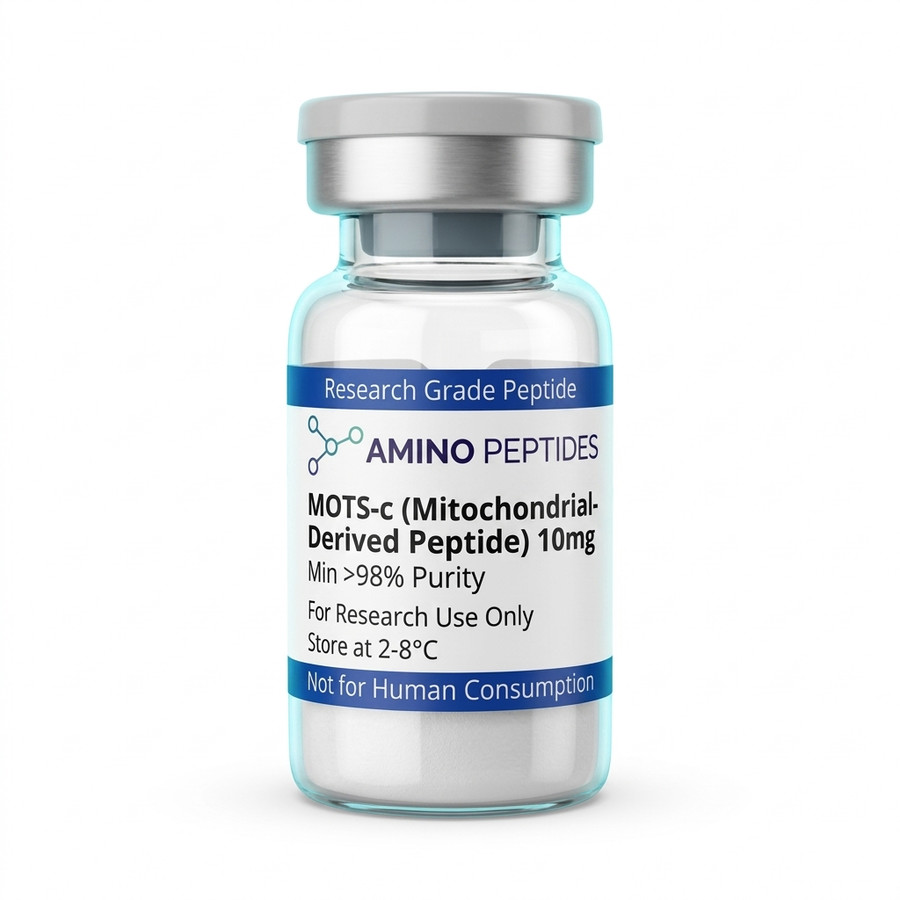
MOTS-c (Mitochondrial Open Reading Frame of the 12S rRNA-c) is a 16-amino acid peptide naturally synthesised within the mitochondrial genome. In cellular assays, this peptide primarily targets metabolic regulation and cellular stress pathways. When examining mitochondrial oxidative stress, researchers observe that MOTS-c moves to the nucleus to regulate gene expression, particularly genes involved in glucose metabolism and energy balance. As a premium research chemical, UK laboratories utilise this peptide to investigate AMP-activated protein kinase (AMPK) activation and cellular energy output. To maintain optimal molecular stability, investigators must follow precise reconstitution protocols, ensuring the lyophilised structure remains intact prior to cellular application. Advanced peptide synthesis techniques guarantee high purity for rigorous in-vitro profiling. Further structural data can be reviewed on PubChem.
Published studies discussed under this heading often explore metabolic regulation and cellular energy pathways. Public search data clusters around these mitochondrial-derived peptides in relation to metabolic optimisation. However, current literature focuses entirely on observations in isolated cell cultures and molecular models. Amino Peptides supplies this compound only as a lyophilised laboratory reagent. Strictly for laboratory research.
- Intracellular target engagement primarily involves the folate cycle enzyme 5-aminoimidazole-4-carboxamide ribonucleotide formyltransferase/IMP cyclohydrolase (ATIC).
- Modulates AMP-activated protein kinase (AMPK) signalling nodes in cellular models.
- Interacts with the methionine-folate cycle to regulate de novo purine biosynthesis.
- Translocates to the nucleus under metabolic stress to bind antioxidant response elements (ARE) in cell-free systems.
- Inhibits the folate cycle, leading to an accumulation of 5-aminoimidazole-4-carboxamide ribonucleotide (AICAR) in isolated cell cultures.
- Activates AMPK cascades, subsequently promoting glucose uptake and lipid oxidation in skeletal muscle cell models.
- Enhances the expression of stress-responsive genes by interacting with transcription factors in the nuclear compartment.
- Regulates metabolic homeostasis by modulating the NAD+/NADH ratio during controlled laboratory experiments.
Technical Specifications
Variant Breakdown
- 10mg Vial: Designed for preliminary cellular assays and short-term metabolic profiling, providing a precise quantity for initial laboratory evaluation-response evaluations.
- 40mg Vial: Suited for high-throughput screening and longitudinal in-vitro studies, ensuring consistent batch availability across multiple experimental runs.
Quality Assurance
- HPLC Verification: High-performance liquid chromatography is employed to confirm the peptide purity exceeds 99 percent, removing synthesis by-products.
- Mass Spectrometry: Molecular weight is rigorously validated to match the theoretical mass of 2174.6 g/mol, ensuring sequence accuracy.
- Lyophilised Form: The peptide is supplied as a freeze-dried solid to maximise shelf life and preserve structural integrity during transit.
- Laboratory Characterisation: Each batch undergoes strict endotoxin testing to guarantee suitability for sensitive cell culture environments.
Research Mechanism
- AMPK Activation: The peptide stimulates AMP-activated protein kinase, a central regulator of cellular energy, promoting glucose uptake and fatty acid oxidation in skeletal muscle cell models.
- Nuclear Translocation: Under conditions of metabolic stress, the peptide moves from the mitochondria to the nucleus to regulate the expression of antioxidant and metabolic genes.
- Folate Cycle Modulation: It interacts directly with the folate-methionine cycle, influencing cellular methylation processes and purine synthesis.
- Metabolic Homeostasis: By altering cellular respiration rates, the peptide enhances mitochondrial function and mitigates reactive oxygen species (ROS) accumulation in-vitro.
Reconstitution & Storage Data
| Vial Strength | Solvent Added | Resulting Concentration |
| 10mg | 1 mL Bacteriostatic Reconstitution Solution | 10.00 mg/mL |
| 10mg | 2 mL Bacteriostatic Reconstitution Solution | 5.00 mg/mL |
| 40mg | 1 mL Bacteriostatic Reconstitution Solution | 40.00 mg/mL |
| 40mg | 2 mL Bacteriostatic Reconstitution Solution | 20.00 mg/mL |
- Lyophilised (Powder): Store in a standard refrigerator (2-8°C) for up to 3 months. For long-term preservation, freeze at -20°C.
- Reconstituted (Liquid): Store at 2-8°C (Refrigerated).
Scientific References
Cell Metabolism: "The mitochondrial-derived peptide MOTS-c promotes metabolic homeostasis and reduces diet-induced obesity" View Study
Aging: "Mitochondrial-encoded MOTS-c prevents metabolic imbalance" View Study
Nature Communications: "MOTS-c is an exercise-induced mitochondrial-encoded regulator of age-dependent physical decline and muscle homeostasis" View Study
Journal of Endocrinology: "The mitochondrial-derived peptide MOTS-c: A player in metabolic homeostasis" View Study
FASEB Journal: "Mitochondrial peptide MOTS-c promotes cell survival under stress" View Study