
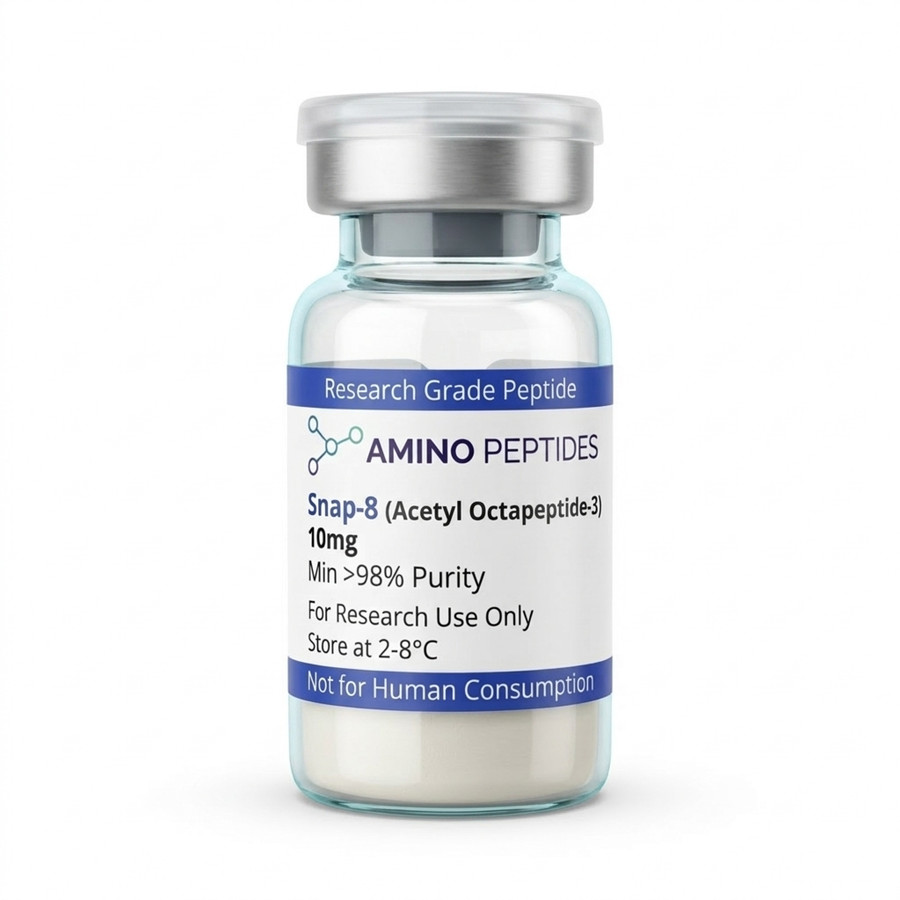
Snap-8 (Acetyl Octapeptide-3) is a synthetic octapeptide designed for in-vitro research focusing on the SNARE complex and synaptic vesicle exocytosis. By mimicking the N-terminal end of SNAP-25, this peptide competes for a position within the SNARE complex, thereby modulating the release of neurotransmitters such as acetylcholine in cellular models. Advanced peptide synthesis techniques ensure the structural integrity required for precise receptor binding assays. As a premium research chemical, UK laboratories utilise this compound to investigate cellular signalling cascades and muscle contraction pathways. Ensuring optimal molecular stability during experiments requires strict adherence to established reconstitution protocols. Researchers can review its chemical properties and molecular structure on PubChem.
Public search data clusters around Acetyl Octapeptide-3 for its role in cellular models of exocytosis and SNARE complex modulation. Current literature uses these search phrases to index studies exploring peptide-mediated inhibition of neurotransmitter release in isolated cell cultures. Amino Peptides supplies this compound only as a lyophilised laboratory reagent. Strictly for laboratory research.
- Competitive binding to the N-terminal domain of the SNAP-25 protein within cell-free models.
- Modulation of the ternary SNARE (Soluble N-ethylmaleimide-sensitive factor Attachment protein REceptor) complex assembly in isolated neuronal cultures.
- Interaction with syntaxin-1 and synaptobrevin-2 (VAMP) to destabilise the fusion core complex during laboratory experiments.
- Targeting of vesicular transport machinery elements responsible for calcium-dependent exocytosis.
- Truncation of the SNAP-25 homologue sequence prevents the stable formation of the required four-helix bundle in the SNARE complex.
- Inhibition of calcium-ion dependent vesicular fusion with the presynaptic plasma membrane in isolated cellular systems.
- Reduction of catecholamine and glutamate release in cultured chromaffin and PC12 cell lines via competitive SNARE destabilisation.
- Attenuation of vesicular docking and subsequent exocytotic events quantified through laboratory fluorescence experiments.
Technical Specifications
Variant Breakdown
- 10mg Vial: Designed for preliminary cellular assays and short-term receptor binding studies.
- 100mg Vial: Optimised for high-throughput screening and extensive longitudinal laboratory research.
Quality Assurance
- HPLC: High-performance liquid chromatography ensures a purity level exceeding 99%.
- Mass Spectrometry: Confirms the exact molecular weight and structural sequence of the synthesised octapeptide.
- Lyophilised Format: Processed as a freeze-dried solid to maximise shelf-life and preserve structural integrity.
- Laboratory Characterisation: Rigorously tested for endotoxin limits to prevent interference in delicate cellular assays.
Research Mechanism
- Competes with native SNAP-25 for binding slots within the SNARE complex.
- Inhibits the successful assembly of the SNARE ternary complex in cellular models.
- Reduces the fusion of synaptic vesicles with the presynaptic membrane.
- Modulates the calcium-dependent exocytosis of neurotransmitters like acetylcholine.
- Provides a reliable model for studying neuromuscular junction signalling pathways in vitro.
Reconstitution & Storage Data
| Vial Strength | Solvent Added | Resulting Concentration |
| 10mg | 1 mL Bacteriostatic Reconstitution Solution | 10.00 mg/mL |
| 10mg | 2 mL Bacteriostatic Reconstitution Solution | 5.00 mg/mL |
| 100mg | 1 mL Bacteriostatic Reconstitution Solution | 100.00 mg/mL |
| 100mg | 2 mL Bacteriostatic Reconstitution Solution | 50.00 mg/mL |
- Lyophilised (Powder): Store in a standard refrigerator (2-8°C) for up to 3 months. For long-term preservation, freeze at -20°C.
- Reconstituted (Liquid): Store at 2-8°C (Refrigerated).
Scientific References
Journal of Biological Chemistry: "SNARE complex assembly and neurotransmitter release modulation by synthetic peptides" View Study
Neurochemistry International: "Inhibition of acetylcholine release by SNAP-25 mimics in vitro" View Study
Peptides: "Structural characterisation of acetyl octapeptide-3 and its interaction with the SNARE complex" View Study
Biochemical and Biophysical Research Communications: "Evaluating the efficacy of SNAP-25 N-terminal fragments in cellular exocytosis models" View Study