
The CJC 1295 Safety Profile: Scientific Deconstruction of the Anti-Ageing Trend
2nd Nov 2026
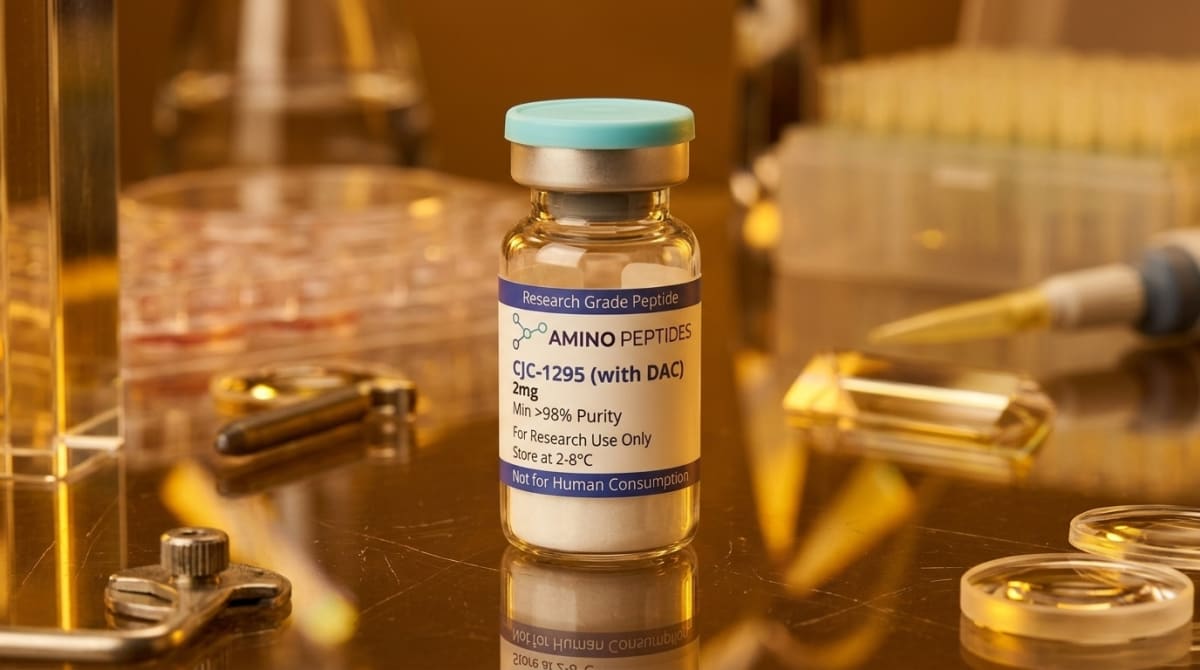
What You Need to Know About CJC-1295
- Curious readers often search for this compound to understand why fitness and longevity forums discuss its role in cellular repair and tissue remodelling.
- In the laboratory, this molecule acts like a key for receptors on pituitary cells, prompting them to release growth hormone in natural waves.
- One version includes an extra chemical hook that grabs onto blood proteins, which keeps the compound active in laboratory models for several days instead of minutes.
- Published studies observed sustained increases in growth hormone and insulin-like growth factor one alongside mild fluid retention and temporary redness in test subjects.
How Pituitary Signalling Drives Recovery and Deep Sleep Cycles
CJC 1295 works in laboratory models by mimicking growth hormone-releasing hormone to support cellular recovery, sleep architecture, and tissue elasticity. Its safety profile depends heavily on whether the chemical structure includes a specialized albumin-binding complex known as DAC.
In nature, the body releases growth hormone-releasing hormone (GHRH) in short bursts, mostly during deep slow-wave sleep. Natural GHRH breaks down in minutes because an enzyme called DPP-4 quickly cuts the chain. Scientists created the 29-amino-acid core of this peptide—often called Modified GRF (1-29) or CJC 1295 without DAC—by swapping four specific amino acids. That structural tweak stops the enzyme from breaking the peptide down too quickly, giving it a clean thirty-minute active window in preclinical models.
The version with DAC (Affinity Complex) behaves very differently. DAC attaches a reactive group that binds directly to serum albumin in the bloodstream, stretching the active half-life from thirty minutes to roughly six to eight days. Published studies note that while the No-DAC version preserves natural pulsatile waves and lets pituitary receptors rest, the DAC version creates a continuous signal—often called a "bleed"—that can cause receptor fatigue and cellular stress in animal models. When people search for side effects, they are usually seeing data linked to this non-stop pituitary stimulation or reactions caused by leftover manufacturing salts in low-grade vials.
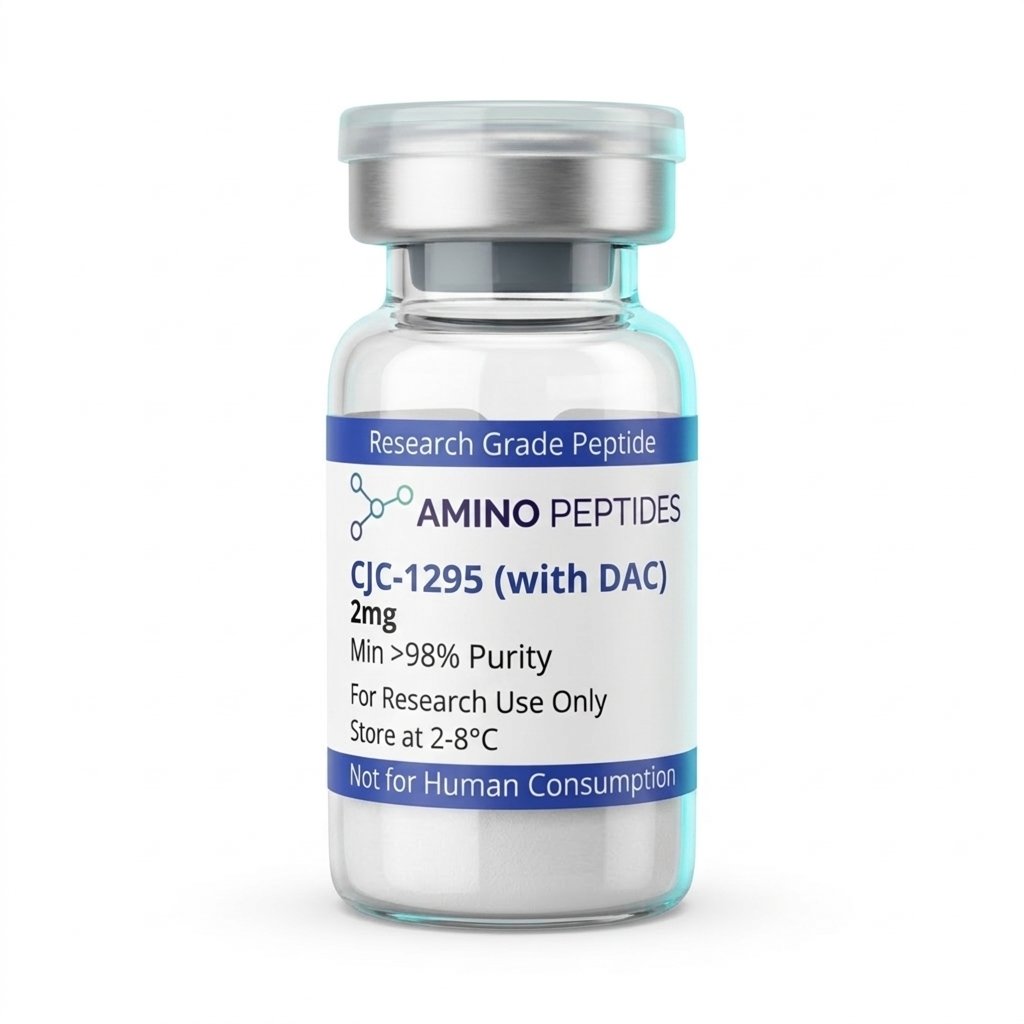
CJC-1295
From £22
Supplied as a sealed freeze-dried vial (stable 12–24 months at 2°C–8°C in a standard refrigerator).
Shop CJC-1295 →What Published Studies Observe Across Early and Late Phases
In laboratory models, the timeline of observed activity splits cleanly between immediate receptor signalling and slower, long-term structural adaptation. Because the peptide acts on the anterior pituitary gland rather than forcing a synthetic hormone directly into tissues, biological responses build gradually across several weeks of observation.
During the first one to two weeks of a study protocol, researchers mainly record rapid changes in intracellular cyclic AMP (cAMP) signalling and nocturnal pulse amplitude. In animal sleep studies, this early window aligns with measurable shifts in slow-wave sleep architecture and an immediate rise in circulating insulin-like growth factor 1 (IGF-1) baseline numbers. Depending on the measured level and protocol ratio chosen for the experiment, IGF-1 markers typically climb within hours of initial receptor contact and stay elevated when using the extended-release DAC variant, whereas the No-DAC variant produces sharp, rhythmic spikes that return to baseline between intervals.
Structural tissue remodelling takes much longer to show up in laboratory data. Between weeks four and eight, published studies begin to document increased nitrogen retention, faster collagen turnover in dermal layers, and improved protein synthesis rates in skeletal tissue. By weeks eight to twelve, preclinical models examining body composition and connective tissue repair show clearer shifts in cellular energy use, lipid oxidation, and skin elasticity. Across every timeframe, the ceiling of the response is capped by the pituitary gland's natural negative feedback loop, which prevents runaway output when using pulsatile No-DAC study amounts.
Biochemical Comparison: Modified GRF (1-29) versus CJC-1295 with Affinity Complex
| Biochemical Feature | Modified GRF (1-29) (Without Affinity Complex) | CJC-1295 (With Affinity Complex) |
|---|---|---|
| Amino Acid Backbone | 29 amino acids with 4 specific substitutions to slow down enzymatic breakdown | 29 amino acids plus a lysine linker attached to maleimidopropionic acid |
| Albumin Binding Ability | Does not form covalent bonds with serum albumin in the bloodstream | Binds covalently to free thiol groups on serum albumin to resist clearance |
| Observed Half-Life in Models | Approximately 30 minutes in published laboratory assessments | Roughly 6 to 8 days in published laboratory observations |
| Signalling Pattern | Creates a short, sharp spike of receptor activity before clearing quickly | Provides continuous background stimulation while preserving natural pulsatile waves |
| Primary Research Application | Investigating acute receptor activation and short-term hormonal pulses | Analysing long-term elevation of insulin-like growth factor 1 and protein synthesis |
Pairing GHRH Analogues with Complementary Research Peptides
Researchers rarely study GHRH analogues in isolation when looking at full-spectrum pituitary signalling. Because CJC 1295 (particularly the No-DAC form, Mod GRF 1-29) only presses the accelerator on growth hormone release, the body's natural brake—somatostatin—can still block the signal if it happens to be active at that moment.
To get around that biological brake, laboratory protocols frequently combine a GHRH analogue with a selective growth hormone secretagogue receptor (GHSR) agonist like Ipamorelin. While CJC 1295 binds to GHRH receptors to increase the size of the pulse, Ipamorelin binds to ghrelin receptors to quiet down somatostatin and start the pulse cleanly. When studied together at balanced protocol ratios, the two compounds produce a much larger, cleaner release wave than either peptide could achieve on its own, without raising cortisol or prolactin markers in preclinical models.
Beyond pituitary pairings, investigators often look at local tissue repair and cellular defence stacks. For example, studies focused on localized mechanical strain and muscle fibre regeneration frequently examine the mgf peptide alongside systemic signalling compounds to see how satellite cell activation responds. Similarly, when experimental designs need to control background cellular inflammation or study barrier integrity during tissue remodelling, researchers often turn to KPV and LL-37 as complementary immunomodulatory agents in their comparative models.
Reconstitution calculator
Choose a vial mass and a bacteriostatic reconstitution solution volume. The figure is the resulting concentration.
Concentration: 2.50 mg/mL
Per 0.01mL (10µL): 25.0 mcg
Open the full calculatorBacteriostatic reconstitution solutionWhy Analytical Verification and Cold Storage Define Vial Quality
When evaluating the safety profile and price of any synthetic 29- or 30-amino-acid chain, the biggest variable is rarely the peptide sequence itself—it is what else is hiding inside the glass vial. Assembling a chain of this length requires dozens of chemical coupling steps, and cutting corners during purification leaves behind truncated peptide fragments and harsh chemical solvents.
The most common hidden contaminant in budget vials is trifluoroacetic acid (TFA), a strong acid used to cleave the peptide during manufacturing. If a supplier skips the desalting step to keep retail prices artificially low, residual TFA stays bound to the freeze-dried powder. In laboratory models, free TFA causes immediate cellular irritation, skews pH balances, and triggers histamine-like flushing reactions that get falsely blamed on the peptide itself. Verified research-grade batches undergo High-Performance Liquid Chromatography (HPLC) and mass spectrometry to confirm at least 99% purity, with toxic TFA salts swapped out for benign acetate salts.
Proper storage is just as important for keeping the sequence intact. Lyophilised (freeze-dried) vials should be kept away from light in a cold environment, and once mixed with a sterile bacteriostatic reconstitution solution, the liquid must stay refrigerated between 2°C and 8°C. Shaking the vial or leaving it at room temperature breaks the fragile peptide bonds, turning an accurate measured level into inactive amino acid soup.
Frequently Asked Questions
Why is the CJC 1295 safety profile searched so frequently online?
People frequently search for CJC 1295 because online anti-ageing forums discuss its effects on growth hormone signalling and tissue recovery. However, published studies show that modifying the peptide with an affinity complex alters how long it stays active in laboratory models, raising important safety questions about sustained hormone elevation.
What timeline do published studies observe for CJC 1295 activity?
In published studies, the standard CJC 1295 peptide with an added affinity complex stays active in laboratory models for six to eight days. Without this chemical attachment, the modified growth hormone releasing factor clears within thirty minutes, meaning researchers observe very different signalling timelines depending on the specific molecular structure.
Why do laboratory models often pair CJC 1295 with Ipamorelin?
Researchers often combine CJC 1295 with Ipamorelin in preclinical models to analyse how two distinct receptor pathways interact simultaneously. While CJC 1295 mimics growth hormone releasing hormone, Ipamorelin targets the ghrelin receptor, allowing scientists to characterise synergistic hormone pulses and subsequent cellular repair without overlapping the exact same biological mechanism.
How do purity and fridge storage affect CJC 1295 in the lab?
High purity and cold storage are essential to prevent the fragile amino acid chain from breaking down before analysis. Once mixed with a bacteriostatic reconstitution solution, the liquid peptide must remain refrigerated between two and eight degrees Celsius, as room temperature rapidly degrades the sample and ruins experimental accuracy.
Bibliography
- Teichman SL, Neale A, Lawrence B, Gagnon C, Castaigne JP, Frohman LA. Prolonged stimulation of growth hormone (GH) and insulin-like growth factor I secretion by CJC-1295, a long-acting analog of GH-releasing hormone, in healthy adults. J Clin Endocrinol Metab. 2006 Mar;91(3):799-805. View published research
- Ionescu M, Frohman LA. Pulsatile secretion of growth hormone (GH) persists during continuous stimulation by CJC-1295, a long-acting GH-releasing hormone analog. J Clin Endocrinol Metab. 2006 Dec;91(12):4792-7. View published research
- Jette L, Leger R, Thibaudeau K, Benquet C, Robitaille M, Pellerin I, Paradis V, van Wyk P, Pham K, Bridon DP. Human growth hormone-releasing factor (hGRF)1-29-albumin bioconjugates activate the GRF receptor on the anterior pituitary in rats: identification of CJC-1295 as a long-lasting GRF analog. Endocrinology. 2005 Jul;146(7):3052-8. View published research
- Alba M, Fintini D, Sagazio A, Lawrence B, Castaigne JP, Frohman LA, Salvatori R. Once-daily administration of CJC-1295, a long-acting growth hormone-releasing hormone (GHRH) analog, normalizes growth in the GHRH knockout mouse. Am J Physiol Endocrinol Metab. 2006 Dec;291(6):E1290-4. View published research
⚠️ Research Use Only Disclaimer: All peptides and compounds are sold strictly for in-vitro laboratory research purposes only. Not intended for human or veterinary use, not a dietary supplement, and not approved to diagnose, treat, cure, or prevent any disease or condition. For use by qualified researchers in suitably equipped laboratory environments only. Amino Peptides Ltd operates in full compliance with UK MHRA regulations and applicable EU research chemical guidelines.