
GHK-Cu, BPC-157 and TB-500: Fibroblast Migration Synergy
27th Aug 2026

What You Need to Know About GLOW BLEND
- Researchers investigate this specific peptide trio to understand how different cellular signalling pathways work together to accelerate fibroblast migration and tissue remodelling.
- TB-500 binds to actin proteins to build the physical scaffolding for cell movement, while BPC-157 activates focal adhesion kinase to help fibroblasts grip and pull themselves across structural gaps.
- Once fibroblasts arrive at the target site in vitro, GHK-Cu supplies bioavailable copper to turn on genes that manufacture fresh collagen and elastin fibres.
- Published studies in preclinical models observe that combining actin regulation, adhesion signalling, and copper-dependent gene expression creates a coordinated environment for structural regeneration.
How Three Peptides Guide Fibroblast Movement and Tissue Remodelling
Fibroblasts are the construction workers of connective tissue, and published laboratory models show that GHK-Cu, BPC-157, and TB-500 each influence a different step of their movement and matrix output. When studied together, these three sequences cover capillary support, internal cell scaffolding, and collagen assembly without competing for the same binding sites.
To understand why researchers group these three compounds together, it helps to look at how a fibroblast actually moves across a culture dish. A cell cannot simply float to a target area; it has to reach out, grab onto the surrounding matrix, pull itself forward, and then lay down fresh structural proteins once it arrives. Each peptide in this trio targets a distinct mechanical requirement of that process.
First, BPC-157 is a fifteen-amino-acid sequence originally isolated from gastric juice studies. In preclinical models, BPC-157 activates focal adhesion kinase (FAK) and paxillin pathways. In plain English, it helps fibroblasts build stronger tiny feet so they can grip the extracellular surface and pull themselves across a gap. It also upregulates growth hormone receptor expression on those same fibroblasts, priming them to respond to local repair signals.
Second, TB-500 is the synthetic research fragment of Thymosin Beta-4. Its main job in cell culture is binding to globular actin (G-actin), the building block of a cell's internal skeleton. By managing how fast G-actin polymerises into filamentous chains, TB-500 keeps the cell flexible enough to crawl rapidly through dense tissue architecture.
Third, GHK-Cu brings a bioavailable copper ion directly into the local environment. Once the fibroblasts have migrated into position, copper-dependent enzymes like lysyl oxidase are required to cross-link new collagen and elastin fibres so the remodelled structure holds its tension and elasticity.
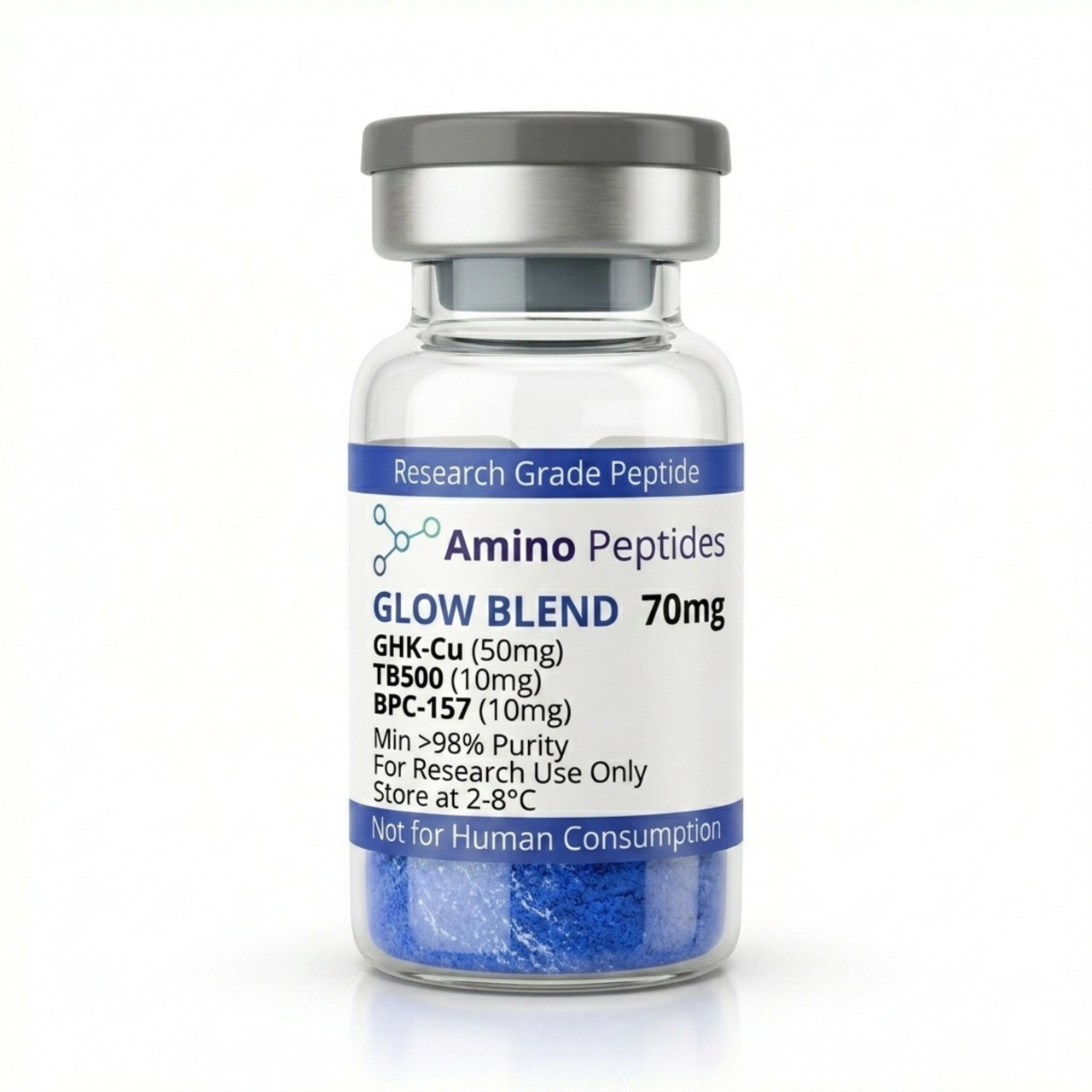
GLOW BLEND
From £65
Supplied as a sealed freeze-dried vial (stable 12–24 months at 2°C–8°C in a standard refrigerator).
Shop GLOW BLEND →What Published Models Observe From Hour One to Week Four
In laboratory models, the cellular response to this trio unfolds in two very different phases: an early signalling wave that begins within hours, followed by a slower structural phase that takes days or weeks to measure. Knowing the difference between these two windows helps researchers set realistic observation points in their assays.
During the first six to twenty-four hours after exposure in scratch-wound or transwell migration assays, the dominant activity comes from TB-500 and BPC-157. Actin monomer sequestration by TB-500 happens almost immediately upon cellular uptake, allowing endothelial cells and fibroblasts to extend lamellipodia—the flat, sheet-like projections cells use to inch forward. Simultaneously, BPC-157 begins increasing the phosphorylation of FAK and paxillin, alongside early upregulation of vascular endothelial growth factor (VEGF) mRNA. At this twenty-four-hour mark, researchers typically measure closure speed across a scratched monolayer rather than looking for finished collagen fibres.
Between days three and seven in preclinical models, the focus shifts from pure cell movement to early granulation and micro-vessel sprouting. Capillary-like tubes form more densely in matrigel assays when angiogenic signals from both BPC-157 and TB-500 are present, establishing the nutrient channels needed for heavier matrix work.
From day seven through week four in longer tissue-remodelling studies, GHK-Cu becomes the star of the readout. Gene expression arrays show GHK-Cu shifting the balance between matrix metalloproteinases (MMPs) and their natural inhibitors (TIMPs). This means old, disorganised proteins are cleared away while fresh Type I and Type III collagen, decorin, and glycosaminoglycans are deposited and cross-linked. While early migration metrics peak inside the first seventy-two hours, measurable changes in tensile strength and organised collagen bundling only appear in the later multi-week observation windows.
Biochemical Comparison of GHK-Cu, BPC-157, and TB-500 in Fibroblast Research
| Research Parameter | GHK-Cu (Copper Tripeptide-1) | BPC-157 (Pentadecapeptide) | TB-500 (Thymosin Beta-4 Fragment) |
|---|---|---|---|
| Amino Acid Length | 3 amino acids bound to a copper(II) ion | 15 amino acids in a stable linear chain | 43 amino acids (or the active 7-amino-acid LKKTETQ fragment) |
| Molecular Weight | Approximately 340.38 Daltons (free peptide) | Approximately 1419.53 Daltons | Approximately 4963.50 Daltons (full Thymosin Beta-4 chain) |
| Primary Fibroblast Role | Stimulates collagen, elastin, and glycosaminoglycan synthesis | Upregulates growth hormone receptors and focal adhesion signalling | Sequestering G-actin monomers to drive cytoskeletal motility |
| Key Signalling Pathway | TGF-beta and copper-dependent lysyl oxidase activation | FAK-paxillin pathway and nitric oxide system modulation | Actin polymerisation and lamellipodia extension |
| Phase of Tissue Remodelling | Matrix maturation, cross-linking, and structural organisation | Early cellular recruitment, attachment, and microvascular support | Rapid cell migration and physical bridging of laboratory scratch assays |
Why Pairing Copper Tripeptide With Actin and Angiogenic Signals Makes Sense
Combining multiple peptides in a single experimental protocol only works when their mechanisms complement each other rather than saturating the same receptor. The reason investigators frequently study bpc157 and tb500 alongside copper tripeptide-1 comes down to non-overlapping biochemical division of labour.
If you stimulate a fibroblast to produce collagen using GHK-Cu alone, the cell at that exact spot will increase its protein output, and local copper-dependent enzymes will cross-link the surrounding matrix. However, in a larger tissue gap model, resident fibroblasts at the edges first need to travel into the middle of the zone. GHK-Cu does attract cells via chemotaxis, but it does not directly regulate the intracellular actin cytoskeleton the way TB-500 does, nor does it drive FAK-paxillin focal adhesion turnover at the rate observed with BPC-157.
Conversely, when researchers examine BPC-157 and TB-500 together, they observe rapid fibroblast recruitment and endothelial tube formation. Yet once those cells arrive at the target site, they still require trace copper cofactors and specific gene modulation to organise newly secreted tropocollagen into mature, elastic fibrils. When laboratories buy ghk-cu to include in the third phase of a migration protocol, they supply the exact cofactor needed by lysyl oxidase to lock that new matrix into place.
Researchers also pay close attention to protocol ratios and physical mixing rules. Because GHK-Cu carries a coordinated copper(II) ion—which gives the lyophilised powder its signature deep blue-violet colour—some laboratories prefer to reconstitute and apply it separately from histidine- or cysteine-rich sequences in prolonged solution storage, ensuring the copper ion remains stably bound to its glycyl-L-histidyl-L-lysine tripeptide carrier until the moment of assay contact.

Figure: GHK-Cu, BPC-157 and TB-500: Fibroblast Migration Synergy
Reconstitution calculator
Choose a vial mass and a bacteriostatic reconstitution solution volume. The figure is the resulting concentration.
Concentration: 2.50 mg/mL
Per 0.01mL (10µL): 25.0 mcg
Open the full calculatorBacteriostatic reconstitution solutionHow Vial Purity, TFA Removal, and Cold Storage Protect Your Data
When your laboratory assay measures subtle shifts in fibroblast speed or collagen gene expression, the chemical cleanliness of your starting vials determines whether your data is clean or noisy. Primary fibroblasts in cell culture are famously sensitive to leftover synthesis byproducts, which is why experienced investigators check Certificates of Analysis before starting a run.
During solid-phase peptide synthesis, trifluoroacetic acid (TFA) is routinely used to cleave the finished peptide chain from its resin and strip away protective side-chain groups. If a supplier skips secondary ion-exchange chromatography, residual TFA salts stay trapped in the lyophilised cake. In fibroblast cultures, excess trifluoroacetate ions lower local pH and can slow down cell proliferation or distort membrane behaviour, creating artefacts that look like poor peptide activity when the real culprit is an acidic impurity. Choosing peptides verified at 99% or higher purity via High-Performance Liquid Chromatography (HPLC) and confirmed by Mass Spectrometry (MS) ensures that the measured level in your dish reflects the actual peptide sequence.
For GHK-Cu specifically, stoichiometric accuracy matters just as much as peptide purity. Properly chelated GHK-Cu has a defined molar ratio of peptide to copper; unchelated free copper ions in a poorly prepared batch can cause oxidative stress in cell monolayers rather than supporting clean tissue remodelling.
Storage discipline protects these sequences once they reach your bench. Lyophilised vials remain stable for extended periods in a freezer at minus 20°C, shielded from light. Once mixed with a sterile bacteriostatic reconstitution solution, the liquid vials should be kept in a dedicated refrigerator between 2°C and 8°C and never subjected to repeated freeze-thaw cycles, which shear delicate peptide bonds and cause aggregation.
Frequently Asked Questions
Why do people search for GHK-Cu, BPC-157 and TB-500 fibroblast migration synergy?
Researchers investigate this trio because each peptide influences a distinct stage of cellular movement and tissue remodelling. In laboratory models, BPC-157 and TB-500 encourage fibroblasts to travel quickly across damaged matrices, whilst GHK-Cu signals those arriving cells to organise new collagen fibres and structural proteins.
What is the typical timeline observed in fibroblast migration studies?
In published studies using cell scratch assays, initial fibroblast movement typically appears within twelve to twenty-four hours of exposure. Full gap closure and noticeable collagen matrix organisation in preclinical models generally unfold over seven to fourteen days, depending on the specific concentration and cellular environment analysed.
Why are GHK-Cu, BPC-157 and TB-500 combined in laboratory research?
Scientists combine these three compounds to observe whether simultaneous signalling pathways optimise overall tissue recovery better than isolated peptides. While TB-500 manages internal actin scaffolding and BPC-157 activates focal adhesion enzymes, GHK-Cu supports gene expression for matrix regeneration, creating a multi-layered research model.
How do purity and fridge storage affect these research peptides?
High analytical purity of ninety-eight percent or above ensures that observed cellular responses come from the peptides rather than manufacturing leftovers. Once mixed with a bacteriostatic reconstitution solution, samples must stay refrigerated between two and eight degrees Celsius to prevent amino acid chains from breaking down.
Bibliography
- Pickart L, Margolina A. Regenerative and Protective Actions of the GHK-Cu Peptide in the Light of the New Gene Data. International Journal of Molecular Sciences. 2018;19(7):1987. View published research
- Chang CH, Tsai WC, Lin MS, Hsu YH, Pang JH. The promoting effect of pentadecapeptide BPC 157 on tendon outgrowth in vitro and in vivo. Journal of Applied Physiology. 2011;110(3):774-780. View published research
- Goldstein AL, Hannappel E, Sosne G, Kleinman HK. Thymosin beta4: a multi-functional regenerative peptide. Basic properties and works on tissue repair. Expert Opinion on Biological signalling. 2012;12(1):37-51. View published research
- Hsieh MJ, Liu HT, Wang CN, et al. Modulatory effects of BPC 157 on vasomotor tone and the activation of Src-Caveolin-1-eNOS pathway. Scientific Reports. 2017;7:44666. View published research
- Philp D, Goldstein AL, Kleinman HK. Thymosin beta4 promotes angiogenesis, wound repair, and hair growth. Mechanisms of Ageing and Development. 2004;125(2):113-115. View published research
⚠️ Research Use Only Disclaimer: All peptides and compounds are sold strictly for in-vitro laboratory research purposes only. Not intended for human or veterinary use, not a dietary supplement, and not approved to diagnose, treat, cure, or prevent any disease or condition. For use by qualified researchers in suitably equipped laboratory environments only. Amino Peptides Ltd operates in full compliance with UK MHRA regulations and applicable EU research chemical guidelines.