
Glow Stack Peptide: Fact vs Hype Claims
7th Sep 2026
What You Need to Know About GLOW BLEND
- Curious readers search for the glow stack peptide after seeing viral social media claims about rapid skin rejuvenation and structural recovery.
- This research blend pairs three distinct amino acid chains that act like cellular messengers to guide structural maintenance.
- In a laboratory setting, these molecules coordinate fibroblast activity, support new blood vessel sprouting, and help organise actin filaments inside cells.
- Published studies observe that while each individual compound supports tissue remodelling in animal and cell culture models, the combined trio lacks formal verification as a single blended formula.
How the Glow Stack Peptide Drives Skin Elasticity and Cellular Recovery
The glow stack peptide combines GHK-Cu, BPC-157, and TB-500 to support skin elasticity and structural recovery in preclinical models. Published studies show these three sequences work together by signalling fibroblasts to build fresh collagen while calming local oxidative stress.
Social media posts often address the glow stack peptide like an overnight cosmetic filter, which misses the real biology happening in the dish. In laboratory settings, this blend is not a single molecule. It is a specific protocol ratio of three separate short-chain amino acid sequences: glycyl-L-histidyl-L-lysine bound to copper (GHK-Cu), Body Protection Compound-157 (BPC-157), and Thymosin Beta-4 fragment (TB-500). Each part of the trio handles a distinct job inside the extracellular matrix, the structural scaffolding that holds dermal and connective tissues together.
GHK-Cu is the primary driver for skin elasticity in this group. When copper ions bind to the GHK tripeptide, the complex easily enters dermal fibroblasts. Once inside, published studies show it turns on genes responsible for producing Type I and Type III collagen, alongside elastin and glycosaminoglycans. At the same time, it regulates matrix metalloproteinases, the enzymes that break down worn-out structural proteins. This dual action clears away damaged scaffolding while laying down fresh, springy fibres. Online hype claims it stops ageing entirely, which is false, yet laboratory models consistently show measurable increases in dermal thickness and firmness.
Meanwhile, BPC-157 and TB-500 handle the physical supply lines and cell movement needed for tissue remodelling. BPC-157 upregulates vascular endothelial growth factor (VEGF), which encourages the growth of tiny new blood vessels in tested tissues. Better capillary density means more oxygen and nutrients reach the busy fibroblasts. TB-500 binds to actin, a structural protein inside cells, allowing keratinocytes and endothelial cells to travel quickly across gaps in damaged tissue layers. By combining collagen synthesis, capillary support, and cellular migration, the trio addresses tissue recovery from three angles at once.
Scientists also compare peripheral tissue repair with central nervous system signalling by examining cognitive research peptides alongside dermal blends to see how cellular energy and focus pathways differ from structural synthesis. In every case, the real value lies in measurable gene expression and protein output rather than exaggerated internet stories.
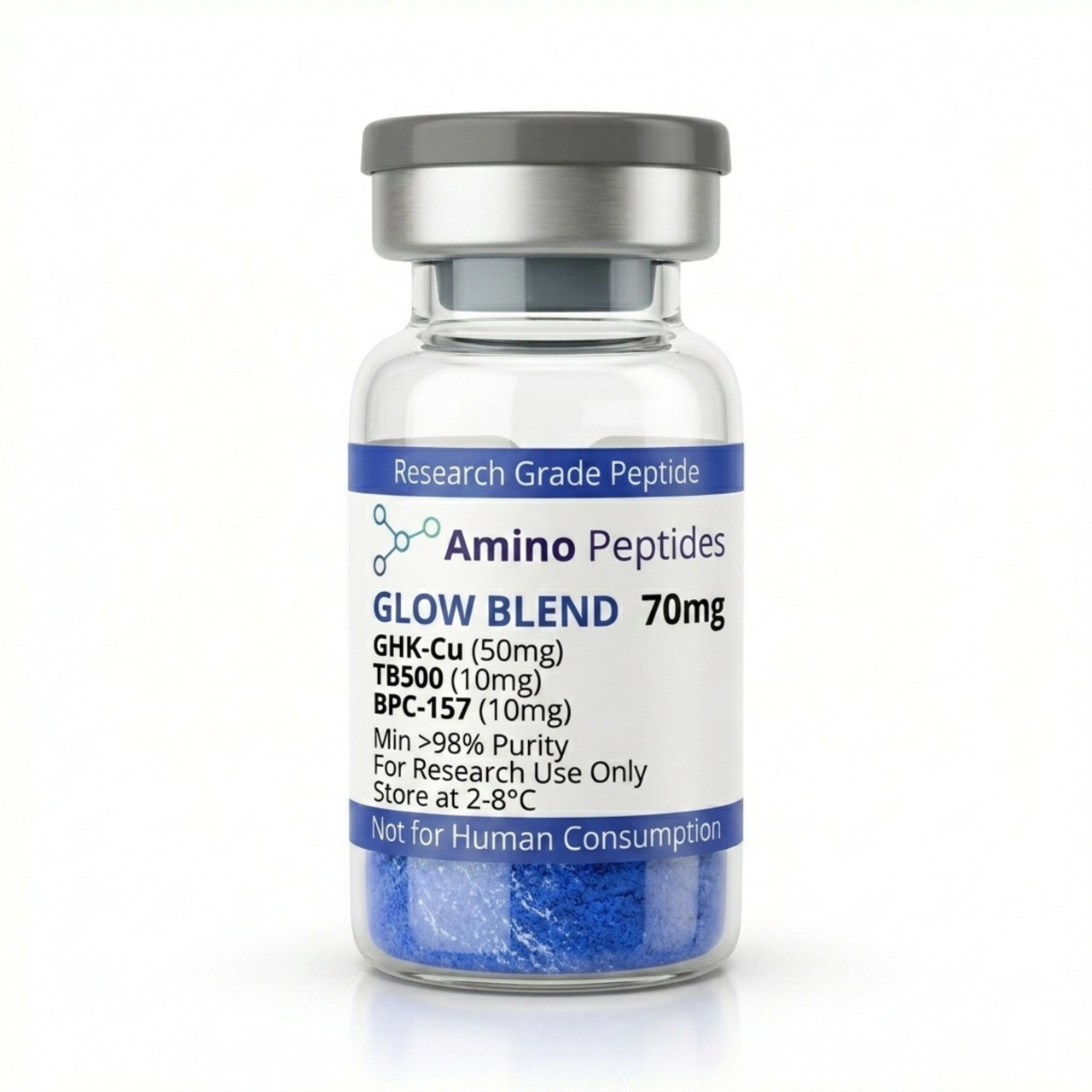
GLOW BLEND
From £65
Supplied as a sealed freeze-dried vial (stable 12–24 months at 2°C–8°C in a standard refrigerator).
Shop GLOW BLEND →What Published Studies Show Across Early and Late Timelines
Online rumours frequently claim that a glow stack peptide protocol changes tissue structure in just forty-eight hours. Published studies tell a much more grounded story, separating immediate biochemical signalling from slower, physical tissue remodelling. When researchers introduce GHK-Cu, BPC-157, and TB-500 into cell cultures or preclinical models, the biological response unfolds in distinct stages over several weeks.
During the first twenty-four to seventy-two hours, the activity is purely about cellular communication and movement. TB-500 immediately begins sequestering G-actin monomers, which loosens the internal cytoskeleton of nearby repair cells and lets them slide toward sites of mechanical stress. At the exact same time, BPC-157 activates focal adhesion kinase (FAK) and paxillin pathways, sending out early signals to start building new capillary buds. GHK-Cu begins resetting the local antioxidant balance by boosting superoxide dismutase activity. At this early point, a microscope reveals plenty of chemical traffic and mRNA transcription, but zero visible changes in collagen density or skin elasticity.
Between days seven and fourteen in preclinical models, the second phase takes over as protein synthesis catches up with the early genetic signals. New capillary networks sparked by BPC-157 start carrying nutrients into the extracellular matrix. Fibroblasts stimulated by the copper-peptide complex begin secreting pro-collagen strands into the surrounding space, where enzymes cross-link them into sturdy fibrils. Laboratory assays taken at the two-week mark typically record a clear rise in hydroxyproline content, a direct chemical marker for fresh collagen deposition, alongside lower levels of pro-inflammatory cytokines like interleukin-6.
True structural maturation takes place between weeks three and six in published studies. Freshly laid Type III collagen is gradually replaced and reinforced by stronger Type I collagen bundles, and elastin fibres organise into a woven mesh that restores mechanical bounce to the tissue sample. This timeline proves why viral forty-eight-hour transformation claims are biologically impossible. Cells can flip genetic switches in a few hours, but physically spinning amino acids into organized, load-bearing dermal scaffolding takes weeks of steady metabolic work.
Glow Stack Peptide Components: Laboratory Profile vs Popular Hype
| Peptide Component | Amino Acid Length | Primary Laboratory Mechanism | Observed Preclinical Model Outcome | Fact vs Popular Hype |
|---|---|---|---|---|
| GHK-Cu (Copper Tripeptide-1) | 3 amino acids plus a copper ion | Modulates gene expression and metalloproteinase balance | Stimulates collagen and elastin synthesis in dermal fibroblast cultures | Well-studied in cell models for matrix upkeep, but not an instant wrinkle eraser |
| BPC-157 (Body Protection Compound) | 15 amino acids | Upregulates growth hormone receptor expression and nitric oxide signalling | Accelerates tendon, ligament, and gut epithelial recovery in rodent studies | Robust rodent data for structural repair, yet large-scale human data remain scarce |
| TB-500 (Thymosin Beta-4 Fragment) | 43 amino acids (full length) or 7-amino-acid active region | Binds to G-actin to promote cell migration and angiogenesis | Enhances dermal and corneal tissue regeneration in laboratory animals | Supports cellular movement in dishes, though viral claims exaggerate its speed |
| Combined Glow Stack Blend | Multi-peptide mixture (3 + 15 + 43 residues) | Proposed multi-pathway synergy across extracellular and intracellular targets | Evaluated mostly by extrapolating data from separate single-compound experiments | Popularised online as a magic bullet, whereas biochemists note potential copper-induced oxidation risks in shared vials |
| Standard Reconstitution Carrier | Not applicable (aqueous solvent) | Solubilises lyophilised peptide powders and inhibits bacterial proliferation | Maintains peptide chain stability during refrigerated storage in laboratory protocols | Requires strict pH control with bacteriostatic reconstitution solution to prevent peptide precipitation |
How Complementary Peptides Pair With the Trio in Research
Because the glow stack peptide already combines three distinct sequences, researchers spend a lot of time analysing how these components interact with one another and with secondary compounds in multi-peptide designs. The core reason GHK-Cu, BPC-157, and TB-500 pair so well together comes down to non-overlapping receptor targets. If three peptides competed for the exact same surface receptor, they would block each other and waste the measured level in the dish. Instead, each member of this trio uses its own biochemical doorway.
TB-500 works inside the cell on actin filaments to speed up cell migration. BPC-157 works on growth hormone receptor expression and nitric oxide pathways to build blood vessel support. GHK-Cu delivers bioavailable copper directly to intracellular enzymes like lysyl oxidase, which is required to cross-link collagen and elastin. Put simply, TB-500 moves the construction crew to the site, BPC-157 builds the supply roads, and GHK-Cu hands the workers the raw materials to weave new fibres.
In advanced laboratory models looking at deeper muscle and connective tissue recovery alongside dermal repair, investigators sometimes pair this trio with other targeted sequences. For instance, researchers studying mechanical load and localized muscle fibre regeneration often track splice variants of insulin-like growth factor, using a specific mgf antibody or research-grade Mechano Growth Factor peptide to observe how satellite cell activation complements the vascular support of BPC-157. While the glow trio handles the extracellular matrix and capillary beds, MGF focuses strictly on myoblast proliferation.
Another common laboratory pairing involves adding SNAP-8 or KPV to the experimental setup. KPV, a C-terminal tripeptide fragment of alpha-melanocyte-stimulating hormone, calms overactive mast cells and nuclear factor kappa B (NF-kB) signalling without interfering with copper transport. When combined with the standard trio, KPV keeps local oxidative stress quiet so fibroblasts can focus their cellular energy on building elastin. Understanding how these sequences share the workload helps researchers design clean, predictable experiments without overloading a single biological pathway.

Figure: Glow Stack Peptide: Fact vs Hype Claims
Reconstitution calculator
Choose a vial mass and a bacteriostatic reconstitution solution volume. The figure is the resulting concentration.
Concentration: 2.50 mg/mL
Per 0.01mL (10µL): 25.0 mcg
Open the full calculatorBacteriostatic reconstitution solutionWhy 99% HPLC Purity and Cold Storage Matter for Vial Quality
When working with a multi-component blend like the glow stack peptide, the physical quality of the vial determines whether a laboratory model produces clean data or confusing noise. Combining GHK-Cu, BPC-157, and TB-500 into a single research protocol means any leftover synthesis byproducts are multiplied across three different sequences. That is why verifying at least 99% purity through High-Performance Liquid Chromatography (HPLC) and Mass Spectrometry (MS) is the first step in any serious laboratory setup.
During solid-phase synthesis, manufacturers use trifluoroacetic acid (TFA) to cleave finished amino acid chains from their resin beads. If a supplier skips the extra ion-exchange steps needed to remove residual TFA, those harsh acid salts stay trapped inside the freeze-dried powder. In a cell culture dish, excess TFA alters the pH of the liquid medium, damages fragile fibroblast membranes, and ruins collagen synthesis readouts. A proper certificate of analysis confirms that TFA counter-ions have been swapped out for benign acetate salts and that the copper bound to the GHK sequence is present in the exact stoichiometric ratio required for biological activity.
Storage conditions before and after adding a bacteriostatic reconstitution solution are equally important for protecting vial quality. In their dry, lyophilised state, these peptides are stable for short periods at room temperature, though keeping them in a freezer at minus twenty degrees Celsius prevents slow oxidation over months. Once liquid is added to the vial, the delicate peptide bonds become vulnerable to heat and physical agitation. Reconstituted vials belong in a dedicated laboratory fridge kept steadily between two and eight degrees Celsius.
Keeping GHK-Cu, BPC-157, and TB-500 in the same liquid vial also requires attention to pH balance. GHK-Cu gives the solution a natural violet-blue tint because of its copper ion, and sudden drops in pH can cause that copper to detach from the histidine ring. Swirling the vial gently instead of shaking it, keeping it away from UV light, and maintaining strict two to eight degrees Celsius refrigeration ensures the sequences stay intact throughout the entire study timeline.
Frequently Asked Questions
Why is the glow stack peptide blend searched so often online?
People search for the glow stack peptide blend because social media claims it supports rapid skin and tissue regeneration. In reality, scientists analyse this mixture of GHK-Cu, BPC-157, and TB-500 strictly within laboratory models to observe cellular signalling, collagen production, and general tissue remodelling without endorsing any personal use.
What timeline do published studies show for these combined compounds?
Published studies show that cellular responses in laboratory models usually appear within one to four weeks of observation. During this timeframe, researchers characterise how the compounds influence fibroblast activity and local recovery rates, though timelines vary depending on the exact study amount and specific experimental design used.
Why do researchers combine these three peptides into a single stack?
Researchers combine GHK-Cu, BPC-157, and TB-500 to see if different cellular pathways work together during tissue repair. By testing a single protocol ratio in preclinical models, scientists can analyse whether copper-binding proteins and actin-regulating chains optimise structural recovery better together than when studied as isolated compounds.
How do laboratories verify purity and handle fridge storage for this blend?
Laboratories verify a minimum ninety-nine percent purity using high-performance liquid chromatography before beginning any tests. Once mixed with a bacteriostatic reconstitution solution, technicians store the liquid vials in a standard refrigerator between two and eight degrees Celsius to prevent the fragile amino acid chains from breaking down.
Bibliography
- Pickart L, Margolina A. Regenerative and Protective Actions of the GHK-Cu Peptide in the Light of the New Gene Data. International Journal of Molecular Sciences. 2018;19(7):1987. View published research
- Seiwerth S, Milavic M, Vukojevic J, et al. Stable Gastric Pentadecapeptide BPC 157 and Wound repair. Frontiers in Pharmacology. 2021;12:627533. View published research
- Goldstein AL, Hannappel E, Sosne G, Kleinman HK. Thymosin beta4: a multi-functional regenerative peptide. Basic properties and preclinical applications. Expert Opinion on Biological signalling. 2012;12(1):37-51. View published research
- Chang CH, Tsai WC, Lin MS, Hsu YH, Pang JH. The promoting effect of pentadecapeptide BPC 157 on tendon repair involves tendon outgrowth, cell survival, and cell migration. Journal of Applied Physiology. 2011;110(3):774-780. View published research
- Philp D, Nguyen M, Scheremeta B, et al. Thymosin beta4 increases hair growth by activation of hair follicle stem cells. FASEB Journal. 2004;18(2):385-387. View published research
⚠️ Research Use Only Disclaimer: All peptides and compounds are sold strictly for in-vitro laboratory research purposes only. Not intended for human or veterinary use, not a dietary supplement, and not approved to diagnose, treat, cure, or prevent any disease or condition. For use by qualified researchers in suitably equipped laboratory environments only. Amino Peptides Ltd operates in full compliance with UK MHRA regulations and applicable EU research chemical guidelines.