
Optimising the Laboratory Synthesis of GHK-Cu for High-Purity In-Vitro Assays
6th Aug 2026
The tripeptide glycyl-L-histidyl-L-lysine (GHK) is a naturally occurring, high-affinity tripeptide chelator that selectively coordinates divalent copper (II) ions. In laboratory settings, the resulting coordinate complex, known as GHK-Cu, serves as a vital biochemical tool for investigating cellular migration, extracellular matrix remodelling, and transcriptional gene expression pathways. To ensure reproducible results in high-purity in-vitro assays, researchers must employ precise chemical synthesis and chromatographic purification protocols. For those new to these molecular structures, consulting a fundamental peptide guide provides essential baseline knowledge regarding peptide bonds and synthesis dynamics.
Key Takeaways
- Purity Requirements: In-vitro assays demand a purity level of at least 98% to prevent confounding data from synthesis byproducts.
- Stoichiometric Precision: A strict 1:1 molar ratio of GHK to copper is critical to prevent excess free copper ions from inducing cellular toxicity.
- pH Sensitivity: Complexation must occur within a specific pH range (6.0 to 7.5) to ensure stable coordinate covalent bonding.
- Analytical Verification: High-Performance Liquid Chromatography (HPLC) and Mass Spectrometry (MS) are mandatory to verify complex identity and purity.
Solid-Phase Peptide Synthesis (SPPS) of the GHK Ligand
The synthesis of the GHK ligand typically employs Fmoc solid-phase peptide synthesis (SPPS). This method involves assembling the peptide chain from the C-terminus (lysine) to the N-terminus (glycine) on a solid resin support. Choosing the correct resin, such as 2-chlorotrityl chloride resin, prevents unwanted side reactions, minimises racemisation of the C-terminal residue, and prevents premature cleavage. Each amino acid coupling step requires highly efficient coupling reagents, such as HATU or HBTU, alongside an organic base like diisopropylethylamine (DIPEA) to facilitate carboxylate activation.
To achieve maximum yield and purity during Fmoc solid-phase peptide synthesis, the choice of protecting groups is paramount. The histidine residue is typically protected with a trityl (Trt) group on the imidazole side chain, while the lysine residue employs a tert-butyloxycarbonyl (Boc) group on the epsilon-amino group. These protecting groups are stable to the basic conditions used during Fmoc deprotection (typically 20% piperidine in dimethylformamide) but are readily cleaved under acidic conditions.
Following the assembly of the Gly-His-Lys sequence, global deprotection and cleavage from the resin are executed using a trifluoroacetic acid (TFA) cocktail. Because the histidine residue is highly susceptible to oxidation and side-chain alkylation, researchers must include scavengers such as triisopropylsilane (TIPS) and water in the cleavage mixture. The crude peptide is then precipitated in cold diethyl ether, centrifuged, and lyophilised. For high-fidelity research, using a certified copper peptide reagent ensures that the starting material meets strict analytical standards.
Molecular Formula: C14H22CuN6O4
Molecular Mass: 340.38 g/mol (free ligand), 403.93 g/mol (complexed)
CAS Number: 89030-95-5
Appearance: Fine blue powder
Solubility: Highly soluble in aqueous buffers and reconstitution solvents.
Copper Complexation and Purification Protocols
Once the GHK ligand is purified via preparative HPLC, the critical step of copper complexation begins. This process involves dissolving the purified GHK acetate in an aqueous buffer, followed by the systematic addition of a copper (II) salt, such as copper chloride or copper acetate. The reaction must be carefully monitored to maintain a pH between 6.0 and 7.5. If the pH drops too low, protonation of the histidine nitrogen prevents coordination with the copper ion; if the pH rises too high, copper hydroxide precipitates out of the solution. The divalent copper ion is coordinated by four donor atoms in a square-planar geometry: the amino nitrogen of glycine, the deprotonated amide nitrogens of the peptide backbone, and the imidazole nitrogen of the histidine residue.
The resulting GHK-Cu compound exhibits a deep blue colour, characteristic of the coordinate covalent complex. To remove any unreacted, free copper ions—which can cause non-specific cellular toxicity in-vitro—the solution is subjected to desalting chromatography or dialysis. The final purified complex is then lyophilised to yield a stable, blue crystalline powder suitable for precise laboratory investigations.
In-Vitro Synthesis FAQ
What are the critical parameters to monitor during ghk cu peptide synthesis?
During ghk cu peptide synthesis, researchers must carefully monitor the coupling efficiency of the histidine residue, as it is prone to racemisation. Additionally, during the complexation phase, maintaining a precise 1:1 molar ratio of GHK to copper is vital. Excess copper can lead to free-radical generation via Fenton-type reactions in cellular cultures, while insufficient copper leaves uncomplexed GHK ligand, altering the experimental variables of the assay.
Is ghk cu peptide synthetic or natural when prepared for laboratory assays?
When asking is ghk cu peptide synthetic in the context of laboratory research, the answer is yes. While the GHK sequence is identical to the tripeptide found naturally in human plasma, the material used in scientific investigations is chemically synthesised via solid-phase or liquid-phase methods. This synthetic approach guarantees a high level of purity, free from biological contaminants, endotoxins, or serum-derived pathogens, making it ideal for controlled in-vitro assays.

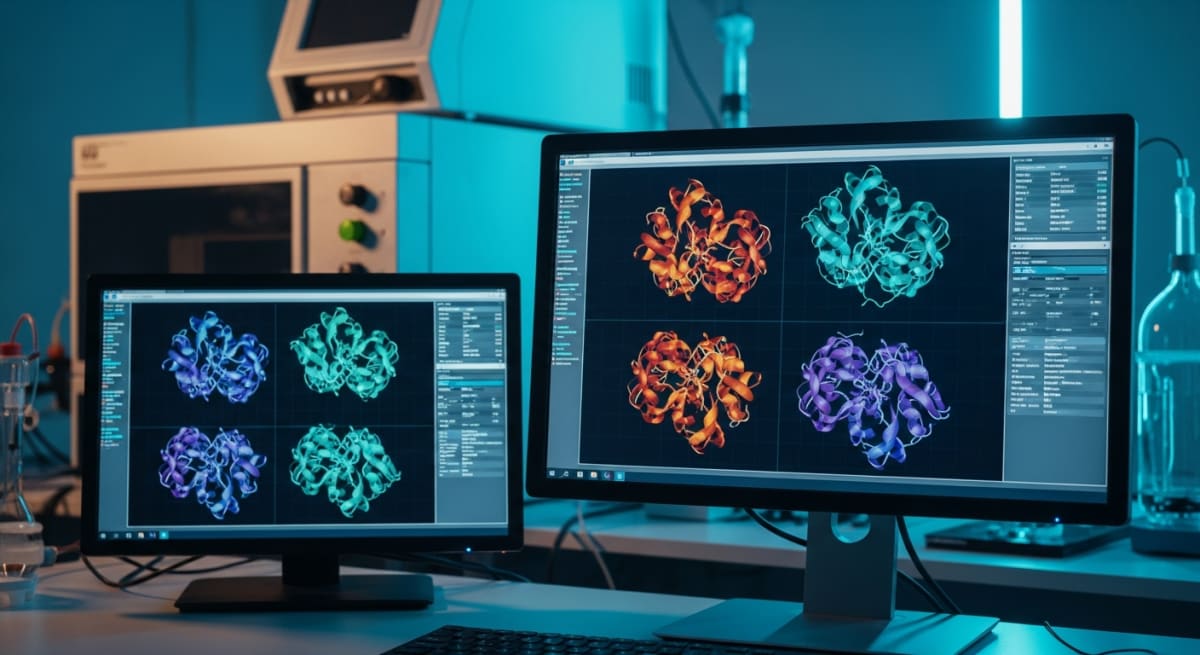
Figure 1: A clean, unlabeled abstract node-and-network biological representation vector graphic displayed on a digital screen in a modern laboratory.
How does copper peptide ghk cu synthesis impact research outcomes, and what do scientific reviews state regarding its properties?
The precision of copper peptide ghk cu synthesis directly dictates the reliability of experimental data. According to peer-reviewed ghk-cu peptide reviews, variations in purity and copper chelation ratios explain historical discrepancies in cellular response studies. When synthesised to high-purity standards, the documented ghk-cu peptide benefits in-vitro include the upregulation of collagen synthesis, activation of antioxidant enzymes, and modulation of metalloproteinase expression. Researchers must ensure their peptide is reconstituted using a sterile reconstitution solvent to maintain stability during assay preparation.
References
- Pickart, L., & Margolina, A. (2018). Regenerative and Protective Actions of the GHK-Cu Peptide in the Light of the New Gene Data. International Journal of Molecular Sciences, 19(7), 1987. View published research
- Pickart, L., Vasquez-Soltero, J. M., & Margolina, A. (2015). GHK Peptide as a Natural Modulator of Multiple Cellular Pathways in Skin Regeneration. BioMed Research International, 2015, 648108. View published research
- Badenhorst, T., Svirskis, D., & Wu, Z. (2016). In vitro membrane permeation of copper tripeptide GHK-Cu. Archives of Dermatological Research, 308(6), 415-422. View published research
⚠️ Research Use Only Disclaimer: All peptides and compounds are sold strictly for in-vitro laboratory research purposes only. Not intended for human or veterinary use, not a dietary supplement, and not approved to diagnose, treat, cure, or prevent any disease or condition. For use by qualified researchers in suitably equipped laboratory environments only. Amino Peptides Ltd operates in full compliance with UK MHRA regulations and applicable EU research chemical guidelines.