
- Hexarelin is studied for one of the stronger growth-hormone pulses in the ghrelin-mimetic family.
- Studies record a robust ghrelin-receptor signal over short windows. Stack guides place it with a GHRH partner rather than another ghrelin mimetic.
- Mix the freeze-dried cake with bacteriostatic reconstitution solution (0.9% benzyl alcohol), keeping the stream off the powder. Unmixed vials keep for 12 to 24 months in a standard household fridge at 2°C–8°C, and the mixed vial stays in that same fridge.
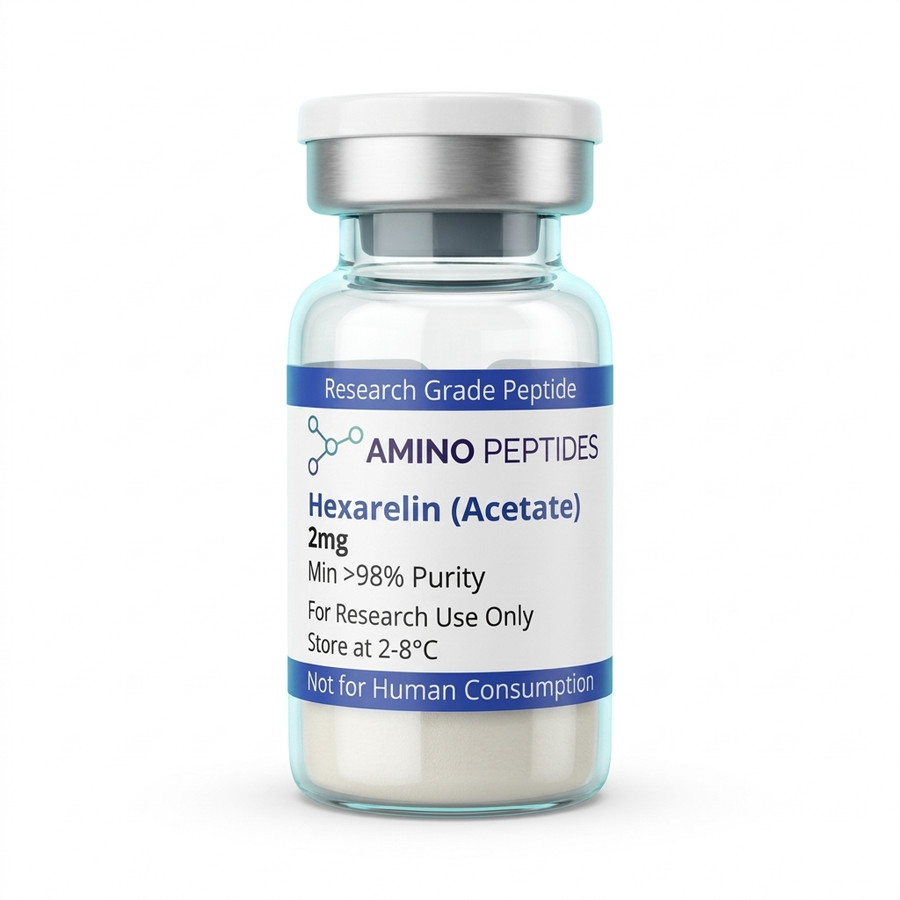
Hexarelin (Acetate) is a synthetic hexapeptide structurally related to ghrelin. It acts as a highly selective agonist of the growth hormone secretagogue receptor (GHSR-1a). In cellular assays, it demonstrates potent binding affinity, triggering intracellular calcium release and activating specific signalling cascades. As a premium research chemical, UK laboratories utilise this compound to investigate receptor down-regulation and somatotropic pathways. To ensure optimal molecular stability during storage and experimentation, researchers must employ precise reconstitution protocols. Advanced peptide synthesis techniques yield a highly purified lyophilised solid that is ideal for rigorous in-vitro evaluation. For comprehensive structural data, researchers can consult PubChem.
Does hexarelin help with fat loss?
Can I legally buy peptides in the UK?
How long does it take for hexarelin to work?
Does hexarelin give you energy?
What are the side effects of hexarelin?
How should I store this peptide?
Public search data clusters around terms like fat loss and energy when querying Hexarelin. Current literature uses these search phrases to index laboratory metabolic and receptor-binding models, not bodily protocols. Amino Peptides supplies this compound strictly for controlled lab experiments.
- Growth hormone secretagogue receptor 1a (GHSR1a) acts as the primary molecular target in isolated pituitary cell cultures.
- CD36 scavenger receptors demonstrate high-affinity binding with Hexarelin in cell-free membrane preparations, mediating lipid accumulation pathways.
- Cardiac-specific GHSR variants exhibit upregulated ligand interaction during molecular-stability evaluations of ischemic tissue homogenates.
- Activation of the phospholipase C (PLC) signalling cascade leads to intracellular calcium mobilization in isolated laboratory models.
- Modulation of the PI3K/AKT survival pathway is observed following receptor agonism in isolated cardiomyocyte cultures.
- Upregulation of diacylglycerol (DAG) and inositol triphosphate (IP3) secondary messengers occurs in controlled cell-free environments.
Technical Specifications
Variant Breakdown
- 2mg Vial: Designed for small-scale cellular assays and initial receptor binding studies.
- 5mg Vial: Optimised for high-throughput screening and extended longitudinal in-vitro research.
Quality Assurance
- HPLC Verification: High-performance liquid chromatography ensures a purity level exceeding 99%.
- Mass Spectrometry: Confirms the exact molecular weight (887 g/mol) and structural integrity of the synthesised peptide.
- Lyophilised Format: Processed as a freeze-dried solid to maximise shelf life and preserve molecular conformation.
- Endotoxin Testing: Rigorously screened to maintain endotoxin levels below 0.5 EU/mg for reliable cell culture applications.
Research Mechanism
- Receptor Binding: Binds selectively to the GHSR-1a receptor in isolated cell cultures.
- Signal Transduction: Activates the phospholipase C (PLC) pathway, leading to increased inositol triphosphate (IP3) and diacylglycerol (DAG).
- Intracellular Calcium Flux: Stimulates the release of stored calcium ions from the endoplasmic reticulum.
- Enzymatic Activation: Promotes protein kinase C (PKC) activity, influencing cellular transcription factors.
Reconstitution & Storage Data
| Vial Strength | Solvent Added | Resulting Concentration |
| 2mg | 1 mL Bacteriostatic Reconstitution Solution | 2.00 mg/mL |
| 2mg | 2 mL Bacteriostatic Reconstitution Solution | 1.00 mg/mL |
| 5mg | 1 mL Bacteriostatic Reconstitution Solution | 5.00 mg/mL |
| 5mg | 2 mL Bacteriostatic Reconstitution Solution | 2.50 mg/mL |
- Lyophilised (Freeze-Dried Vial): Stable at ambient room temperature during postal transit; store in a standard refrigerator (2–8°C) away from direct light for 12–24 months.
- Reconstituted (Liquid Solution): Store refrigerated at 2–8°C away from light. Using sterile bacteriostatic reconstitution solution (0.9% benzyl alcohol) preserves sterility across multiple draws while refrigeration maintains peptide integrity. Do not refreeze once mixed.
Scientific References
Cardiovascular Research: "Hexarelin, a growth hormone secretagogue, in cardiovascular research" View Study
Endocrinology: "In vitro characterisation of hexarelin binding to the GH secretagogue receptor" View Study
Journal of Molecular Endocrinology: "Hexarelin protects cardiac cells from apoptosis" View Study
Cellular Signalling: "Signalling pathways activated by the GH secretagogue hexarelin" View Study
International Journal of Pharmaceutics: "Stability of hexarelin in aqueous solutions" View Study