
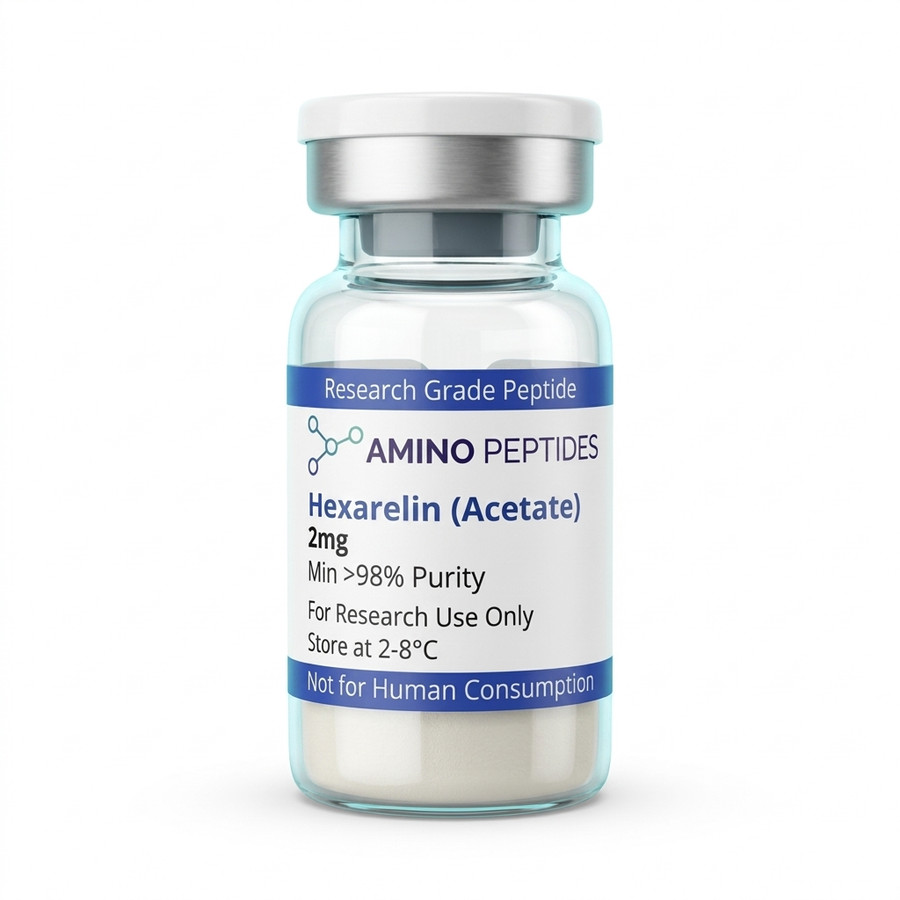
Hexarelin (Acetate) is a synthetic hexapeptide structurally related to ghrelin. It acts as a highly selective agonist of the growth hormone secretagogue receptor (GHSR-1a). In cellular assays, it demonstrates potent binding affinity, triggering intracellular calcium release and activating specific signalling cascades. As a premium research chemical, UK laboratories utilise this compound to investigate receptor down-regulation and somatotropic pathways. To ensure optimal molecular stability during storage and experimentation, researchers must employ precise reconstitution protocols. Advanced peptide synthesis techniques yield a highly purified lyophilised solid that is ideal for rigorous in-vitro evaluation. For comprehensive structural data, researchers can consult PubChem.
Public search data clusters around terms like fat loss and energy when querying Hexarelin. Current literature uses these search phrases to index laboratory metabolic and receptor-binding models, not bodily protocols. Amino Peptides supplies this compound strictly for controlled lab experiments.
- Growth hormone secretagogue receptor 1a (GHSR1a) acts as the primary molecular target in isolated pituitary cell cultures.
- CD36 scavenger receptors demonstrate high-affinity binding with Hexarelin in cell-free membrane preparations, mediating lipid accumulation pathways.
- Cardiac-specific GHSR variants exhibit upregulated ligand interaction during molecular-stability evaluations of ischemic tissue homogenates.
- Activation of the phospholipase C (PLC) signalling cascade leads to intracellular calcium mobilization in isolated laboratory models.
- Modulation of the PI3K/AKT survival pathway is observed following receptor agonism in isolated cardiomyocyte cultures.
- Upregulation of diacylglycerol (DAG) and inositol triphosphate (IP3) secondary messengers occurs in controlled cell-free environments.
Technical Specifications
Variant Breakdown
- 2mg Vial: Designed for small-scale cellular assays and initial receptor binding studies.
- 5mg Vial: Optimised for high-throughput screening and extended longitudinal in-vitro research.
Quality Assurance
- HPLC Verification: High-performance liquid chromatography ensures a purity level exceeding 99%.
- Mass Spectrometry: Confirms the exact molecular weight (887 g/mol) and structural integrity of the synthesised peptide.
- Lyophilised Format: Processed as a freeze-dried solid to maximise shelf life and preserve molecular conformation.
- Endotoxin Testing: Rigorously screened to maintain endotoxin levels below 0.5 EU/mg for reliable cell culture applications.
Research Mechanism
- Receptor Binding: Binds selectively to the GHSR-1a receptor in isolated cell cultures.
- Signal Transduction: Activates the phospholipase C (PLC) pathway, leading to increased inositol triphosphate (IP3) and diacylglycerol (DAG).
- Intracellular Calcium Flux: Stimulates the release of stored calcium ions from the endoplasmic reticulum.
- Enzymatic Activation: Promotes protein kinase C (PKC) activity, influencing cellular transcription factors.
Reconstitution & Storage Data
| Vial Strength | Solvent Added | Resulting Concentration |
| 2mg | 1 mL Bacteriostatic Reconstitution Solution | 2.00 mg/mL |
| 2mg | 2 mL Bacteriostatic Reconstitution Solution | 1.00 mg/mL |
| 5mg | 1 mL Bacteriostatic Reconstitution Solution | 5.00 mg/mL |
| 5mg | 2 mL Bacteriostatic Reconstitution Solution | 2.50 mg/mL |
- Lyophilised (Powder): Store in a standard refrigerator (2-8°C) for up to 3 months. For long-term preservation, freeze at -20°C.
- Reconstituted (Liquid): Store at 2-8°C (Refrigerated).
Scientific References
Cardiovascular Research: "Hexarelin, a growth hormone secretagogue, in cardiovascular research" View Study
Endocrinology: "In vitro characterisation of hexarelin binding to the GH secretagogue receptor" View Study
Journal of Molecular Endocrinology: "Hexarelin protects cardiac cells from apoptosis" View Study
Cellular Signalling: "Signalling pathways activated by the GH secretagogue hexarelin" View Study
International Journal of Pharmaceutics: "Stability of hexarelin in aqueous solutions" View Study