Create an account with us and you'll be able to:
Check out faster,
Save multiple shipping addresses,
Access your order history,
Track new orders,
Save items to your Saved Lists
UK Buyer's Guide to Peptide Bundles & Multi-Vial Research Stacks
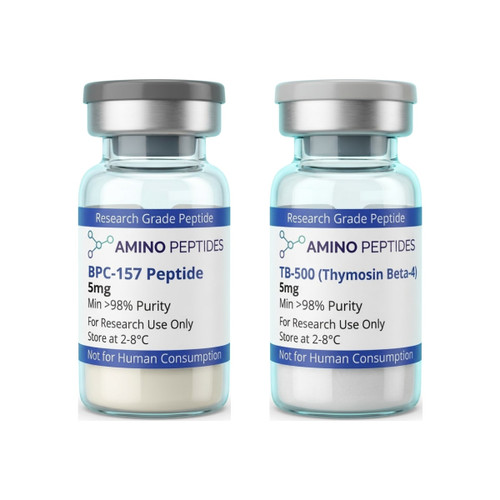
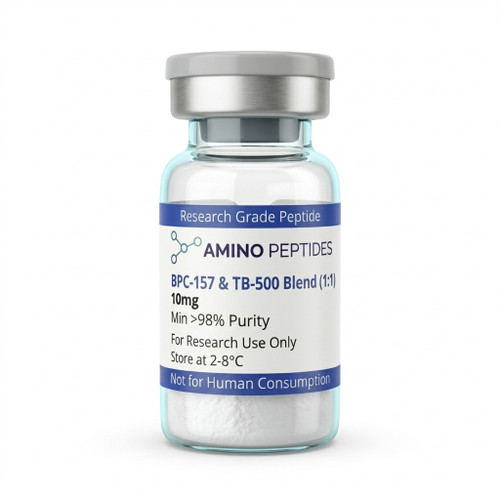
Peptide Bundles and Stacks gathers the pre-matched research sets that would otherwise be assembled vial by vial. A blend is one lyophilised vial that already contains more than one sequence at a stated combined mass. A bundle is two or more separate vials sold together at bundle pricing, so each sequence stays in its own cake and can be reconstituted on its own timetable. GLOW is the single-vial blend of GHK-Cu, BPC-157, and TB-500 at 70mg combined. KLOW adds the tripeptide KPV to that set at 80mg combined. The BPC-157 and TB-500 blend is the 1:1 combined vial, stocked in 10mg, 20mg, and 30mg combined masses. Separate from those blends, the catalogue lists paired and triple vials: BPC-157 with TB-500, the three-vial GLOW-style set of BPC-157, TB-500, and GHK-Cu, the mitochondrial trio of SS-31, MOTS-c, and NAD+, the Mito Prime set of NAD+, MOTS-c, and 5-Amino-1MQ, the Kisspeptin-10 and PT-141 pair, and the Tesamorelin and Ipamorelin pair. Each stack is built from the same batches sold as individual products, so the Certificate of Analysis for each constituent still applies to the vial inside the stack.
These sets are supplied for in-vitro laboratory research, cellular assays, and molecular stability work. Tissue stacks are the practical choice where one protocol calls for BPC-157 and TB-500 in the same cellular-migration or extracellular-matrix experiment. Copper-peptide stacks add GHK-Cu where collagen-synthesis readouts are collected from dermal fibroblast cultures. Mitochondrial stacks place MOTS-c, NAD+, SS-31, or 5-Amino-1MQ in the same bioenergetic or AMPK-linked series. The endocrine pair places Kisspeptin-10 and PT-141 together for melanocortin and HPG-axis receptor work. The secretagogue pair places Tesamorelin and Ipamorelin together for somatotropic receptor work. Purity on each peptide constituent is at least 99% by HPLC, with mass spectrometry recorded on the Certificate of Analysis. Lyophilised vials are held at -20°C. Once a vial is reconstituted with sterile bacteriostatic reconstitution solution, the solution is held at 2°C–8°C. Where a constituent page specifies 0.6% acetic acid reconstitution solvent, that vehicle is reserved for that vial. UK dispatch on in-stock stacks is next-day.
Q: What is the difference between a peptide blend and a peptide bundle?
A blend is one lyophilised vial that already contains more than one sequence, such as GLOW or the BPC-157 and TB-500 1:1 vial. A bundle is two or more separate vials sold together at bundle pricing, so each sequence is reconstituted on its own.
Q: Which stacks are aimed at mitochondrial assay work?
The SS-31, MOTS-c, and NAD+ bundle, and the Mito Prime bundle of NAD+, MOTS-c, and 5-Amino-1MQ, group bioenergetic reagents as separate vials. Each constituent remains a ≥99% HPLC batch with its own Certificate of Analysis.
Q: How are bundle vials stored and reconstituted?
Keep every lyophilised vial at -20°C until it is opened. Reconstitute with sterile bacteriostatic reconstitution solution and then hold that solution at 2°C–8°C. Follow a constituent page when it specifies 0.6% acetic acid reconstitution solvent instead.
Q: Are bundle constituents the same batches as the individual products?
Yes. Stacks are assembled from the catalogue vials also sold on their own, including BPC-157, TB-500, GHK-Cu, MOTS-c, NAD+, PT-141, Kisspeptin-10, Tesamorelin, and Ipamorelin. The analytical paperwork for each of those batches still applies.