
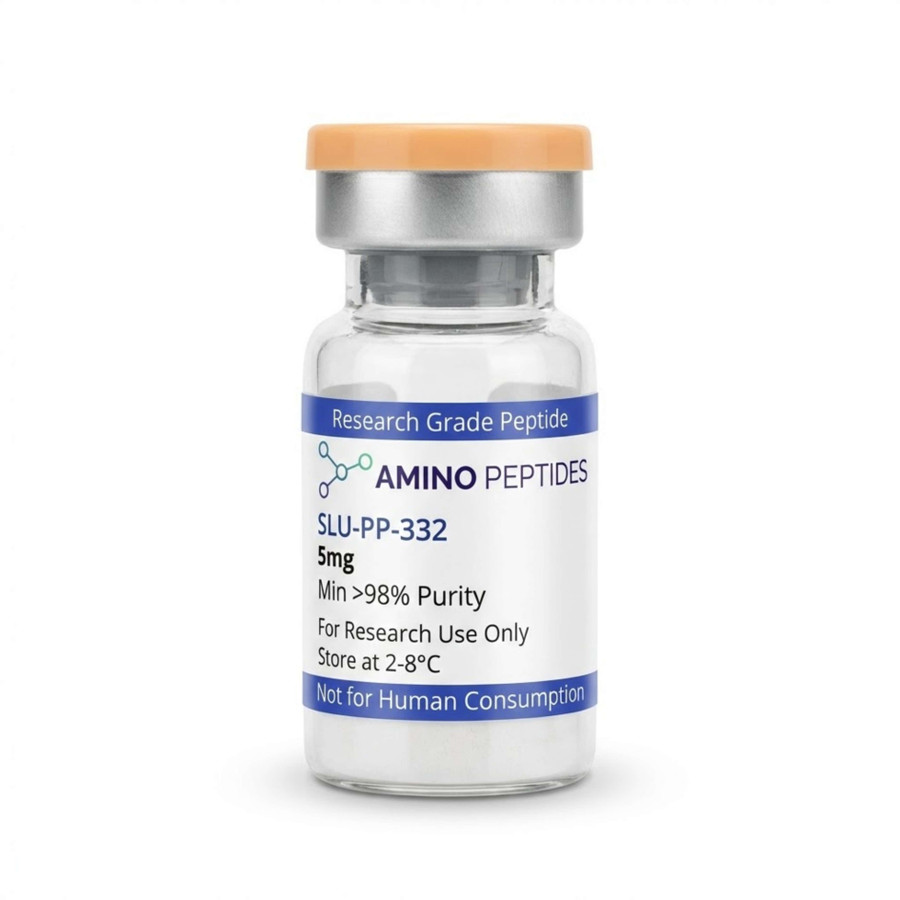
SLU-PP-332 is a highly selective agonist for the oestrogen-related receptor (ERR) family, specifically targeting ERRα, ERRβ, and ERRγ. In cellular assays, this compound functions as an exercise mimetic by upregulating the expression of genes involved in mitochondrial biogenesis and cellular respiration. Unlike compounds derived from traditional peptide synthesis, SLU-PP-332 is a small molecule that exhibits unique binding kinetics to nuclear receptors, triggering metabolic cascades that enhance fatty acid oxidation and lipolysis in vitro. For optimal laboratory results, researchers must follow precise reconstitution protocols to ensure long-term molecular stability in aqueous environments. As one of the most advanced research chemicals in the UK, this agent is widely utilised to investigate metabolic pathways and cellular energy homeostasis. Further exploration of its metabolic impact can be found in our detailed review on Slu Pp 332 Exercise Mimetic Research. Comprehensive structural data is also available via PubChem.
Public search data clusters around the phrases "exercise mimetic" and "endurance" when indexing this compound. Current literature summarises those papers as observations in isolated cell cultures and metabolic laboratory models, not as a consumer protocol. Amino Peptides supplies this compound only as a lyophilised laboratory reagent. Strictly for laboratory research.
- Selective agonism of the Estrogen-Related Receptor alpha (ERRα), a constitutively active orphan nuclear receptor regulating metabolic gene transcription.
- Interaction with Estrogen-Related Receptor beta (ERRβ) and gamma (ERRγ) isoforms in cell-free binding studies, exhibiting variable affinity profiles.
- Modulation of peroxisome proliferator-activated receptor gamma coactivator 1-alpha (PGC-1α) recruitment dynamics within isolated nuclear extracts.
- Upregulation of oxidative phosphorylation (OXPHOS) gene networks via ERRα-mediated transcriptional activation in cultured myotubes.
- Enhancement of mitochondrial biogenesis markers and fatty acid oxidation pathways in isolated cellular models.
- Repression of glycolytic enzyme transcription, shifting cellular energy dependence toward lipid substrate utilisation in controlled laboratory environments.
Technical Specifications
Variant Breakdown
- 5mg Vial: Provides a precisely measured 5mg aliquot of lyophilised solid, ideal for standard cellular assays and establishing laboratory evaluation-response curves in metabolic research.
Quality Assurance
- HPLC Verification: High-performance liquid chromatography ensures a purity level exceeding 99%, confirming the absence of synthesis by-products.
- Mass Spectrometry: Molecular weight and structural integrity are rigorously validated to match the exact theoretical mass of 290.3 g/mol.
- Lyophilisation Process: Processed into a stable lyophilised solid to maximise shelf life and preserve molecular integrity prior to reconstitution.
- Endotoxin Testing: Strict quality control measures guarantee endotoxin levels remain below 0.5 EU/mg, preventing unwanted cellular stress in sensitive in vitro cultures.
Research Mechanism
- ERR Activation: Selectively binds to the ligand-binding domain of ERRα, ERRβ, and ERRγ, inducing a conformational change that promotes coactivator recruitment in vitro.
- Mitochondrial Biogenesis: Upregulates the transcription of PGC-1α target genes, increasing mitochondrial mass and respiratory capacity in skeletal muscle cell cultures.
- Fatty Acid Oxidation: Stimulates the expression of enzymes responsible for lipid metabolism, promoting cellular lipolysis and reducing intracellular lipid droplet accumulation.
- Metabolic Reprogramming: Shifts cellular energy reliance from glycolysis to oxidative phosphorylation, mimicking the biochemical adaptations typically observed during aerobic exertion.
Reconstitution & Storage Data
| Vial Strength | Solvent Added | Resulting Concentration |
- Lyophilised (Powder): Store in a standard refrigerator (2-8°C) for up to 3 months. For long-term preservation, freeze at -20°C.
- Reconstituted (Liquid): Store at 2-8°C (Refrigerated).
Scientific References
Journal of Pharmacology and Experimental Therapeutics: "A Synthetic ERR Agonist Alleviates Metabolic Syndrome" View Study
ACS Chemical Biology: "Design and Characterization of SLU-PP-332, a Pan-Estrogen-Related Receptor Agonist" View Study
Biochemical Journal: "Estrogen-related receptors as emerging targets in metabolic regulation" View Study
Cell Metabolism: "Exercise mimetics: impact on health and performance" View Study
Molecular Metabolism: "Targeting the ERR pathway for the laboratory evaluation of metabolic diseases" View Study